
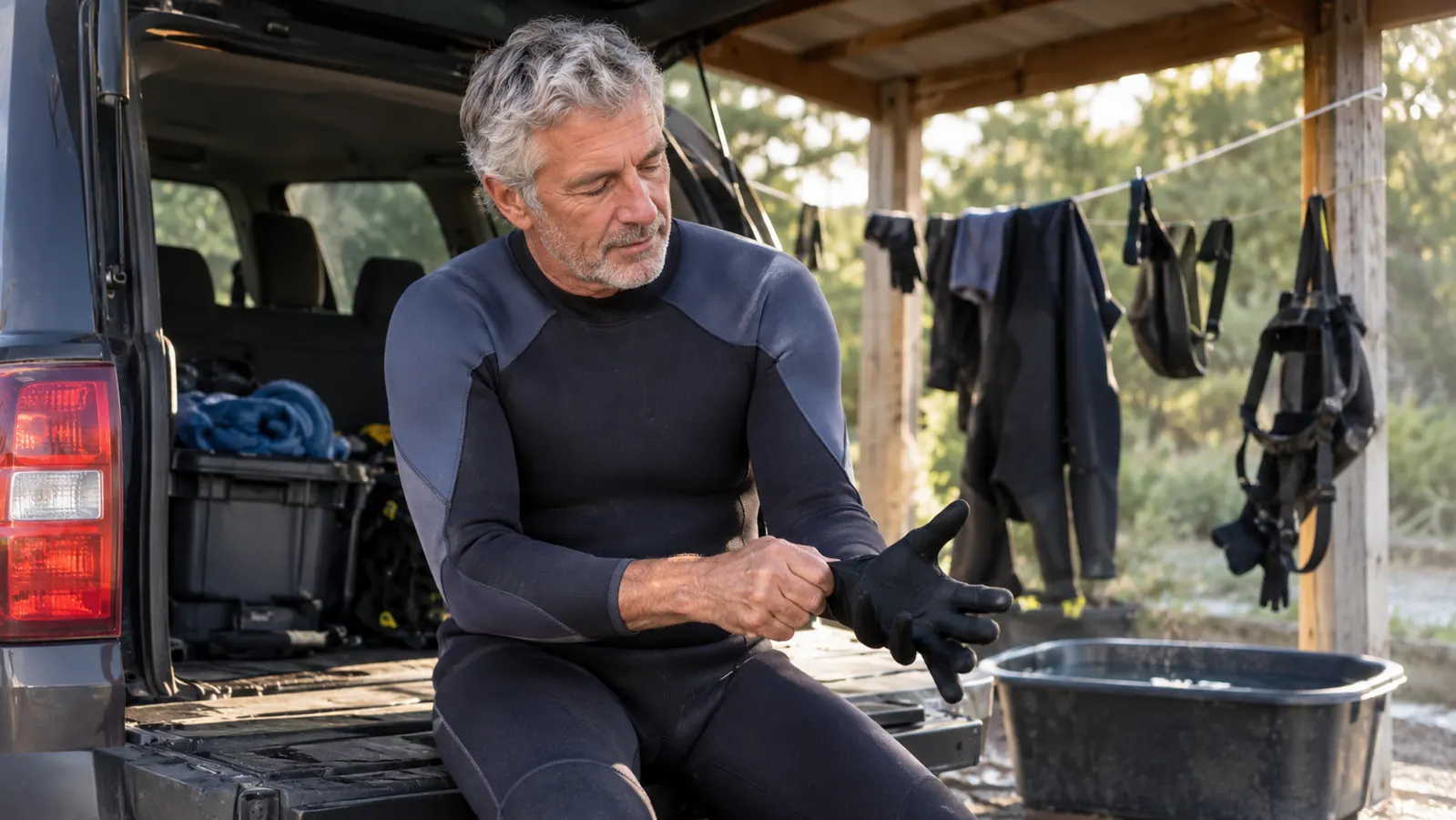
Three Novembers ago I came up a limestone ledge on a shore entry with my knuckles looking like I had lost an argument with a cheese grater. The water at the entry was 71 degrees, which at 61 I feel in my hands before I feel it anywhere else, and I was wearing cotton work gloves that had gone heavy and cold before I even had my fins on. I finished the dive. I also spent the next week with two fingers taped together, which is a stupid way to lose a week.
So last spring, when the seam on my old mesh bag finally let go and I rebuilt the whole kit in a single order, I put a pair of XUKER Water Gloves in the cart. I want to be honest about my expectations. I figured they were a stopgap and I would be buying something else by August.
That was 18 months and about 90 dives ago, and the same pair is still in the bag. This is what they have done, where they have held up, and the one part of them I would change. If you want the short version it is a few lines down. If you want to know how a piece of gear actually fails in salt water, that is the rest of this.
The Quick Verdict
Glued blind stitched 3mm neoprene that has done 90 dives without losing a seam. The hook and loop wrist strap grabs everything in the bag, and that is the only thing I would redo.
Amazon Check Today's Price →The pair that ended the taped-fingers routine
3mm neoprene, glued blind stitched, five finger, ambidextrous, sizes XS through 2XL. If your hands are the part of you that pays for every shore entry, start here.
Amazon Check Today's Price on Amazon →How I've Used It
My diving is unglamorous and it has been for 14 years. Certified Open Water at 47, about 400 logged dives, Advanced Open Water, and I stay inside 20 to 60 feet. I dive from local charter boats and I dive from shore. I do not own a boat. Wrecks I look at from the outside and never go into. I do not touch coral or living reef, gloves or no gloves.
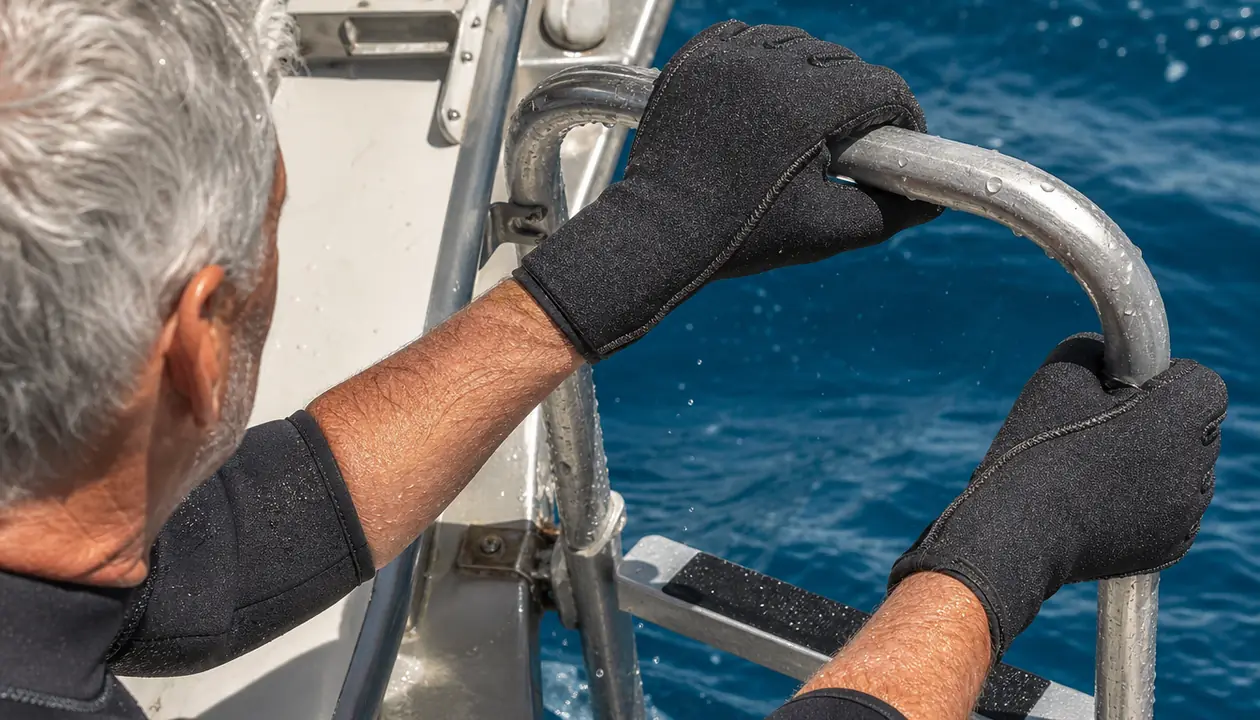
What I do with my hands underwater is specific. I grab aluminum ladder rails that are slick with algae. I haul on a mooring line when the chop is up and the boat is rolling. I push off rough limestone at the entry. And I dig.
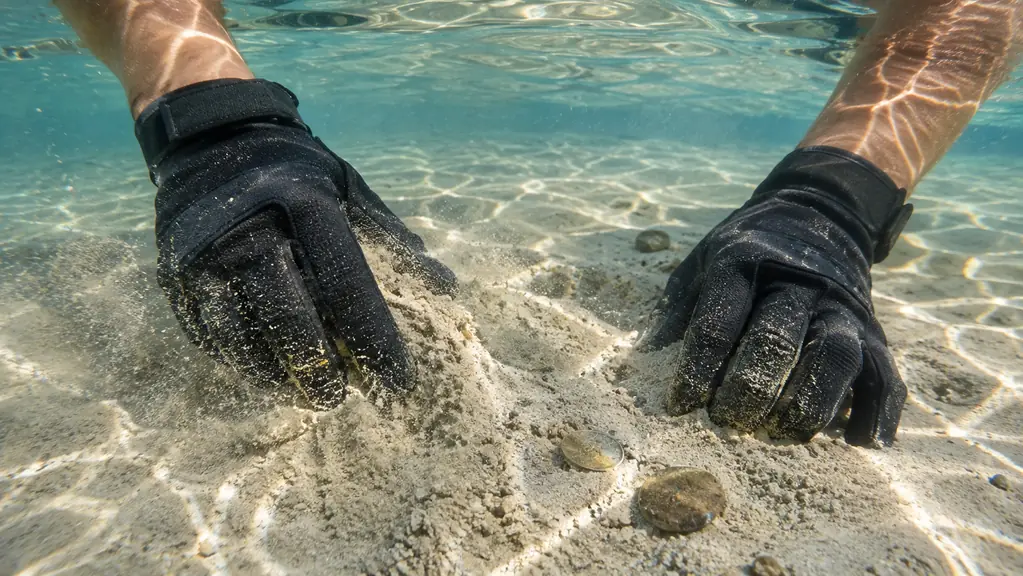
The digging is the part that matters. Five years now I have hunted lost metal, working sand bottoms at public swim beaches and around docks and boat ramps where the rules allow it. I check the local rules before I go anywhere and I take nothing from a protected wreck, a sanctuary or a historic site. When a ring can be traced to its owner it goes back. All of that means my hands are in sand and rock and salt water a good deal more than the average recreational diver's hands are, and it means a glove that fails costs me a dive rather than a little comfort.
From November through April the gloves go on for every single dive. In summer they go on for rough entries and any sand hunt. Water at home runs about 71 in January and into the mid 80s by July, so this pair has seen both ends of the range. Call it 90 dives. That is enough to know what a glove is.
One dive from last February sticks with me as the test case. Twenty two feet of water off a sand beach, air temp in the low 60s, and I was on my knees digging for the better part of fifty minutes because I had a signal and I was not going to walk away from it. When I finally stood up, my hands were the only part of me that was not stiff. The gloves had not done anything clever. They had just been between my skin and the sand.
What 3mm Neoprene Actually Buys You
The listing offers 3mm and 5mm in the same glove. I bought the 3mm. In 71 degree January water that is the right call for me. It is enough that my fingers stay useful for the whole dive instead of going wooden in the first ten minutes, and thin enough that I can still feel a coin edge through the material while I am sifting. The outside face is nylon over 90 percent neoprene, and that nylon face is what takes the abuse from limestone and ladder tread.
Where 3mm stops being enough is the second dive. By the time you have been in the water an hour, peeled the top of your suit down, eaten something and gone back in, the glove is wet through and the water has already pulled the heat out of it. A 5mm would hold longer. If I dove cold water seriously I would own both pairs. I do not, so I do not, but you should know where the limit sits before you buy, because it is not a flaw, it is just what 3mm is.
Neoprene does not absorb water the way fabric does, which is why these drain fast and stay light. The cotton work gloves they replaced would be a pound heavier at the end of a dive and cold the entire time. After 18 months the outer face of the XUKER pair is scuffed across the palm and at the base of the index fingers, which is exactly where sand and limestone hit, and it is not worn through anywhere.
Glued and Blind Stitched, Which Is the Part That Matters in Salt Water
Glued blind stitched means the seams are bonded with adhesive and then sewn with a stitch that does not pass all the way through the material. That is the construction you want in salt water. A through stitch leaves a row of tiny holes for water to travel along and for the seam to begin parting, and once it begins it does not stop.
I spent 33 years as a marine electrician watching what salt water does to anything with a fastener in it. A glove seam is the same problem in miniature: every hole is a place where something gets in and something fails. Both gloves on this pair are still intact at every finger, which is where cheap neoprene usually goes first.
They are hand wash only per the listing, and that is what they get. Fresh water rinse in the tub under the carport, hung on the line, never in a machine and never near a dryer. That is the entire maintenance routine and it has taken about three minutes a week for a year and a half. If you are the sort of person who throws gear in the washer, understand going in that these will not survive that, and the listing says so plainly.
Grip and Fit: Five Fingers and a Wrist Strap
The glove is five finger and pre-shaped, and it is ambidextrous, which means either glove goes on either hand. That sounds like a small thing until you are on a rolling deck with the sun in your eyes and you do not have to think about which one goes where. It also means that if one ever fails you are not hunting for a left in a size that is sold out.
Wet neoprene pressed against an aluminum ladder rail holds well. I am not going to tell you there is a special palm material, because the listing does not describe one and I have no way to test it. What I can tell you is what the material does. Grabbing a mooring line in a chop, my grip has not been the weak point. Feeling for a coin edge in sand, I can still tell a bottle cap from a quarter most of the time, which is the whole reason I am not wearing 5mm.
Sizing runs XS through 2XL. I take a medium in a work glove and a medium here fits, with the hook and loop strap across the back of the wrist pulled snug. That strap is my one real complaint. The hook side grabs the mesh of my bag, grabs the neoprene of my suit, grabs my own velcro, and I have had to peel a glove off the bag more than once. Snug the strap and then fold it back on itself before you stow them, and it stops being a problem. It is a nuisance, not a defect.
After 18 Months and About 90 Dives
Here is the condition report. No seam separation at any finger. The nylon outer face scuffed across the palm and the base of the index fingers. The neoprene at the fingertips compressed a little, so they are slightly less warm than they were the first winter. No holes. Nothing has delaminated. They still go on wet without a fight.
I have not been gentle with them. They have been stepped on in the bottom of a bag, shoved in a 4Runner cargo area with fins and boots on top of them, and left in the sun on a carport line more than once. None of that is recommended. All of it happened, and they are still a pair of gloves rather than a pair of rags.
What has worn is the strap. The hook and loop has lost some of its bite after 18 months of salt water and rinsing, and I expect to be folding it a little tighter next season. That is the failure point I would predict on these, and at least it is a slow one that gives you warning.
The listed item weight is 3.2 ounces. In the bag they are nothing. They rinse, they hang, they dry, and they have never once been the reason a dive went badly. They are the least troublesome item in my kit, and they were not the most expensive thing in it either.
What They Are Not
They are not a dry glove. Nothing in this construction is. Water gets in at the wrist and stays there, and the glove works by keeping that water warm against your skin. That is how all wet neoprene works, and it is worth saying plainly because the word thermal in a listing can mislead a new diver into expecting something the material was never going to do.
They are not a heavy work glove either. There is no armor, no reinforced knuckle, no leather. If you are handling barnacle covered pilings, or doing anything with a knife in current, you want more glove than this. I use mine for ladders, lines, limestone and sand, and for that list they are right.
Against what I have handled: Cal, my dive buddy, wears a name brand neoprene glove that carries a heavier palm and is a better glove for rough work. It is also more glove than I need on a sand flat at 20 feet, and I am not going to pay for armor I will not use. I have not owned the Cressi or the other brands people ask me about, so I will not pretend to a comparison I cannot back up. What I can tell you is that the XUKER pair has done 90 dives without a seam failure, and that is the number I care about.
What I Liked
- Glued blind stitched seams, which is the right build for salt water
- 3mm neoprene keeps hands useful in 71 degree water without going clumsy
- Ambidextrous, so one lost glove does not strand the other
- Five finger, pre-shaped, easy to get on when wet
- Sizes run XS through 2XL
- Rinses and dries fast, almost no weight in the bag
- Hands protected on limestone entries, ladder rails and mooring lines
Where It Falls Short
- Hook and loop wrist strap grabs mesh, wetsuit and everything else in the bag
- Hand wash only, no machine
- 3mm loses warmth on a long second dive
- Fingertips compress after a couple of seasons
- Not a substitute for 5mm in genuinely cold water
Glued and blind stitched, and after 90 dives neither glove has a single finger that has started to part. That is the whole test, and they passed it.
Who This Is For
The recreational diver who does shore entries, boat ladders and mooring lines and does not want to think about their hands. If your water sits in the 70s and you want protection from rock and metal rather than serious thermal protection, 3mm is the right thickness and the XUKER pair is a sensible way to get it. It is also for the sand hunter. If you spend an hour with your hands in the bottom digging, bare skin will not do it and cotton will not survive a week. This pair is the least expensive way I know to stop that happening, and I say that as a man who tried the other ways first.
Who Should Skip It
If your water is in the 50s, or you are doing two long dives a day in it, buy the 5mm version or buy from a brand that specializes in cold water, and do not ask a 3mm glove to do a job it was not built for. If you need a specific reinforced palm for heavy line work, this glove does not advertise one and I cannot tell you it has one. And if a loose wrist strap is going to bother you every time you open your bag, understand that it will, because it is the one thing on these gloves I would change.
90 dives, no split seams, one strap I would redesign
3mm neoprene, glued blind stitched, five finger, ambidextrous, XS through 2XL. If your hands are what pays for every shore entry, this is the cheapest fix I have found.
Amazon Check Today's Price on Amazon →