
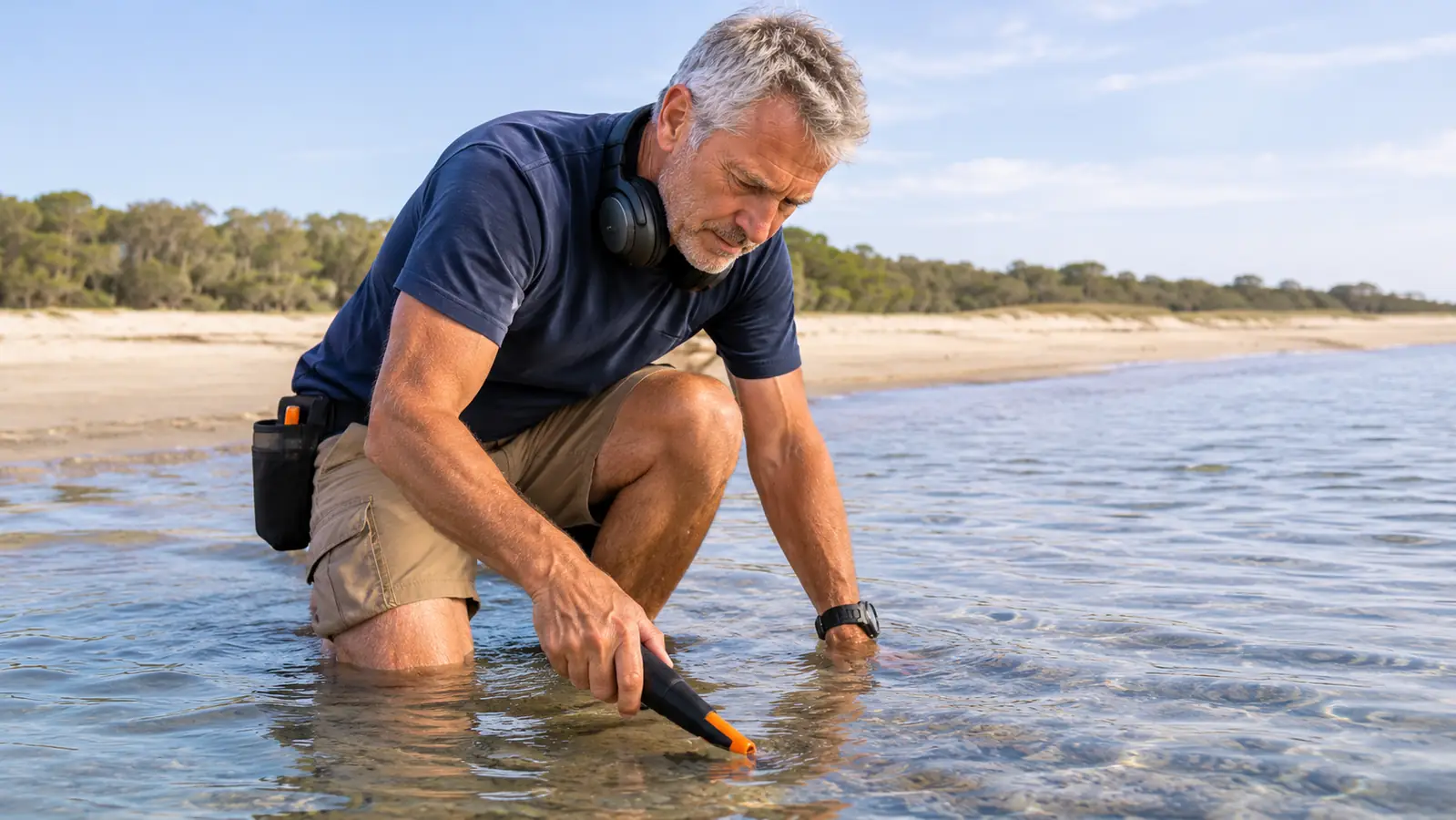
Eighteen months ago I knelt in waist-deep water off a public swim beach south of Tavernier with a land pinpointer in my fist, and it did exactly what a land pinpointer does when you take it swimming. It squealed, fogged behind the lens, and quit. I had a signal in the sand under six inches of water and no way to chase it. That is the short version of how a PulseDive from NOKTA DETECTION TECHNOLOGIES ended up in my gear bag, and why it has been on close to ninety dives since.
I am 61, I spent 33 years as a marine electrician, and I have watched a great deal of equipment die in salt water for reasons that had nothing to do with how it looked on the box. What I want from a pinpointer is short. Keep the water out. Find metal in wet sand. Survive being dropped on a ladder, a dock, and the cargo floor of a 4Runner. Everything past that is sales literature. This review is about the three things I actually asked of it.
The Quick Verdict
A waterproof pinpointer that does the job I bought it for. Four programs, a lost alarm that has saved me twice, and no leak in eighteen months. It is heavier in the hand than the land unit it replaced, and it will never tell you what you have found.
Amazon Check Today's Price →A Pinpointer That Keeps Working Below the Waterline
Rated to 200 feet, pulse induction at 3 kHz, four programs, and a lost alarm that sounds off after five minutes of inactivity. Mine lives in the mesh bag wrapped in a towel and has not leaked yet.
Amazon Check Today's Price on Amazon →How I've Used It
I bought this in the spring of last year, along with a new mesh duffle, a set of boots and a light, after the bag I had been carrying for years split along a seam. The five pieces came in one order and they have been used together since. The PulseDive from NOKTA DETECTION TECHNOLOGIES replaced a land pinpointer I used to keep in a dry bag, on the theory that I would only ever need it on the beach. That theory lasted one season.
Since then it has been a sand hunting tool and nothing else. I work public swim beaches, the sand around docks and boat ramps where the rules allow it, and I check the local rules before I get my feet wet. Every hunt has been between waist deep and roughly 30 feet. The deepest the unit has been is about 60 feet, clipped to my harness on a reef dive where I never actually switched it on. It is rated to 200 feet. I have not tested that and I do not plan to.
A typical morning starts at the rinse tub under the carport. Gear goes in the 4Runner, I drive to the beach or the charter dock, and I wade out until the water is over my knees. Then it is a slow sweep with the wider coil and, when I get a hit, the plain pointer tip to narrow it down. The whole job is small and repetitive, and the tool either makes it faster or it does not. This one does.
One morning in February I worked the sand in front of the boat ramp at the state park, water at 71 degrees and flat calm, and I counted recoveries out of habit. Twelve targets in ninety minutes, three worth keeping, and the rest bottle caps and a rusted pair of pliers. That ratio is normal for a public ramp and it has nothing to do with the machine. The machine only told me where to dig, and it told me every time.
What comes out of that sand is mostly junk and occasionally not. I have pulled coins, a handful of brass boat hardware, a couple of cheap pendants, and one silver ring that had a name inside it and went back to the woman who lost it two years earlier. The rest goes in a bucket, gets sorted on the carport table, and the better pieces go to a weekend flea market. That is a hobby, not an income, and I would not want anyone reading this to think otherwise.
What the PulseDive Actually Is
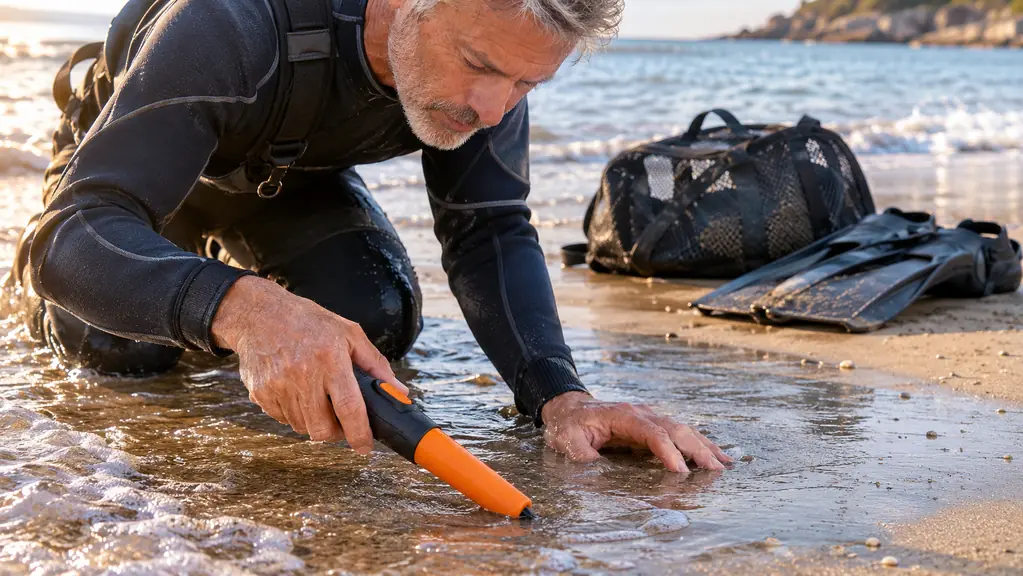
The set is a two part arrangement. You get the detector body, and you get a replaceable scuba coil with a cover, so the same unit works as a hand held pointer for close work or with the 5.5 inch coil fitted for sweeping a wider patch of bottom. NOKTA DETECTION TECHNOLOGIES lists it as a 2 in 1 set for that reason. The extended length is 15.3 inches and the overall footprint is given as 15.3 by 5.5 by 5.5 inches. The search coil is 14 centimeters, which is the same 5.5 inches. The unit weighs 1 kilogram.
Two details in that list matter more than the rest. The first is IP68, the rating that tells you the housing is built to be submerged rather than splashed. The second is the 200 foot depth rating, which is far past anything I do. I dive to 60 feet at the outside. A recreational diver hunting sand is working in the top 30 feet, and most of that is the top 6. The rating is not the point. The point is that the seals were designed for pressure instead of rain.
Swapping between the pointer tip and the scuba coil takes less time than pulling on a glove. The coil cover lifts off for rinsing, and that matters more than the swap itself. Sand works into every seam of every piece of gear I have ever owned, and a cover that comes away clean is the difference between a rinse and ten minutes with a toothbrush on the carport. I still use the toothbrush. I just resent it less than I used to.
What the spec sheet will not tell you is how it sits in your hand. It weighs a kilogram, and that is noticeable on the surface. On a dock, in the air, it hangs heavier than the little land unit I carried before. In the water it is a different story. Once my arm is under, the weight stops being a nuisance and the body sits steady against my wrist, which is what I want when I am trying to hold a tip still over a target.
Pulse Induction at 3 kHz in Salt Sand
The unit runs pulse induction at 3 kHz. If you have only used a land detector, the practical difference is the wet stuff. A conventional very low frequency machine sees salt water and wet sand as a target and spends the whole hunt chattering at you. Pulse induction does not care about the salt. It sends a pulse, waits, and listens for the return from metal. On a salt beach at the waterline, that is the difference between hunting and fighting your equipment.
I have worked black sand patches on the outer beaches and the muck around boat ramps, and the machine has stayed quiet until it is over metal. It does not need to be rebalanced every time the water moves. I set it, I wade out, I sweep. For a 61 year old with a bad shoulder and limited patience for menus, that is worth more than any feature printed on the box.
One morning last summer I worked a patch of black sand where a charter outfit had been tying up for years. The machine stayed stable the whole time, which is more than I can say for the operator. I dug 40 targets in two hours and kept four. Two were brass, one was a coin with enough left on it to identify, and one was a fishing weight that has since gone back to the bottom of the same harbor.
The contrast I keep coming back to is an afternoon at that same ramp with the old land unit, back when I still carried it in a dry bag on the theory that I would only ever need it above the waterline. I got one clean signal at the edge of the wash, stepped out to dig it, and by the time I turned around the tide had moved over the spot. I never found it. That is the sort of thing a pinpointer that can go under stops happening to you.
The trade is discrimination, which is to say there is none. Pulse induction finds everything conductive, and in salt sand everything conductive includes bottle caps, pull tabs, foil, fish hooks and the occasional chunk of boat zinc. You dig it all. If you want a machine that tells you what is under the coil before you dig, this is the wrong technology and you should buy something else. If you want to find metal and are willing to dig, this is a fast way to do it.
The Lost Alarm and the Rest of the Small Stuff
The feature I did not expect to care about is the lost alarm. After five minutes of inactivity the unit sounds an audible alarm and the LED starts flashing. I have left it on the sand twice, once when I stopped to talk to another diver about a found ring and once when I walked back to the 4Runner for a drink. Both times I heard it before I got far. On a public beach that is the difference between a tool and a story about the tool you lost.
It runs on batteries, and I replace them on a schedule rather than waiting for the unit to fade on me mid hunt. That is not a complaint about runtime. It is what I do with every battery powered tool I own, because I have been the man with a dead light at the far end of a night dive and I do not intend to be him again. The compartment has stayed dry through eighteen months of rinsing, which is the only battery question that matters to me.
There is an LED display on the unit. It is readable in the shade of the carport and in the water at 20 feet. In full July sun with the water flat and bright, I read it by shading it with my free hand, the same way I read a watch face. The housing is listed as plastic. Plastic and salt water are not natural friends, but plastic that gets rinsed and dried properly lasts, and this one has.
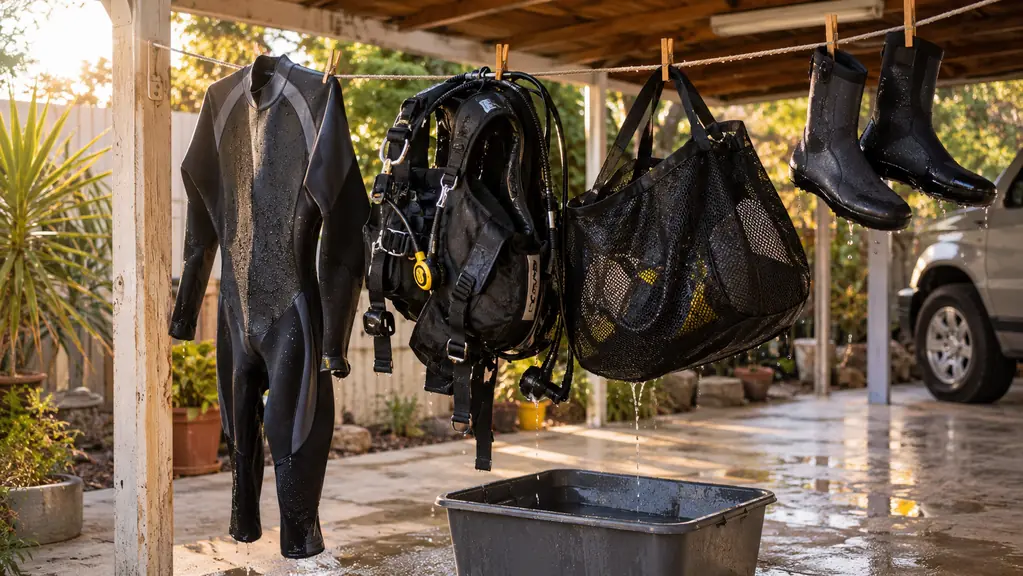
I have a routine with it, and the routine is most of the reason it still looks the way it did in the first month. Fresh water rinse at the tub, towel dry, then up on the line under the carport to finish. The coil cover comes off for the rinse and goes back on dry. Four minutes, once per trip, and no part of it is difficult. Gear that gets treated this way outlasts gear that gets thrown in a bucket, and I have thrown a lot of gear in a lot of buckets.
What It Will Not Do
It will not tell you what you have found. A ring and a crushed can read the same through a pulse induction coil, and you will dig both. On a good morning that is a fair trade for the simplicity. On a bad morning at a beach that hosted a picnic for 400 people, you will dig a great deal of foil for one coin.
It also will not replace a full detector on open sand. The coil is 5.5 inches across and the unit is 15.3 inches long. That is a pinpointing and close work tool, not a machine for covering a wide stretch of beach. I use it to recover targets another detector found, or to work the tight waterline where a full machine is awkward to swing.
Last, it is not a dive instrument. It is rated to 200 feet and it will go where you take it, but it does not log depth, it does not track your dive, and it has no business being the only reason you are under the water. It is a hand tool that happens to be waterproof, and that is the honest description.
What I Liked
- Waterproof to 200 feet with an IP68 housing, so the seals are built for pressure rather than spray
- Pulse induction at 3 kHz stays quiet in salt water and wet sand
- Two part set: pointer body plus a replaceable 5.5 inch coil with a cover for wider sweeps
- Lost alarm sounds and the LED flashes after five minutes of inactivity
- Four programs cover every kind of sand I hunt
- Eighteen months and roughly ninety dives with no leak
Where It Falls Short
- No discrimination at all, so you dig every bottle cap and scrap of foil
- One kilogram is heavy in the hand on the surface
- The 5.5 inch coil is too small to sweep open beach
- The LED display needs shading in bright direct sun
Ninety dives, one rinse under the carport hose, and the only thing that has failed on this unit is the towel I wrap it in.
Who This Is For
This is for the diver who already hunts, or wants to start, in shallow salt water and wet sand. If you work public beaches, the sand around docks and ramps, or the waterline on a falling tide, the PulseDive does the job it was built for. NOKTA DETECTION TECHNOLOGIES aimed it at a narrow task and did not dilute it with features that belong on a full machine. It suits the person who has killed a land pinpointer by taking it swimming, and the person who is tired of a detector that argues with salt. It also suits a charter diver who wants something small enough to clip off and forget about until there is a reason to switch it on.
Who Should Skip It
Skip it if you hunt dry sand only. A cheap land pinpointer will do that work and weigh less while doing it. Skip it if you want to know what is under the coil before you dig, because this machine will never tell you. Skip it if you expect one tool to cover a wide beach, because the 5.5 inch coil is not built for that. And skip it if you want a dive instrument that logs depth and time. This is a hand tool with a good seal on it, not a computer, and it should be judged that way.
If Your Pinpointer Has Only Ever Been Splashed, It Has Not Been Tested
Mine has been under for eighteen months of sand hunts, rinsed in fresh water, and dried on a line under a carport. It is still the first thing I reach for when the water gets over my knees.
Amazon Check Today's Price on Amazon →