
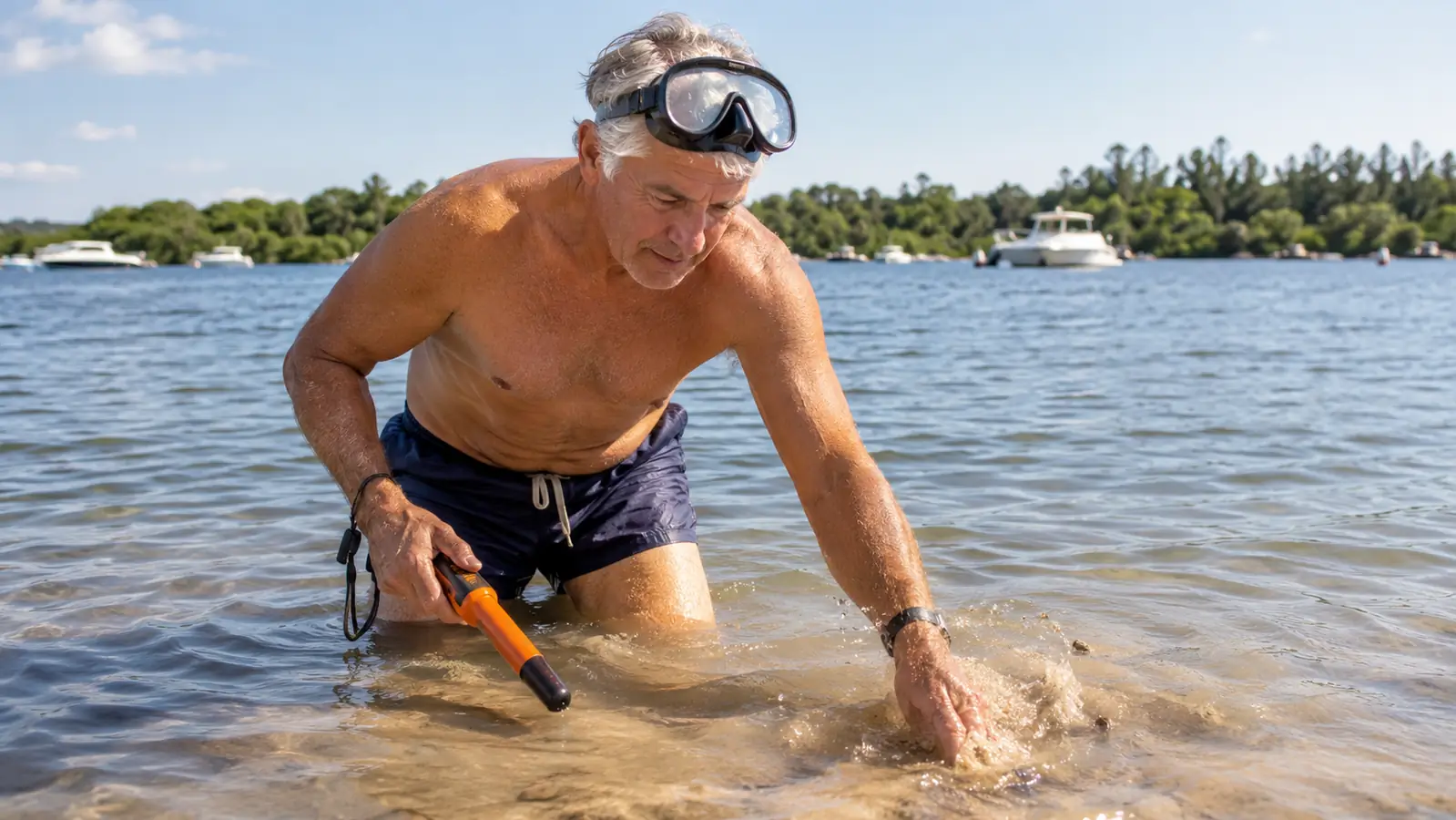
The short answer: if you actually dive, buy the PulseDive. If your hunting happens on the towel line and in the dry sand, with only the odd wade into the shallows, the Garrett Pro-Pointer AT is the lighter and simpler tool and you will not miss what the PulseDive adds. I own the PulseDive from NOKTA DETECTION TECHNOLOGIES. I have used Cal's Pro-Pointer AT on the dock and in waist-deep water often enough to know exactly what it does well and where I would not want to be without mine.
I bought the PulseDive in the spring of last year, when my old mesh bag split and I rebuilt the whole kit in one go. It has been on roughly 90 dives since, all sand hunts, from waist deep out to about 30 feet. I have never taken it past 60 feet and I have never needed to. What I want from a pinpointer underwater is narrow and specific. It has to survive pressure. It has to find a target in a hole I cannot see into. And it has to earn the space it takes in a bag that already holds a light, boots, gloves and a wetsuit. The Garrett is built for the first two. The PulseDive is built for all three.
Side by Side
| PulseDive | Pro-Pointer AT | |
|---|---|---|
| Depth rating | Waterproof to 60 m (200 ft), IP68 rated | Submersible to 20 ft per Garrett's published spec |
| What it is | Pinpointer plus a replaceable scuba coil, so it doubles as a small detector | A pinpointer only |
| Search coil | 5.5 inch (14 cm) coil, replaceable, with a replaceable coil cover | No coil, pinpointing tip only |
| Settings | 4 programs | Three sensitivity levels with proportional audio and vibration |
| Lost alarm | Alarm plus flashing LED after 5 minutes of inactivity | Not listed in Garrett's published specs |
| Weight and length | 1 kg, 15.3 inches extended | Lighter and shorter in the hand |
| Best for | Divers working a sand bottom at 20 to 60 feet | Wading, towel line and dry sand hunting |
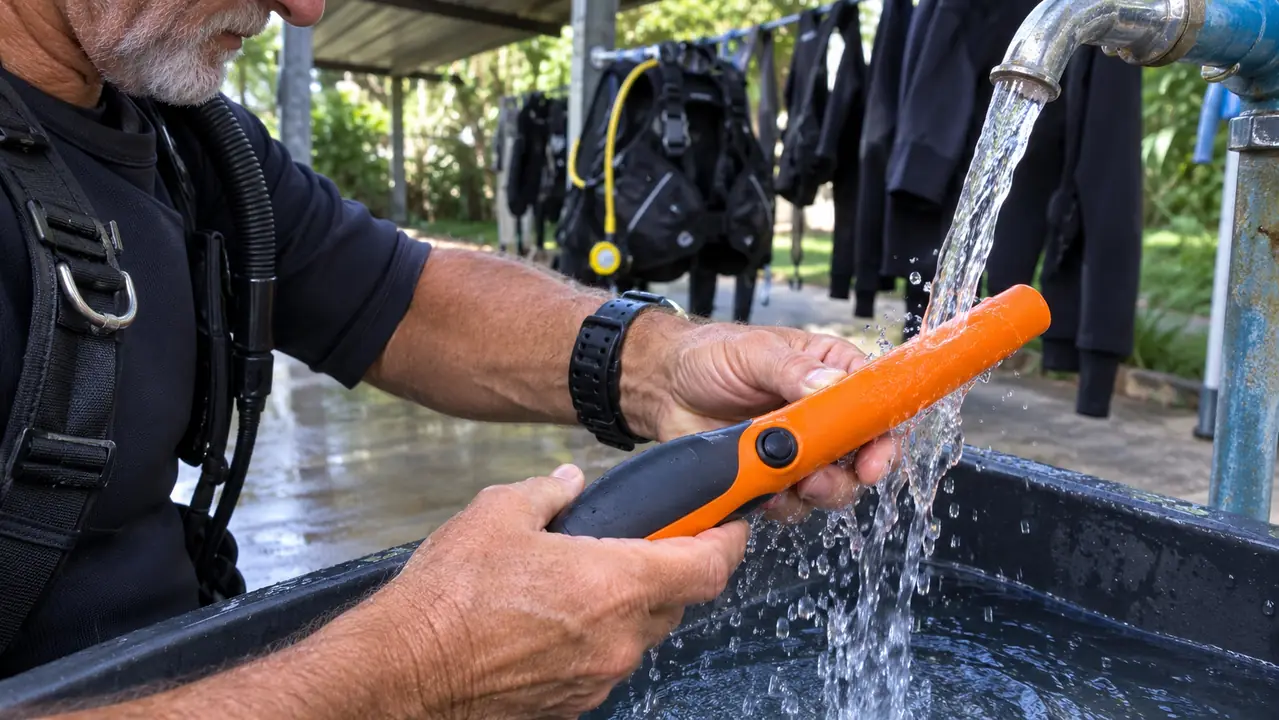
Where the PulseDive Wins
Start with the number that decides it for a diver. The PulseDive is waterproof to 60 m, which is 200 feet, and it carries an IP68 rating. I will never test 200 feet. I have had mine to about 30 feet on a normal sand hunt and to 60 once on a clear day off a charter boat, and that is my whole working range. What matters is not the ceiling. It is that NOKTA DETECTION TECHNOLOGIES sealed the case for pressure rather than for splashes. The Garrett Pro-Pointer AT is submersible to 20 feet by its own published spec. That is plenty for a wading hunter in the shallows and it is not enough for a diver kneeling on the sand at 40 feet, which is where a good deal of the interesting ground is.
The second thing the PulseDive does that the Garrett does not is change jobs. The package includes a replaceable scuba coil and a replaceable coil cover, and the coil is 5.5 inches, or 14 centimeters, across. With the coil fitted the unit becomes a small detector you can sweep over a patch of sand before you ever start fanning it. That changes how a sand hunt runs. I sweep a lane, note the hits, then go back to pinpointing and dig them one at a time. With the Garrett I would be fanning blind and digging every whisper. The Garrett is not worse at what it was built to do. It was simply never asked to do this, and NOKTA built the coil to come off and go back on for exactly that reason.
Four programs is more choice than I use. I run one in wet sand and one when I am checking finds in the rinse tub under the carport, and I have never needed the other two. The lost alarm is the feature I did not know I wanted. After 5 minutes of inactivity the unit sounds an alarm and the LED starts flashing. I set mine down on the sand at a public swim beach once, both hands in the hole, and walked away from it. Five minutes later it started carrying on at me. A pinpointer is a small dark object that you put down in a place where everything looks the same, and finding it again by feel is not a plan.
Where the Pro-Pointer AT Wins
Three sensitivity levels with proportional audio and vibration are genuinely good on dry sand. Proportional audio means the tone climbs as you close on the target, so your ear learns the distance without you having to think about it. On land, with your head out of the water and no hood over your ears, that is faster than reading anything, and it is faster than the way I work underwater with a coil and a float line. I used Cal's on the towel line at a swim beach last summer and what struck me was how little I had to look at it.
It is also the smaller tool in the hand. The PulseDive is 1 kg and 15.3 inches extended, and holding that out at arm's length in current for an hour is work by the end of it. The Garrett's pinpointing tip goes into a tight hole, a crack in the limestone, the scoured gap under a piling, places a 5.5 inch coil will never fit. And there is nothing to program. Cal handed it to me, I switched it on, and it worked. For a diver who hunts an hour a month and wants one simple thing in the bag, that simplicity is worth more than everything the PulseDive adds.
The pinpointer that is still working at 40 feet
Waterproof to 60 m (200 ft) with an IP68 rating, 4 programs, a 5.5 inch replaceable scuba coil, and a lost alarm that sounds after 5 minutes of inactivity. Mine has been on about 90 dives on sand.
Amazon Check Today's Price on Amazon →Three Places I Have Used It and One Where Cal Uses His
Around the pilings at a boat ramp is where a small tip earns its keep and a coil does not. I work the pinpointing tip down the side of the timber into the sand where the current has scoured a pocket. Rings collect in those pockets. A 5.5 inch coil is not going in there and I do not try to force it. This is the one place where I would rather have Cal's Garrett in my hand, and I have told him so more than once.
A lane sweep at a public swim beach is the opposite situation. I fit the coil, sweep a strip about the length of the 4Runner, and mark the hits with weighted line. Then I switch back to the tip and dig. On a beach that gets raked every morning, the targets are either fresh drops in the top two inches or old ones down at the hard layer where the sand stopped moving, and the sweep tells me which before I waste ten minutes on my knees.
Night dives are where the light and the lost alarm stop being features and start being the reason you carry the thing. On a sand hunt at dusk you have a light on your wrist and a light on your head and neither one is pointed at the hole you are digging. The unit has a light on it for exactly that. The lost alarm matters more at dusk than at any other time, because a pinpointer dropped on a black bottom at eleven at night is gone for good.
What the Paper Specs Do Not Tell You
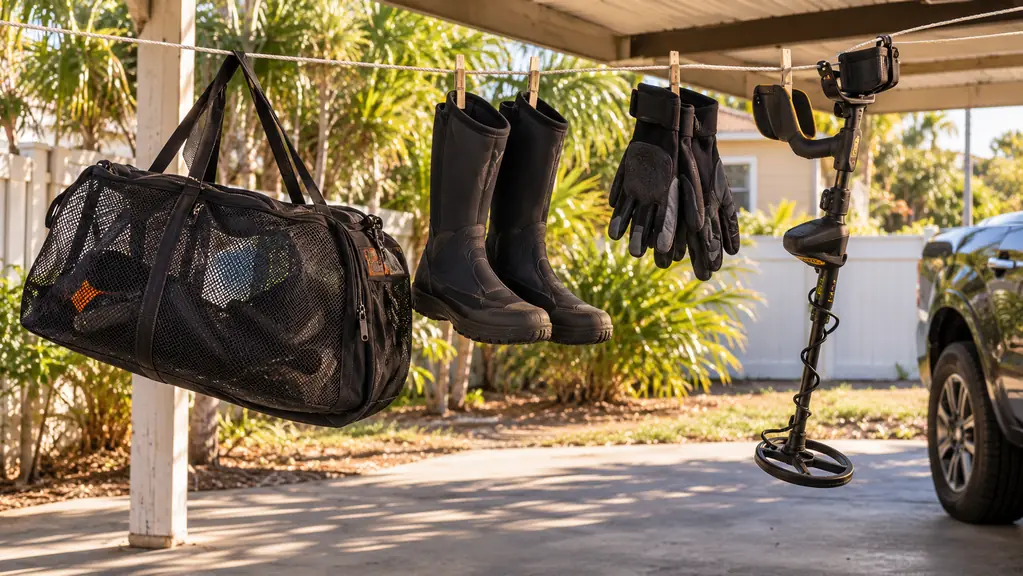
What fails in salt water is almost never the electronics first. It is the seal, the switch boot, the coil cover, the threads on the battery compartment. Every piece of gear I own gets the same treatment at the rinse tub under the carport. Fresh water, the whole thing, then a dry in the shade on the clothesline. The PulseDive gets that treatment because salt crystallizes in the seams and a stiff O-ring is a leak waiting for your next dive.
The replaceable coil cover is the part that wears out, and that is by design and it is the right design. A scuffed cover is a part you change. A scuffed coil is the instrument. After about 90 dives the cover on mine is scuffed and the coil underneath it is fine, and I have not had to think about it once.
What I cannot tell you is how either of these behaves after five years, because neither of mine is that old. Cal has had his Garrett longer than I have had the PulseDive and it still works, and it has had a harder life, because Cal hunts dry sand all summer and leaves it in a hot car. Two data points is not a reliability study. If you want certainty about either one, buy it new, rinse it every time, and do not store it wet in a sealed bag.
Neither One Tells You What You Have Found
Both of these are pulse induction tools, and pulse induction does not tell you what the target is. There is no readout that spells out gold and no tone that means bottle cap. You dig everything. On a public swim beach that is fine, because the junk is mostly bobby pins, foil and the odd tent stake, and the good finds are coins and rings that have been sitting in the same sand for years. On a site with heavy trash you would spend your whole bottom time digging nails.
I bring it up because a lot of people buy their first pinpointer expecting it to sort for them, and then they blame the tool. Neither the PulseDive from NOKTA nor the Pro-Pointer AT will do that. What they will do is tell you, within an inch, where the thing you are about to dig is sitting. That is the entire job, and both of them do it.
I set mine down on the sand at a public beach with both hands in the hole and walked away from it. Five minutes later it started flashing and sounding off at me.
Who Should Buy Which
Buy the PulseDive if you are actually diving. If your hunting runs from the sand down to 20 or 30 feet, if you work the bottom of a swim beach from a kneeling position, if you are on a charter where you get one shot at a site and you want to sweep a lane before you commit to digging it, the depth rating and the replaceable scuba coil are the reason the tool exists. The 1 kg weight and the 15.3 inch body are what you pay for that, and in current you will feel it by the end of the dive.
Buy the Garrett Pro-Pointer AT if you are a wading and dry sand hunter who wants one simple instrument. If you work the towel line, the volleyball court and the dry sand at low tide, and you want proportional audio in your ear and nothing to program, the Garrett is the lighter and simpler answer, and it will find everything the PulseDive would find in that ground. If you do both, and plenty of us do, this is one of the few places where owning two tools is not a waste. The Garrett stays in the 4Runner for land. The PulseDive stays in the bag.
Rinse it, dry it, and it goes back in the bag
NOKTA rates the PulseDive to 60 m (200 ft) and seals it to IP68, with 4 programs and a lost alarm at 5 minutes. Mine has done about 90 dives on sand, from waist deep out to 30 feet, and it has not given me a reason to send it in.
Amazon Check Today's Price on Amazon →