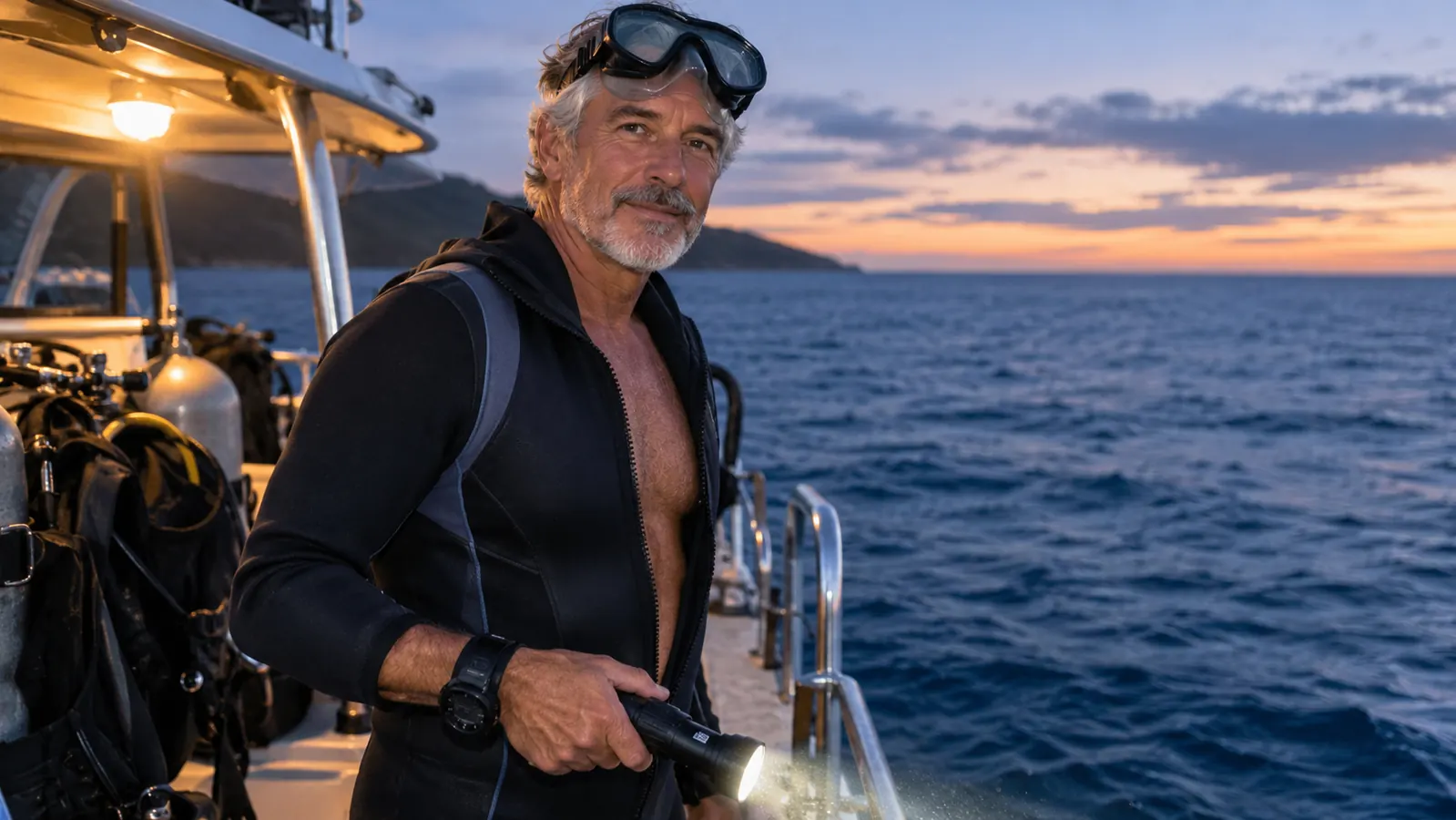
The light I borrowed from the dive club for two seasons was a plastic torch that took three batteries a night and quit somewhere around 30 feet. I spent more time swapping cells on the boat deck than looking at anything. When I rebuilt my kit in the spring of last year, I bought the Genwiss dive light along with four other pieces of gear I had been making do without, and I have put about 90 dives on it since. It has been to 60 feet off Tavernier, under ledges on the outer reef, and out on guided night charters. It has not flooded.
Here is the short version before the long one. The Genwiss is a machined aluminum torch with five modes, a rechargeable lithium-ion cell and a charger in the box, and the specification sheet lists 1000 lumens. It is not the light a technical diver bolts to a helmet. It is the light an ordinary recreational diver keeps in the bag for a night charter or shines under a ledge at ten in the morning, and at that job it has been solid for 18 months and about 90 dives.
The Quick Verdict
A plain, tough, rechargeable torch that handles night dives and daytime ledge work without fuss. It is not a technical primary, and the listing headline promises more output than the spec sheet delivers.
Amazon Check Today's Price →The torch that has stayed dry through 90 dives at 60 feet
Five modes, a rechargeable lithium-ion cell and a USB charger in the box. Check today's price and the current listing details on Amazon.
Amazon Check Today's Price on Amazon →How I've Used It
I dive 20 to 60 feet, mostly. About 400 logged dives since I certified at 47, Advanced Open Water, and I stay inside recreational limits. That is the range this light lives in. On a night charter the boat runs maybe fifteen minutes to the reef, the divemaster wants a light in your hand before you roll, and the Genwiss rides in the mesh bag on the way out and stays in my hand from the roll until I am back on the ladder.
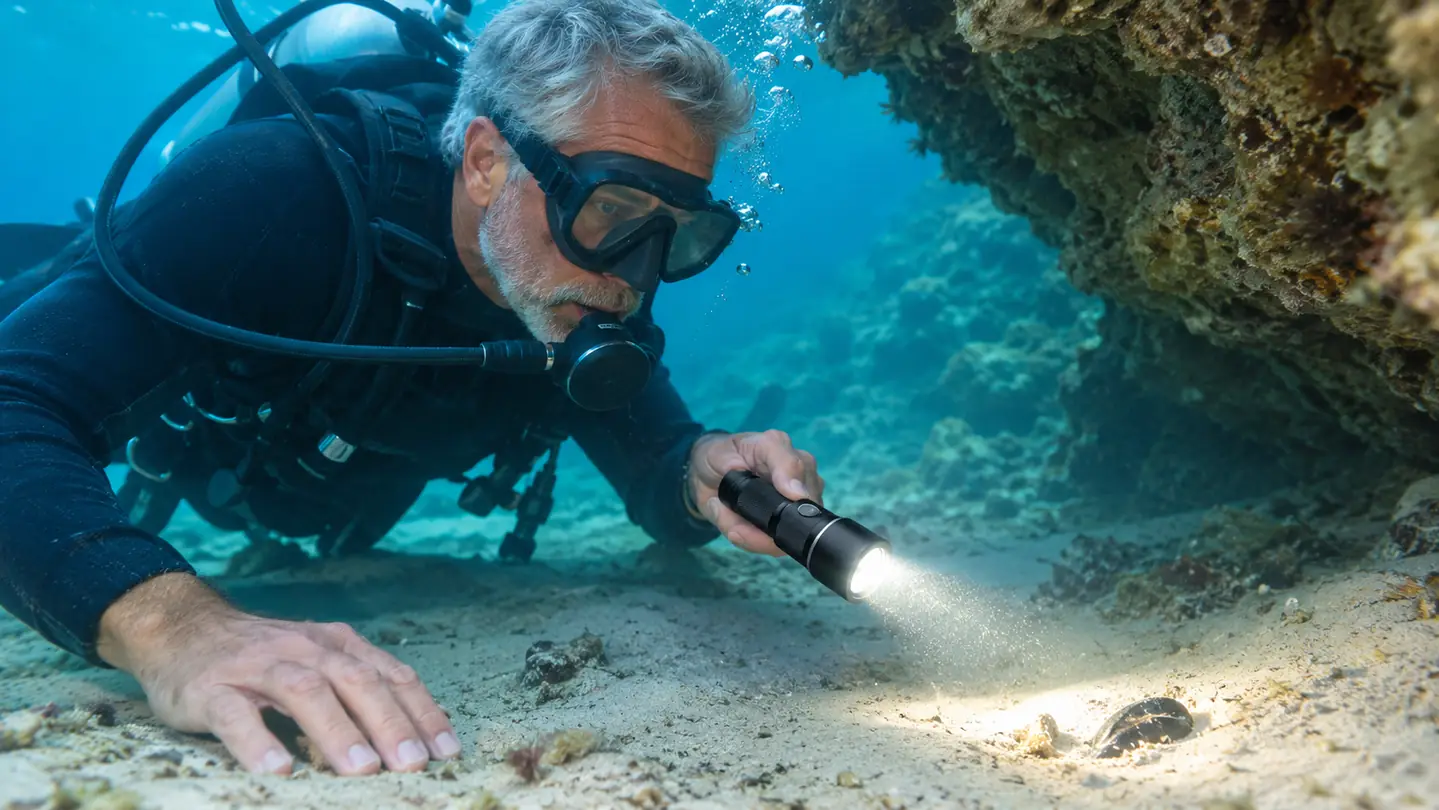
It has done three jobs for me. Night dives on guided charters, where you want a beam that reads the reef ahead of you and finds your buddy's signal. Daytime ledge work, poking the beam under a coral ledge on the outer reef to see what is tucked back in there, which is exactly where a dim light is useless because the ambient water washes it out. And sand hunting, where I am on my knees in 8 to 20 feet of water fanning silt and want a beam tight enough to catch the glint of brass or the rim of a coin before I lose it again.
One night last January sticks with me. The water was 71 degrees, which at 61 I feel in my hands before I feel it anywhere else, and the charter ran out to the outer reef with six divers and one divemaster. I rolled with the Genwiss on medium, held low and ahead of me, and spent 40 minutes following Cal's beam along the ledge. Halfway through I shut it off for a minute to let my eyes come back, which is a trick worth knowing, because the reef comes up out of the dark on its own once you stop blinding yourself. When I switched it back on it lit first press. That one dive is most of the review, honestly.
Ninety dives is not a lifetime. It is enough to know whether a light floods, whether the switch gums up, and whether the coating on the body starts to blister. So far it has done none of those. I rinse it in the outdoor tub under the carport after every saltwater day, dry it on the line, and put it back in the bag. That is the whole routine. It has not asked for more than that.
What the Spec Sheet Actually Says
The listing headline is louder than the specification sheet, which is normal and worth knowing before you buy. The sheet lists 1000 lumens, a 10 watt LED, a 4.2 volt lithium-ion battery, one battery included, a USB charger included, and an aluminum alloy body with an anti-abrasive coating. It gives the light as 7.8 inches deep by 3.86 wide by 1.85 high and 331 grams, a bit over 11 ounces. The size designation is GN-T42.
331 grams in the hand is not nothing. It is a light with mass, and on a night dive that mass sits steady in your palm instead of skittering around when you point it. The trade is that it is not a light you forget you are carrying. If you are used to a tiny backup torch on a lanyard, this will feel like a tool rather than a trinket.
To put the size in terms I actually understand: it is about the length of my hand from wrist to fingertip, and it does not fit in any wetsuit pocket I would trust to hold it. It rides in the mesh duffle with the rest of the kit, or it rides in my hand. The 3.86 inch width at the head is the number that explains why it feels substantial. There is a real reflector behind that lens, not a pinhole.
What the sheet does not list is a depth rating. That is the one number I want and cannot find. I have had it to 60 feet on a wall and it was dry inside when I opened it that evening. I am not going to tell you it is rated to 300 feet, because I do not know that and neither does the listing. If you dive inside recreational limits, which is what this whole site is about, then what I can tell you honestly is that mine has held at the depths I actually dive.
It has been to 60 feet on a reef wall, and when I opened it that evening the inside was dry.
Five Modes, and the Two I Actually Use
The switch cycles high, medium, low, strobe and SOS. High is for the night dive when you want to see the shape of the reef ahead of you and put a beam on your buddy. Medium is what I use for most of a dive, because high drains the cell and once your eyes adjust you do not need it. Low is for the sand, where I am close to the bottom and a wide hot beam just washes out the glint I am looking for.
An example of why that matters. There is a limestone ledge out on the outer reef I go back to, maybe four feet of shadow under the overhang at around 35 feet. In daylight with no light at all you see a dark slot and nothing more. On low, held at arm's length and angled up under the lip, the beam picks out the texture of the wall and a cluster of squirrelfish hanging in the shadow, and it does not bounce back into your eyes the way high does in a tight space. High is the wrong tool for that job and low is the right one, which is why the mode switch earns its place ahead of any lumens number.
Strobe and SOS I have used exactly twice, both on a boat drill. I have no use for them. If you are the kind of diver who wants a signal mode on a night dive, they are there and they work. If you are not, you will click past them every time you cycle the switch, which is a minor annoyance and not a failure of the light.
Cycling through all five modes to get back to off is the one thing about the switch I genuinely do not like. With cold hands in a neoprene glove in January water, I want one press and darkness. Instead I press through the whole sequence. It is a small thing. It is also the thing I notice every single dive.
Night Dives, Which Is Where It Earns Its Keep
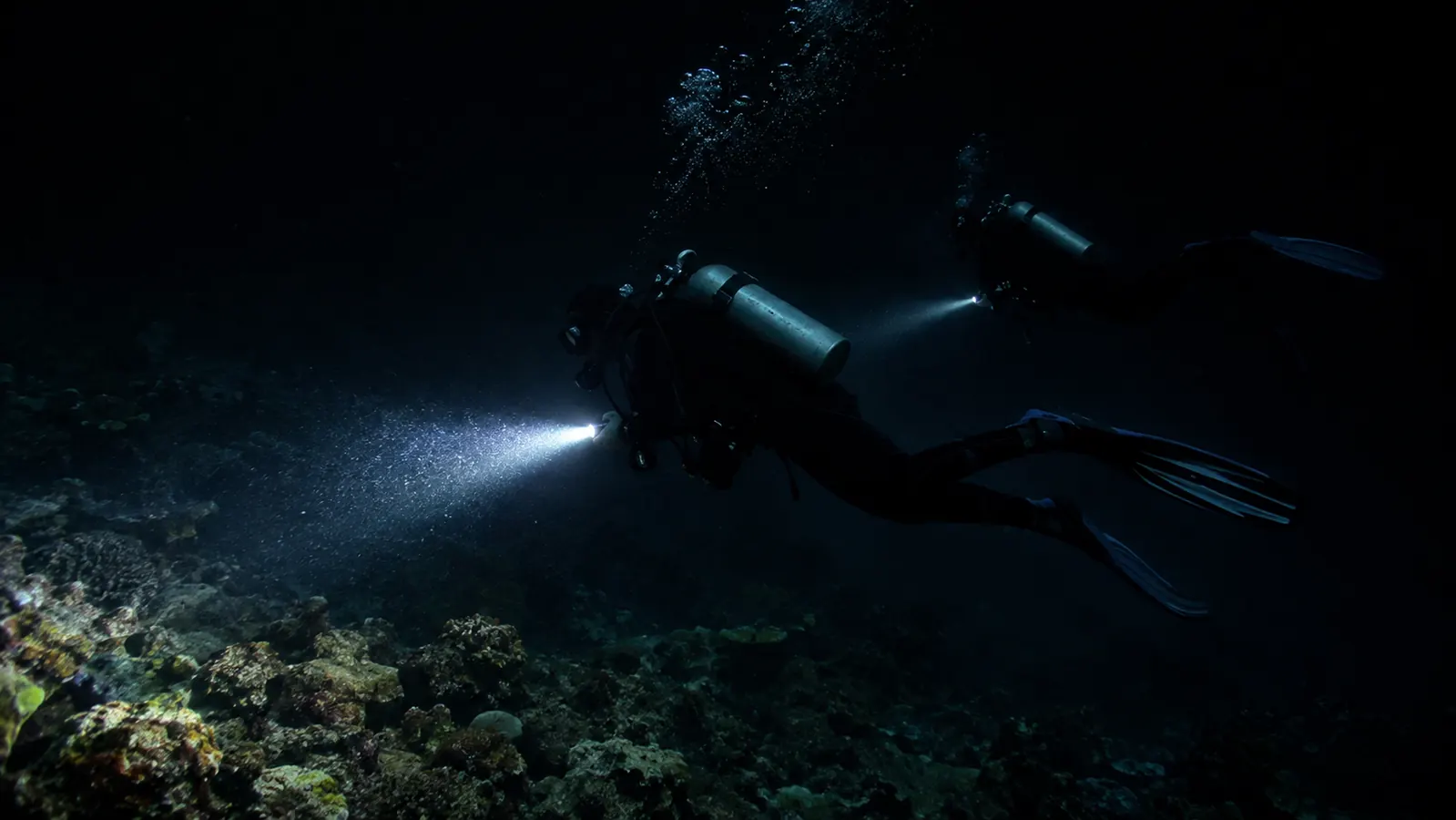
A night dive is a different job from a day dive. Your whole world is the cone in front of you and the buddy light off your shoulder. On a guided charter out of Tavernier the divemaster drops a line and everyone follows it down to the reef, and if your light dies at the bottom you are a problem for everyone on that boat. I have run the Genwiss on medium for a full night dive and had it come back up still lit. That is the test I care about most.
The beam is tight enough to be useful at 30 feet and wide enough at 10 feet that you are not hunting around with a pencil. On the reef it shows you the shape of the ledge and the shadow under it. It also shows you the lionfish sitting in that shadow, which is the other reason I want a light on a night dive.
Two things I do before every night charter. I charge the light the evening before, and I check that it still comes on after the tail cap goes back on. That second check is the one that matters. A light that works on the deck and does not work at 20 feet is worse than no light at all, because you planned your dive around it.
Charging runs through the USB charger that comes in the box, and one lithium-ion cell is included. The sheet does not publish a runtime figure, so I will tell you what I do instead of quoting one: I charge the night before a dive and I have not had it go flat on me underwater. If you are doing three night dives in a week, charge between each one and do not assume the cell owes you anything.
The cell is the part of any rechargeable light that quietly decides its life. Mine is 18 months old and still takes a full charge. When a battery eventually stops doing that, I would rather be able to deal with it than throw the whole torch away, and a light that ships with a separate cell and a charger at least leaves that door open.
Salt Water, Sand and the O-Ring
I spent 33 years as a marine electrician, so I look at gear the way I look at a junction box on a boat. Where does the water get in, and what does it eat first. On this light the answers are the tail thread and the switch boot. Both have stayed sound. The anti-abrasive coating has scuffed at the tail where I set it down in the sand, and that is cosmetic. There is no corrosion blooming at the seams, which is what I actually watch for.
The O-ring is the part that will end this light eventually. Not this year, probably. I keep a thin film of silicone grease on it and I do not crank the cap down like I am torquing a through-hull fitting. If you cross-thread it in a hurry on a rolling deck, you will find out about it on the next dive. That is not a knock on the Genwiss. It is how every sealed light I have owned has died.
I had one bad afternoon at a boat ramp down in Islamorada. I set the light down on the concrete while I rinsed the detector and a wash from a passing boat pushed grit across the tail cap. I did not notice until I got home, worked the switch, and felt it catch halfway. Ten minutes with fresh water and a soft brush and it was fine again, and I have been more careful about where I set it down ever since. That is the sort of thing that ends a light early, and it is entirely avoidable.
Sand is the other enemy. I hunt public swim beaches and around boat ramps, which means fine silt and grit, and the switch has stayed free. I rinse the whole light in fresh water after every day, work the switch a few times while it is wet, and let it dry on the line under the carport. Do that and the light will outlast the diver.
What I Liked
- Five modes with a usable medium setting that will carry a whole night dive
- Rechargeable lithium-ion cell and a USB charger both in the box, so no buying disposables
- Aluminum alloy body with an anti-abrasive coating that has taken sand and scuffs without corroding
- 331 grams sits steady in the hand instead of skittering around
- Held dry at 60 feet across about 90 dives on nothing but a fresh water rinse
Where It Falls Short
- No depth rating published in the listing, and that is the number I most want to see
- You cycle through all five modes to turn it off, which is awkward with cold gloved hands
- The listing headline claims more output than the 1000 lumens on the spec sheet
- At a bit over 11 ounces it is not a light you forget you are carrying
- The O-ring and tail thread need grease and a careful hand, like any sealed light
Who This Is For
Recreational divers who do night charters and want one torch that lives in the bag and works. Divers who poke under ledges in daylight. Sand hunters who need a low beam close to the bottom to catch a glint. Anyone rebuilding a kit who wants a rechargeable light with the cell and charger in the box instead of a drawer full of dead disposables.
It also suits the diver who wants a backup that could carry a night dive if their primary fails. It is bright enough on medium to run a dive and heavy enough to feel like a tool in the hand.
Who Should Skip It
If you dive past 100 feet, go inside wrecks, or run cave lines, buy a light with a published depth rating and a maker who will stand behind it at that depth. I do none of those things and I am not going to pretend this torch is built for them.
If you want a light small enough to forget on your harness, this is not it at 331 grams. If you want one press and off, this is not it either. And if the output number in the listing headline is what sold you, read the specification sheet first, because 1000 lumens is the figure repeated in the specs and that is the honest one.
One torch, five modes, and 90 dry dives behind it
Cell and charger included. Check today's price and the current listing details on Amazon before you commit.
Amazon Check Today's Price on Amazon →