

I bought the PulseDive from NOKTA DETECTION TECHNOLOGIES about eighteen months ago, in the same spring I replaced four other pieces of dive gear at once. My old mesh bag had split along a seam and I decided to rebuild the kit rather than keep patching it. Since then the detector has been on roughly ninety dives with me, almost all of them sand hunts at public swim beaches and around two boat ramps where the rules allow it. That is enough time to like a tool and still find its rough edges. This review spends most of its words on the rough edges, because that is the part a product page cannot tell you.
Some context if you have not read anything else here. I am sixty-one, retired after thirty-three years as a marine electrician, and I live in Tavernier. My hunting happens in water from waist deep out to about thirty feet. The unit is rated to two hundred feet and I have never had it past sixty, so read everything below as a shallow water opinion. I owned a land pinpointer for years and could not use it below the surface, which is the whole reason I went looking for something sealed. Salt water is patient with gear. It works on the seam, the gasket and the screw thread quietly, and then one day the thing floods and you are out the money.
The Quick Verdict
A genuinely sealed pulse induction pointer that also takes a small scuba coil, with an inactivity alarm that has saved me twice. Heavy in the hand and slower to change over than the listing implies.
Amazon Check Today's Price →Ninety dives in salt water and the seals are still holding
If you want the numbers and today's price before the long version, the Amazon listing has them. Everything below is what the listing leaves out.
Amazon Check Today's Price on Amazon →How I Have Used It, and How I Have Not
The unit rides wrapped in a towel inside the mesh bag, which lives in the back of the 4Runner between trips. On the beach I work a grid, and when the big machine calls a target I switch to the pointer to find it in the sand. That is ninety percent of what this tool does for me. Fan the sand with a gloved hand, sweep the tip through the loose stuff, and the tone tells you when you are getting close. Most of what I turn up is pull tabs, bottle caps and the occasional brass fitting off an old boat. Now and then a ring, and twice a ring I could trace back to an owner, which is the best half hour you can have on a public beach.
One morning last February I worked a stretch of public swim beach at low tide, water about the temperature it always runs that time of year, and I spent the first forty minutes on my knees in the shallows with the pointer. What I turned up was the usual: eleven pull tabs, four bottle caps, a brass eye off a boat cover and one dime. The dime is not the story. The story is that the land pinpointer I used to carry in a dry bag would have been useless the moment my hand went under, which is why it stayed in the bag and I stayed on my knees getting nothing done. The PulseDive went where the sand was wet and did not care.
The depth question comes up a lot, so here is my honest answer. I have used it in ankle deep surf and out to about thirty feet on flat sand, and the behaviour did not change between those two extremes. It is not bothered by the salt, which is the entire point of pulse induction. My old land pointer would chatter itself into uselessness a foot under the surface. This one does not care, and that alone was worth the switch for the kind of hunting I do.
What I have not done with it is cave, wreck penetration, or anything past sixty feet. I stay inside recreational limits and I do not pretend otherwise. If you are looking for a review from a diver who pushed one to its rated depth, this is not that review. What I can tell you is what eighteen months of salt water, sun, sand and being dropped in a rinse tub does to the seals and the coil cover, and that is a different kind of useful.
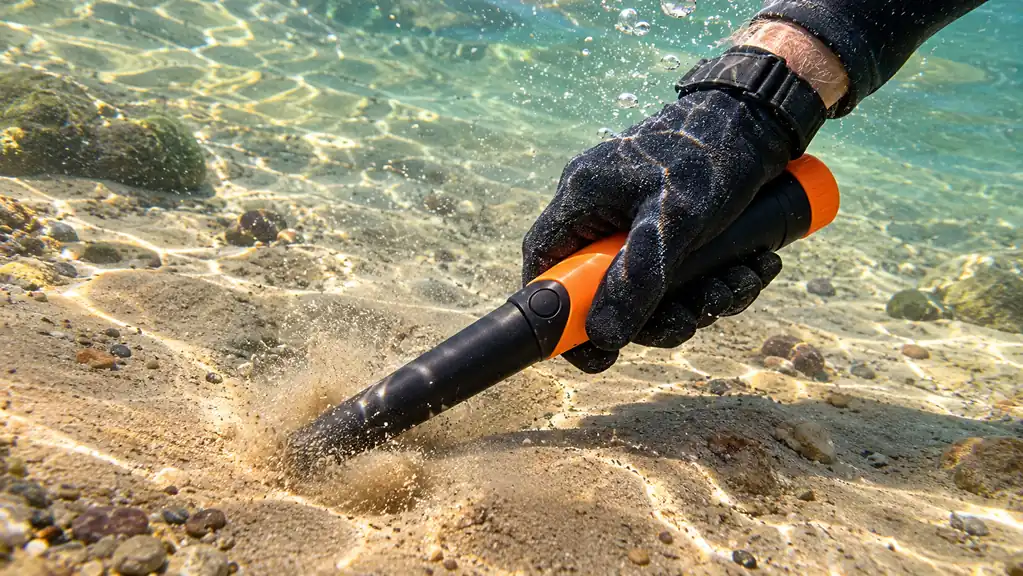
The Truth About the 2-in-1 Setup
The listing calls it a 2-in-1 set, and it is, but the phrase undersells the decision you have to make. The unit arrives as a hand-held pointer with a replaceable scuba coil and a replaceable coil cover. You can run it as a pointer, which is what most people picture when they hear the word pinpointer, or fit the 5.5 inch coil and use it as a very small detector. Both of those are real jobs. Neither one is instant. The people at NOKTA DETECTION TECHNOLOGIES built a housing that does two things, and doing two things in one body always involves a compromise somewhere.
Changing from one setup to the other is a dry-hands job. I do it on the boat or under the carport before I get in the water, not bobbing in the surf with cold fingers. If you picture yourself swapping the coil mid-hunt you will be disappointed. If you plan ahead, which takes about as long as putting on a fin, it is a non-issue and you forget about it entirely.
The first time I tried that swap sitting on a piling with the swell moving, I fumbled the cover and dropped it. It floated, which was luck, and I caught it, which was more luck. Since then the routine is fixed. I lay a hand towel on the boat seat or the tailgate of the 4Runner, set the body down, back the cover off square so I do not cross-thread it, seat the new one finger tight, and check the lip all the way around before it goes in the water. That is three minutes on dry land. Doing it in the surf is five minutes of swearing and a real chance of losing a part in the sand.
The coil mode is the part people overestimate. A 5.5 inch coil is for close work: a hole you already opened, a patch of structure, the narrow strip of sand between a swim ladder and a piling. It is not going to sweep a wide beach in a morning. If you are hunting blind, with no target to start from, a full size machine will cover far more ground per hour. I use the coil mode to check a small area properly rather than to search a large one, and that is the honest framing of what it can do.
What the 200-Foot Rating Actually Buys You
The rating is IP68 and the depth figure on the listing is 60 metres, or 200 feet. I have never been near that. What the rating buys you is not permission to be careless. It buys you a housing built to be sealed, so a day at thirty feet is a normal day rather than a gamble with a tool that was never designed for immersion. That is a real difference, and you feel it the first time you take it under without checking the cap twice.
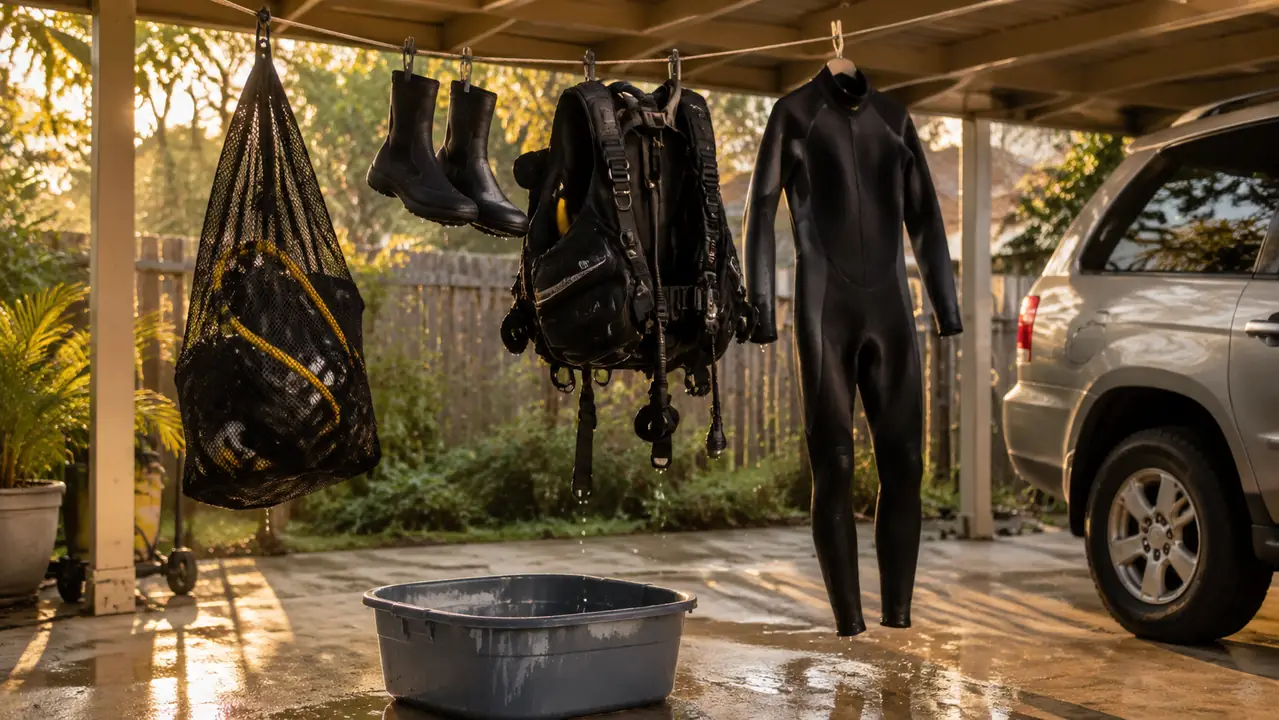
Care still matters. Salt crystals form in the joints and around the coil cover, and they are abrasive. Mine gets a fresh water rinse after every trip and hangs on the clothesline under the carport to dry, the same routine I use on regulators. Do that and a sealed housing stays sealed. Skip it for a season and you will be the person writing the angry review about water intrusion that everybody else scrolls past.
Salt crystals also hide in the tight spots a quick dunk will not reach. My outdoor rinse tub sits under the carport and gets filled after every trip. I dunk the unit, work a soft brush around the cap thread and flush the edge of the coil cover where sand packs in. The one time I skipped the brush I found grit in the thread on the next trip, and grit in a thread is how a cap stops seating flat. It took a quarter of an hour with a toothbrush to clear. Fifteen minutes of prevention once beats a flooded tool and a claim form.
Power is a battery, and the listing does not promise anything more exotic than that, so I treat it like every other battery tool I own. Spare cells live in the bag and I check them before a night charter, because I am not going to be the man on the boat asking if anyone has a spare. The other number worth knowing is the weight. It is 1 kg, extended length 15.3 inches, and that is a serious piece of plastic in your hand. It changes how long you can hunt, and no product page is going to say so.
The Lost Alarm and the Parts That Earn Their Keep
After five minutes of inactivity the unit sounds an audible alarm and the LED starts flashing. I did not think much of that feature when I ordered. I think a great deal of it now. Set the thing down in the sand while you dig, get distracted by a current, drift twenty feet, and that alarm is the difference between finding your tool and buying another one. It has saved me three hunts. It has also embarrassed me twice, in front of a beach full of people who now know exactly where I left it.
The LED display is small and it does the job above water and at dusk. In bright midday glare on wet sand I have to turn my body to shade it. That is a minor annoyance, not a defect. The four programs are more interesting. I use two of them for the ground I actually hunt and I have never needed the other two. They exist for conditions I do not dive in. I would not choose this tool, or reject it, on the count of four programs against two, because on my beaches it has effectively been a two program instrument since the first month.
One of the listing bullets mentions using the unit as a hand-held detector and a light. I have used that in low light at the edge of visibility on a guided night charter, and it is handy. It is not a dive light and I would not treat it as one. My actual light does the illumination and the detector does the finding. The bit of light on the tool is a convenience for when both your hands are busy, nothing more than that.
Where It Falls Short
The weight is the honest limit. One kilogram does not sound like anything until you hold it out at arm's length, underwater, in current, for forty minutes. My wrist knows. On a long hunt I switch hands and I take breaks I never used to take with a light plastic pointer. If you have wrist or shoulder trouble, handle one before you commit. That is the single biggest thing I would tell a friend across a kitchen table, and it is not on the listing anywhere.
The fatigue shows up around the thirty minute mark, and it shows up as sloppy technique before it shows up as pain. I noticed it first on a flat off a boat ramp, working a grid in about fifteen feet with a mild current pushing me off line. By forty minutes my forearm was shaking and my sweeps were wandering, and a wandering sweep misses targets that are sitting right there in the sand. Now I rest the unit on the mesh bag every ten minutes, stretch the hand out, and switch sides. I also cut my hunts from ninety minutes to about an hour. A younger diver with better shoulders may not care. Most people buying this will.
Second, the settings are a dry-hands job, same as the coil swap. I set the program before I get in the water and I leave it alone until I am back on the boat. Anyone imagining they will adjust modes with a thumb while hanging at thirty feet should hear that plainly now. This is a simple tool, and simple is exactly what you want underwater. The complication lives on the product page, not in the water.
Third, the coil cover is a wear item. NOKTA DETECTION TECHNOLOGIES made it replaceable, which is the right call, and it will wear, which is the reality of dragging a coil across sand. Check it every few months. Mine is scuffed and still serviceable, but I will be ordering a spare before next season rather than after a hole opens up in the middle of a good hunt.
What I Liked
- Rated IP68 and waterproof to 60 metres, so shallow salt water counts as normal use rather than a gamble
- Pulse induction at 3 kHz ignores salt and wet sand instead of chattering itself useless
- Lost alarm sounds and the LED flashes after five minutes of inactivity, which has retrieved the tool for me twice
- Two jobs in one housing, with a replaceable scuba coil and a replaceable coil cover
- LED display, four programs, 5.5 inch coil and 15.3 inches extended
Where It Falls Short
- 1 kg in the hand is real fatigue by the end of a long hunt
- Swapping coil or program is a dry-hands job, not something for the surf
- The 5.5 inch coil is for close work and will not cover open beach
- The coil cover is a wear part you will end up replacing
- Battery powered, so spare cells are one more thing to remember before a charter
Five minutes of inactivity and it starts hollering and flashing. That alarm has saved me three hunts and embarrassed me twice.
Who This Is For
This is for the recreational diver who already has a machine, or who hunts small areas on purpose, and who wants a pointer that will not drown. If you work swim beaches, boat ramps, dock edges and the sand around pilings, the way this thing behaves in salt is the whole argument. It is also for the diver who is tired of borrowing a club light and a dry bag pointer and wants one sealed tool that does the close work properly. Eighteen months in, with the housing rinsed and hung to dry after every trip, mine has not let water in and has not missed a target that the big machine called.
Who Should Skip It
Skip it if you want one device to cover a whole beach. A 5.5 inch coil on a pointer body is a close quarters instrument and a wide open flat will wear you out before you have covered a tenth of it. Skip it if your wrist or shoulder gives you trouble, because a kilogram at arm's length is a different animal from a plastic pointer that weighs almost nothing. Skip it if you are the sort who will not rinse gear, since a sealed housing only stays sealed with five minutes of care after each trip. And skip it if you dive past recreational limits and want a tool proven at depth, because I have not taken mine past sixty feet and I will not pretend otherwise. For everybody else, the honest summary is this: NOKTA DETECTION TECHNOLOGIES built a tough little salt water tool with one real design cost, and that cost lands in your hand, not in the water.
Read the specs yourself before the next beach trip
Rated to 60 metres, pulse induction, four programs, lost alarm. If that list matches the water you actually dive, the listing is the place to check today's price and the current package contents.
Amazon Check Today's Price on Amazon →