
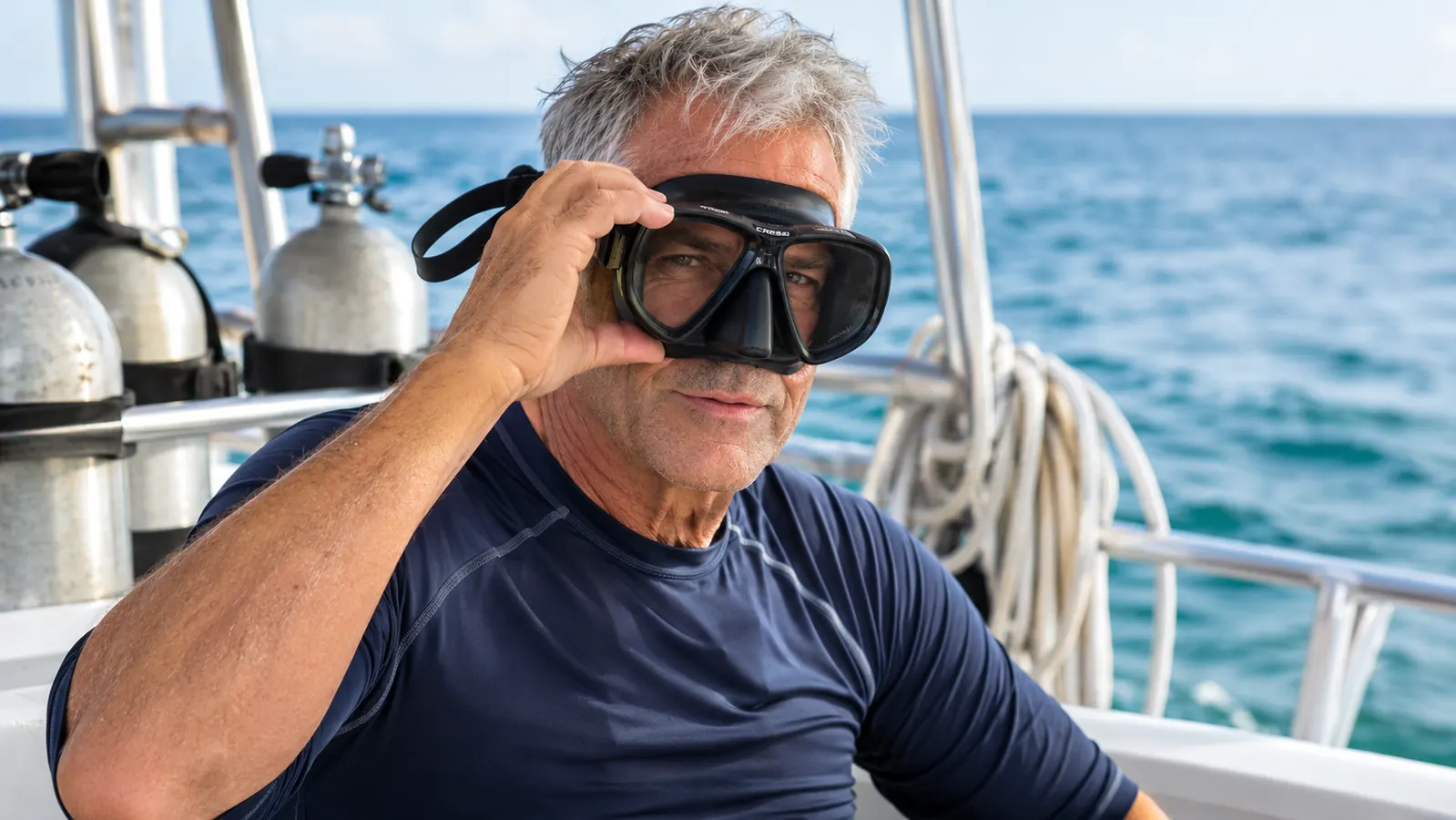
The mask that leaks is usually not the mask that is broken. Mine seeped at the right cheek for six years, a slow cold trickle that I blamed on the glass, on the dive, on the cold water, on anything except the fit. It was the fit, and the old mask was never going to fit me. The Matrix fixed that, and five habits keep it sealed.
I dive out of Tavernier, mostly 20 to 60 feet, and for the last three years and about 180 dives I have worn a Cressi Matrix. It replaced a single-window mask I had used for six years, and it is the mask I reach for on every scuba dive, charter or shore. What follows is the routine that keeps water on the outside of it. The habits work with any mask. I am just telling you where I learned them, and what this mask does and does not do.
The mask that finally stopped the seep at my right cheek
The Cressi Matrix is the mask on my face for every scuba dive, charter or shore, about 180 of them now. Two lenses, soft silicone skirt, adjustable buckles, 6.4 ounces, 2-year limited warranty.
Amazon Check Today's Price on Amazon →Why a Mask Leaks Before You Blame the Mask
Water almost never comes through the lens. It comes around the skirt, the soft silicone edge that sits on your face, and on most divers it comes in at the same three places: beside the nostrils, at the corners of the upper lip, and along the top of the brow where the strap is pulling the frame forward. Figure out which of the three it is and you have solved most of the problem before you get wet.
A mask does not seal because you press it on hard. It seals because the skirt flares outward and a small difference in pressure holds that flare flat against your skin. Crank the strap down and you flatten the flare before you ever leave the swim step. Break the flare and the seal is gone. I have watched divers reef on the buckles at the bench and then spend a whole dive dealing with water in the mask, and the fix was always to loosen the strap, not tighten it.
The second thing to understand is that a skirt is a shape, and faces are shapes too. A mask that leaks on you can be perfect on the diver next to you. Nothing in this article will make a mask that does not fit your face seal, which is why Step 1 matters more than the other four combined.
Step 1: Test the Seal on a Dry Face Before You Ever Get Wet
Do this dry, at the kitchen table or on the boat bench, before the mask is wet. Leave the strap loose and hanging, press the mask lightly to your face with one hand, and draw a little air in through your nose and hold it. The skirt should pull in against your skin and stay there when you take your hand away, and you should feel nothing at the edges. A faint hiss at the cheek or under the eye tells you exactly where the water will get in.
The listing for the Cressi Matrix says the skirt is hypoallergenic soft silicone, shaped wide to give a broad sealing surface. That is the seller talking, but it matches what I found with the mask in my hand. The edge is soft enough to sit flat along the cheekbone without a hard frame digging in, and the two lenses sit close to the face, so there is not a lot of air inside to move around. A soft skirt forgives a face that is not perfectly symmetrical. A stiff one does not, and you will know it inside thirty seconds.
No mask fits every face, and the Matrix is no exception. If the skirt edge lifts when you smile, or the bridge sits on your nose instead of around it, that mask is not yours and no amount of strap tuning will fix it. Try a buddy's mask before you buy, or buy from a shop that will take a mask back after a pool session. Ten minutes spent trying masks saves more dives than any bottle of defog.
Step 2: Set the Strap Across the Crown, Above the Ears
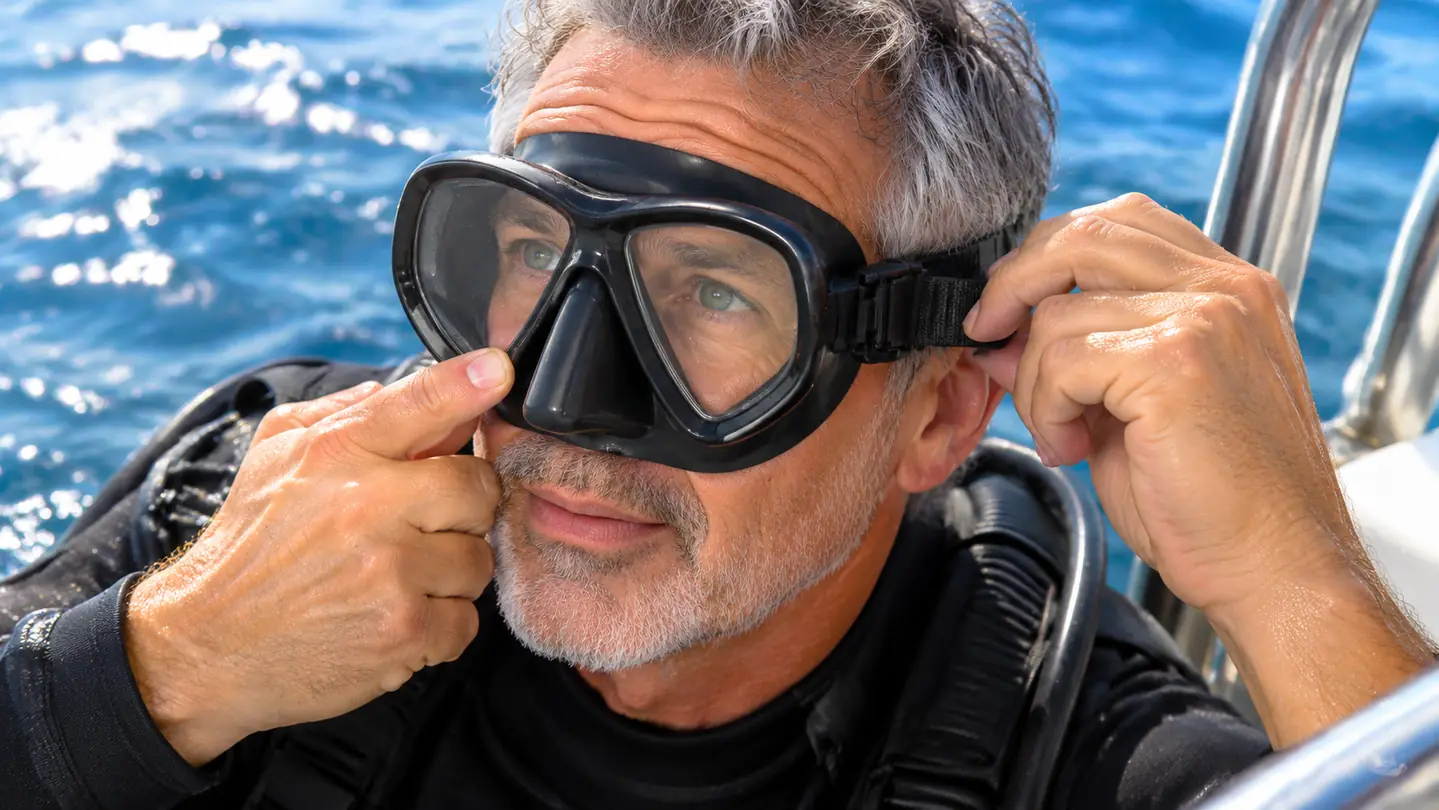
The strap belongs high, across the widest part of the back of your head, above the ears. Not low, across the base of the skull, which is where it slides and where it drags the top of the skirt down your forehead. Set it snug enough that the mask stays put when you take your hand away, and no tighter. Two fingers should still slide under the strap at the crown. If they will not go, it is too tight.
The Cressi Matrix has adjustable buckles, and here is the whole point of them: you adjust them once. My first dive with the mask was a two-tank charter. I moved the strap a notch between those two dives, and I have not touched it since, across about 180 dives. It lives in the bag with the strap set where I left it. I do not re-tune it on the boat, I do not fiddle with it at the surface, and nobody else moves it.
The symptom of an over-tight strap is easy to read after the fact. You come up with a deep groove across both cheeks and a red band on your forehead, and the skirt has been flattened against your face the entire dive. Loosen it a notch before the next one. It will feel almost loose on the surface, and it will seal better at depth, because the water pressure down there does the work the strap was trying to do.
Step 3: Get Hair, Hoods and Collars Out of the Skirt Line
I am clean shaven and I keep my hair short, and I still run a finger around the seal line before every entry. One hair under the skirt edge is enough to open a channel, and the place it happens to me is the top of the brow, where the hair is fine and I cannot feel it. A moustache, a beard line or a fringe under the frame does exactly the same thing.
Hoods are the other culprit. A neoprene hood edge that folds over on itself under the skirt makes a gap you will not see from the outside. Smooth the hood flat, pull the skirt down onto it, and run the finger around again. Same story with a wetsuit collar that rides up at the back of the neck and pushes the lower edge of the skirt forward.
That is the only leak I have had with the Matrix. A few dives in, on a shore entry, I got a slow seep at the right cheek. I checked the skirt line at the surface, found hair caught under it, cleared it, and that was the end of it. A mask that starts leaking after months of behaving is almost always a hair, a hood fold, or a strap that has moved. It is almost never the glass.
Step 4: Prep the Lens So You Leave the Mask Alone Underwater
A fogged mask makes you fiddle, and every time your hand goes to the skirt you push water under it. New tempered glass comes out of the factory with a film on the inside of the lens. Scrub both lenses inside and out with plain white toothpaste and a soft cloth, rinse, and repeat two or three times before the first dive. No flame. I do not care who does it on the dock. A flame on a lens is a fine way to ruin a mask you just bought.
For defog I use a drop of mild dish soap, rubbed on the inside of the lenses, then a quick dip to rinse the excess off. It works on every dive and a small bottle lives in the bag. The factory coating on my spare mask did not survive the first handful of dives, and I do not expect coatings to last. I prep every mask the same way, soap and water, and then stop thinking about it.
The real rule is the one nobody wants to hear. Once the mask is on and sealed, leave it alone. Do not pull it down to look at something, do not lift the skirt to let a little water out, do not slide it up to wipe your face. I never take a mask off underwater. On a sand hunt, kneeling on the bottom to dig, the mask stays on my face the whole time, and that is a rule I do not bend for anything.
Step 5: Rinse, Dry and Store It So the Skirt Stays Soft
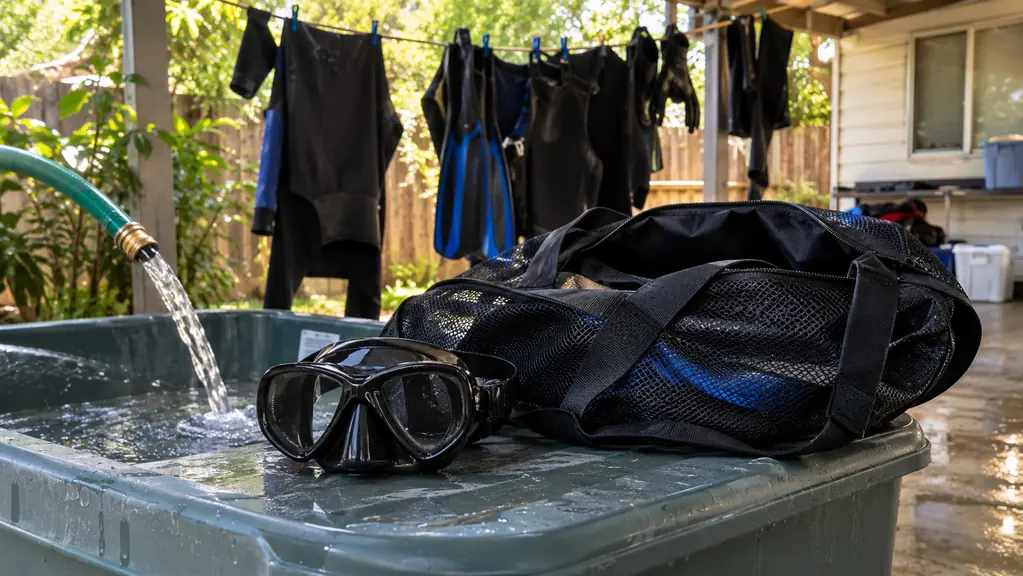
Silicone takes a beating from salt, chlorine and sunscreen. After every dive the mask goes into the rinse tub under my carport when I get home, fresh water, a few minutes of soaking, the skirt worked open and closed a couple of times so the water gets into the folds. Sunscreen is the worst of the three. Rinse it off before it dries on the skirt.
Dry it in the shade. Not on the dashboard, not hanging off the mirror of the 4Runner. Sun ages silicone and turns a soft skirt stiff, and a stiff skirt leaks. My Matrix rides in the mesh duffle rolled in a towel, with no hard case, and nothing heavy gets stacked on top of it. When it comes off my face it goes down lens up on a towel, never face down on the deck where somebody steps on it.
Before each trip I look at the strap and the buckles. A strap breaks without warning. About ten months ago a buddy of mine was gearing up on the bench on a morning charter out of Tavernier and his strap snapped in his hands, and nobody aboard had a spare strap for him. That is why there is a second mask in my bag. The Matrix carries a 2-year limited warranty, which is worth having, but a warranty does not help anybody on a boat with one dive left in the day.
What Else Helps
Low internal volume does more for a mask than most divers give it credit for. There is less air inside the Cressi Matrix to shift around, which means less air to clear when water does find its way in. The lenses are inclined tear-drop shapes, a Cressi patented design, and the downward view is the part I use on every single dive: my gauges without tilting my head back, and the sand in front of me when I am hunting. The listing claims a wide field of view laterally and low, and the low half of that claim is the one I would stand behind.
It weighs 6.4 ounces by the listing. That matters less than it sounds on a scuba dive and more than it sounds on a long snorkel, when you are holding your face in the water for an hour. The honest faults, since you asked: the lenses sit close to the face and it took me a few dives to stop noticing the frame edges, it costs real money against a budget mask, and it will not fit every face. Run the seal test in Step 1 before you spend anything.
The rest of the fix is boring gear discipline. A mesh bag that drains means the mask is not sitting in a puddle on the ride home. A second mask means a snapped strap costs you one dive instead of one day. A small bottle of dish soap means you never dive a fogged lens. None of it is expensive, and all of it beats a wet face in cold water.
One strap adjustment between the two dives on my first charter with it. About 180 dives later, the strap has not moved since.
If your mask has seeped on every dive this season, stop tuning the strap and check the seal line
Dual lens, low internal volume, soft silicone skirt, 6.4 ounces, 2-year limited warranty. Mine has about 180 dives on it and the strap has not moved since the first week.
Amazon Check Today's Price on Amazon →