

A two-lens mask is a bad place to cut corners and a worse place to overspend. I have worn the Cressi Matrix on every scuba dive I have made for three years, about 180 of them, most out of Tavernier on the charter boats and a good many off the beach on sand hunts. The ScubaPro Spectra I have never had on my face. Nobody in my club dives one, so everything I tell you about the Spectra comes off its published listing and nothing else. That is a real limit and I will keep reminding you of it rather than pretend otherwise.
So here is the short answer. If you want the lighter mask, the longer warranty and the lower cost, and your diving is mostly reading gauges and looking down at sand, the Cressi Matrix is the one I would put in your hand. If you dive bright water, fight glare at the surface, and want pushbutton buckles you can work with gloves on, the ScubaPro Spectra earns its extra weight and its extra money on paper. Neither is a bad mask. They are built for slightly different afternoons.
How I Am Judging a Mask I Use at 60 Feet
I got certified Open Water at 47, so I am 14 years in with about 400 logged dives. My water runs 20 to 60 feet. I see wrecks from the outside and I stay inside recreational limits. That is the whole of my authority, and it is enough to tell you how a mask behaves on a working dive, which is what most people actually do with one.
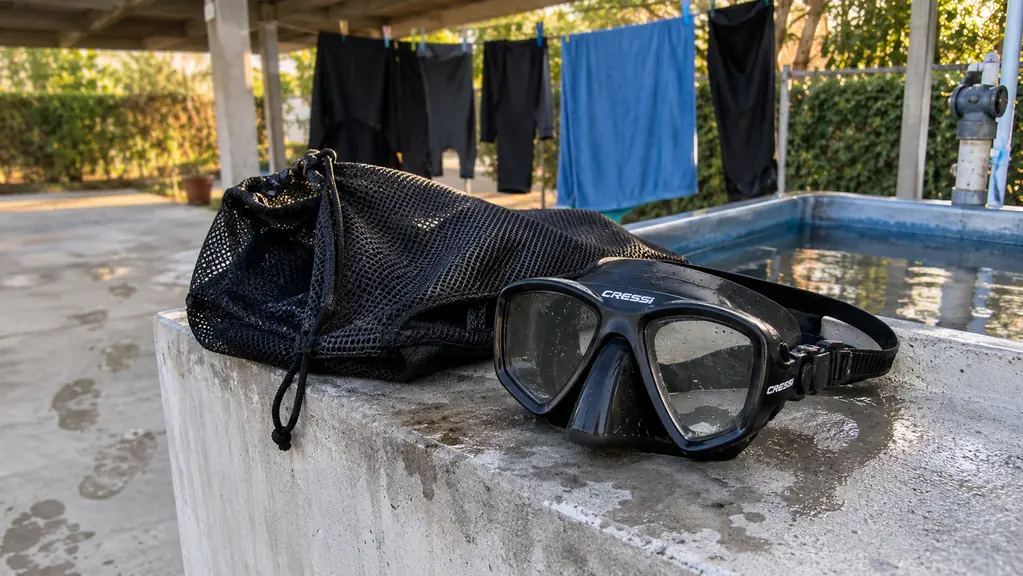
The Matrix replaced a high-volume mask with one big window that I had used about six years and that had started seeping at the right cheek. The Matrix went straight onto a two-tank charter. I made one strap adjustment between those two dives and I have not touched the strap since. Three years and about 180 dives later, the only leak I get is the odd seep when hair works under the skirt, and I check for that now before I go in. It rides in my mesh bag rolled in a towel, with no case.
That old mask is worth one more minute because it is the reason I am fussy. A single big window, six years on it, and it started seeping at my right cheek on a two-tank morning in January when the water was 71 degrees. By the second dive I was clearing it every few minutes and missing the top of the reef wall while I did it. A seeping mask does not ruin a dive, it eats it, one clear at a time. I did not want to spend another season doing that, which is why the first dive on the Matrix mattered more to me than any spec sheet.
Everything about the Spectra is paperwork. Two mirrored tempered glass lenses. A double-sealed silicone skirt. Pushbutton buckles. About 8 ounces. A plastic storage case in the box. A one-year warranty. I have not held it, I have not seated one on my face, and I have not looked through those mirrored lenses in the water. Cal has not either. Treat the Spectra side of this comparison as a man reading a spec sheet out loud, because that is exactly what it is.

Cressi Matrix vs ScubaPro Spectra, Side by Side
Read the table the way I read any spec sheet, which is to look for what is missing before you look at what is there. One row is a flat tie in my book because the two masks are answering different questions. Four rows go to the Spectra and I am not going to soften that. The rest go to the Matrix.
| Cressi Matrix | ScubaPro Spectra | |
|---|---|---|
| Lenses | Two inverted tear-drop tempered glass lenses, set at an incline, Cressi patented shape | Two mirrored tempered glass lenses |
| Downward view | Inclined tear-drop lenses widen the view in the lower zone, built for looking down | Not listed |
| Internal volume | Extremely low, on par with freediving masks, so less air to clear | Not listed |
| Skirt seal | Hypoallergenic soft silicone skirt with a wide sealing surface | Double-sealed silicone skirt |
| Buckles | Adjustable buckles | Pushbutton buckles |
| Weight | 6.4 ounces | About 8 ounces |
| Storage case | Not included | Plastic case included |
| Warranty | 2-year limited | 1 year |
| Cost | Roughly half the Spectra | About twice the Matrix |
| Best for | Reading gauges, working sand bottoms, light travel kit | A diver who wants mirrored lenses and pushbutton buckles, and a case in the box |
Where the Cressi Matrix Wins
Weight first, because it is the number I can feel. 6.4 ounces against about 8. A mask is not what tires your neck at the end of a two-tank morning, but every ounce on your face is an ounce you notice on the third dive of a long day. Warranty second: two years limited against one. If a buckle or a strap fails in year two, that matters, and it is the kind of thing that fails in salt water. Cost third, and I will only say this much, that the Matrix runs roughly half what the Spectra does. If you are outfitting yourself from nothing and still need a light, a bag and boots, that difference is gear you can actually hold in your hands.
The lens shape is the part I would miss if I went to another mask. The lenses are inverted tear-drops and they are set at an incline, so the lower part of the window sits closer to your cheeks and gives you a longer look down. On a sand hunt I am kneeling on the bottom reading the texture of the sand under me, and I need that look down. It matters at a safety stop too, when a gauge is in my hand and I would rather not hold the whole mask at an angle to read it. The listing calls that shape a patented design and I have no reason to argue with it.
One honest fault, and it took a few dives to notice it. The lenses sit close to your eyes, which is the whole point of low volume, and for the first three or four dives that closeness felt like the mask was on tighter than it was. I kept checking the strap. Somewhere around the fifth dive I stopped thinking about it. If you are coming off a big single window, give it a handful of dives before you make up your mind, and do them shallow where a moment of fuss costs you nothing but a clear.
Volume is the quiet one. The listing puts internal volume on par with freediving masks, which is as low as a two-lens mask gets. Low volume means less air to clear, and that is the only claim I will make for it. The skirt is soft silicone with a wide sealing surface, and on my face it seats with a strap that is snug and not tight, across the crown of the head and above the ears. Tight straps cause leaks. That single adjustment I made on the first charter was me loosening it, not tightening it.
Three years, about 180 dives, one strap adjustment between the first two tanks, and the strap has not moved since.
Where the ScubaPro Spectra Wins
Pushbutton buckles are the cleanest win on the Spectra sheet, and I will not pretend otherwise because my own mask has plain adjustable buckles. I wear 3mm gloves from November through April and on any rough entry or sand hunt, and a pushbutton is the difference between squeezing two buttons and feeding a strap back through a slide. Over a season that is a small thing done many times with cold hands on a moving deck. If you dive gloved, that row is worth more than the weight row.
I can give you the specific moment. On a morning charter the boat is on a mooring, the deck is wet, and six people are gearing up at once on the same bench. That is where the listing's pushbutton buckles sound handy, two buttons pressed once and you are done. My strap has stayed where I set it for three years, so I have not needed that, but a diver who adjusts a mask often might.
Mirrored lenses are the other honest win. The listing says mirrored and I will take it at that. The listing calls the view glare-free, and I have no way to test that from a product page. The skirt is double-sealed, which is one more line of defense against a seep than I have. And a plastic storage case comes in the box. I had to go buy a case separately for my second mask, so I know what that errand costs you in an afternoon. A mask that ships with one is a mask you can throw in the back of the 4Runner without wrapping it in a towel first.
The Mask I Have Not Had to Adjust in Three Years
Two lenses, low internal volume, a strap I set on the first charter and left alone. The Cressi Matrix is the one that goes on every scuba dive I make. Check today's price on Amazon, then do the seal test before you commit to any mask.
Amazon Check Today's Price on Amazon →What Neither Listing Will Tell You
No spec sheet anywhere will tell you whether a mask fits your face. Fit is the seal, and the seal is the only thing that decides whether you have a good dive or a wet one. Seat the skirt on your bare face with the strap hanging loose and let the skirt hold suction on its own. If it does not, no buckle design and no warranty length will save it. This is why I tell people to try a mask before they fall in love with a row in a table, mine included.
The toothpaste scrub is not folk wisdom, it is the only way I know to strip the release agent off a new tempered lens. A pea-sized dab of plain white paste, no gel and no grit, rubbed with a fingertip for two or three minutes across both sides of the glass, then rinsed clean. The flame trick I have never used and will not recommend to anyone. If a lens still fogs after the paste, that is a defog problem, not a lens problem.
The rest is housekeeping that both masks need and neither listing mentions. Defog with a drop of mild dish soap and a fresh water rinse, every time. Keep hair out of the skirt, which is the one leak I still get. Rinse the mask at the tub after the drive home, not at the dock, and let it dry out of the sun. None of that is brand specific and all of it outlasts the mask.
Who Should Buy Which
Buy the Cressi Matrix if your diving looks like mine. You work 20 to 60 feet, you read your own gauges, you spend time looking down at sand or at the bottom of a wreck, and you want the lightest thing on your face that still seals. You want two years of coverage instead of one and you would rather put the difference into a light or a spare strap. You are not fussy about a case, or you already have one. The Matrix has been that mask for me for about 180 dives and I have not been tempted to change it.
Buy the ScubaPro Spectra if your diving is bright and your hands are covered. You dive the shallows on sunny mornings, you fight glare on the surface, you wear gloves on the ladder and on the line, and buttons beat buckles for you. You like a case in the box and you do not mind a few more ounces on your face or a shorter warranty. That is a coherent set of priorities and the Spectra answers all of them on its listing. It just is not the mask I would carry on a sand hunt.
One last thing, and it is the least popular advice I give. Whichever you pick, buy it for the face you have and not the diver you read about. The Matrix fits me. That is a fact about my face, not a promise about yours. Seat it, seal it, and if it seeps at the cheek the way my old one did, send it back and try again. That is the only comparison that ends with you dry.
If You Read Gauges and Sand, Start With the Mask I Wear
The ScubaPro Spectra takes the buckles, the mirror and the case. The Cressi Matrix takes the weight, the downward view, the warranty and the cost. If that second list is the one you need, this is where to look at it.
Amazon See the Cressi Matrix on Amazon →