
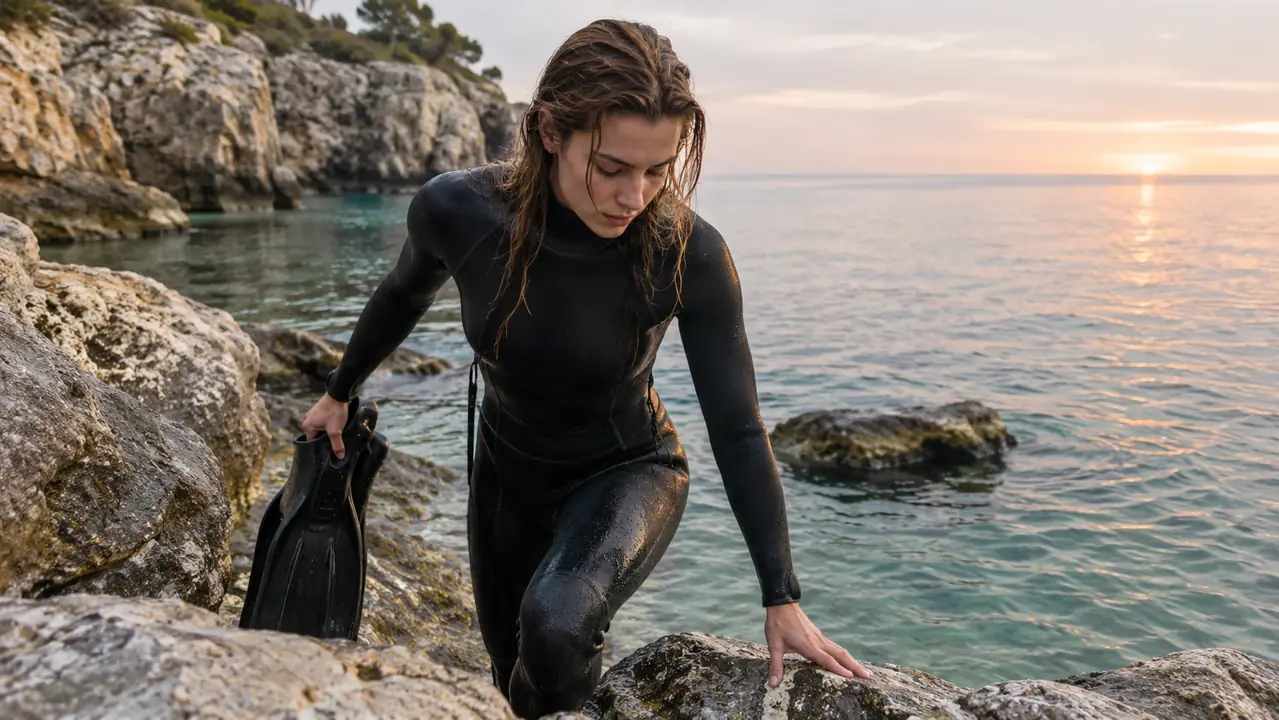
Nine out of ten hand injuries I have seen on a shore dive happened above the waterline. Not at depth, not on the swim out. On the rocks, in the twenty feet between the 4Runner and the sea. You are carrying fins in one hand, you put the other down to steady yourself, the limestone is wet and sharp, and the swell picks that exact second to push. I have torn a thumbnail open that way. I have also watched a grown man slice his palm on an urchin spine because he went in barehanded and put his hand down where he could not see it.
Fourteen years and about 400 logged dives into this, I stopped treating my hands as expendable. The pair I wear now is a set of XUKER neoprene water gloves, the 3mm version, five finger. I have had them about 18 months and roughly 90 dives, mostly on rough entries, ladder climbs and sand hunting. They are not the warmest glove you can buy and I will get to what they do not do. What they are is a sensible first purchase for a diver who is tired of coming home with cut knuckles.
Gloves that survive the rocks, not just the cold
The 3mm XUKER water glove is what I wear from November through April and on every limestone entry in between. Five finger, glued and blind stitched seams, sizes XS to 2XL.
Amazon Check Today's Price on Amazon →The Part of the Dive Nobody Plans For
Ask a dive shop what sells the most gloves and they will tell you it is cold water. That is half the story. The other half is the entry. Down here we have limestone shore entries, boat ladders slick with algae, mooring lines crusted with barnacles, and sand that hides broken glass and rusted can tabs. None of that is cold water territory. It is abrasion territory, and abrasion does not care how tough you think your hands are.
I went through a phase of cotton work gloves. They are worse than bare hands once they are wet, because wet cotton holds grit against your skin and grinds it in with every movement. Neoprene at least stays where you put it and does not soak up sand. That is the whole reason the XUKER pair lives in my bag now, and has for 18 months.
The dive club I belong to runs a shore entry most weekends through the winter. Cal and I keep a running count of who shows up barehanded and who does not. It is never a mystery who is asking for a bandage at the tailgate afterward. Cold is not what gets them. It is a barnacle on a ladder rung, or a rock that rolls when they put weight on it.

The Five Steps I Run Before Every Rocky Entry
Step 1: Size the glove before you size anything else
A glove that is too big is worse than no glove at all. It fills with water on the entry, it slides when you weight it, and the extra material at the fingertips catches on every edge you grab. The XUKER runs from XS to 2XL with a pre-shaped ergonomic cut and five separate fingers. The fingers matter more than they sound. A mitt keeps you warmer and takes away your ability to work a clip.
Measure around the widest part of your hand, across the knuckles, not around the fingers. If you land between two sizes, take the smaller one. Neoprene gives a little once it is wet, and a snug glove stays put when you pull yourself up a ledge. Mine are a small, and they were tight for the first two dives and right after that.
Then check the closure with the glove on. These use a hook and loop strap at the wrist, and it needs to sit flat over the cuff of your wetsuit. If you cannot get the strap flat against the suit, the size is wrong, whatever the chart says.
Step 2: Check the seams before you trust them
Neoprene gloves die at the seam. Not at the fingertips, not through the panel. The seam goes first, and it goes because of how the glove was built. On this pair the panels are glued and blind stitched, which means the needle does not run all the way through the material. There is no line of thread sitting on the outside waiting to be rubbed open on limestone.
Before the first dive, turn each glove inside out and run your thumb along every seam. You are feeling for a gap in the glue, not for a loose thread. Then flex the fingers hard, twenty times, and look again. A seam that opens at the kitchen table would have opened on the rocks, and it is a lot easier to deal with at the kitchen table.
I do this check at the start of every winter season. Eighteen months and about 90 dives in, the seams on my pair are still closed. That is not a promise about yours. It is just what mine have done, and I rinse them every single time, which is most of the reason.
Step 3: Retrain your hands on land first
Three millimeters of neoprene takes away most of your fine feeling, and the first thing you lose is not your grip. It is your clip. Mask strap buckles, the clip on your gauge console, the dump valve on your BC. Practice all of it with the gloves on, sitting in a chair, before you try it on a boat in a chop.
On the sand it matters more. When I am hunting with the Nokta PulseDive I cannot feel a target through the glove, so I stopped trying. I fan the sand with gloved fingers and let the pinpointer tell me where the metal is. Bare hands on a shell bed come back cut. It is that simple.
The other thing to practice is your own mask. Clearing a flooded mask with a gloved hand is a different motion than doing it bare, and you want to find that out in a living room, not at 40 feet with a nose full of salt water.
The panels are glued and blind stitched, so there is no line of thread on the outside for limestone to chew through.
Step 4: Seal the wrist and stop the pump
Water inside a glove is worse than water outside it. If the cuff is loose, every hand movement pumps cold water in and out, and by the end of a January dive your fingers are useless. Water here runs about 71 degrees in January and I feel every bit of it at 61.
Fasten the hook and loop strap over the wetsuit cuff, snug but not tight enough to throb. If you can slide a finger under the strap without effort, it is too loose. If your hand goes numb while you are still on the surface, it is too tight, and that is a bad way to start a dive.
Do not tuck the glove under the suit cuff. It looks neat in a photo and it defeats the seal, because the water runs down the sleeve and straight into the glove. Glove goes on last, over everything.
Step 5: Rinse, dry and store them like they cost you something
Salt is the enemy of every soft piece of gear I own and neoprene is no different. Fresh water rinse after every dive, inside and out, with the gloves still on your hands so the fingers open up and the water gets into the seams. Hand wash only. No machine, no dryer, no detergent.
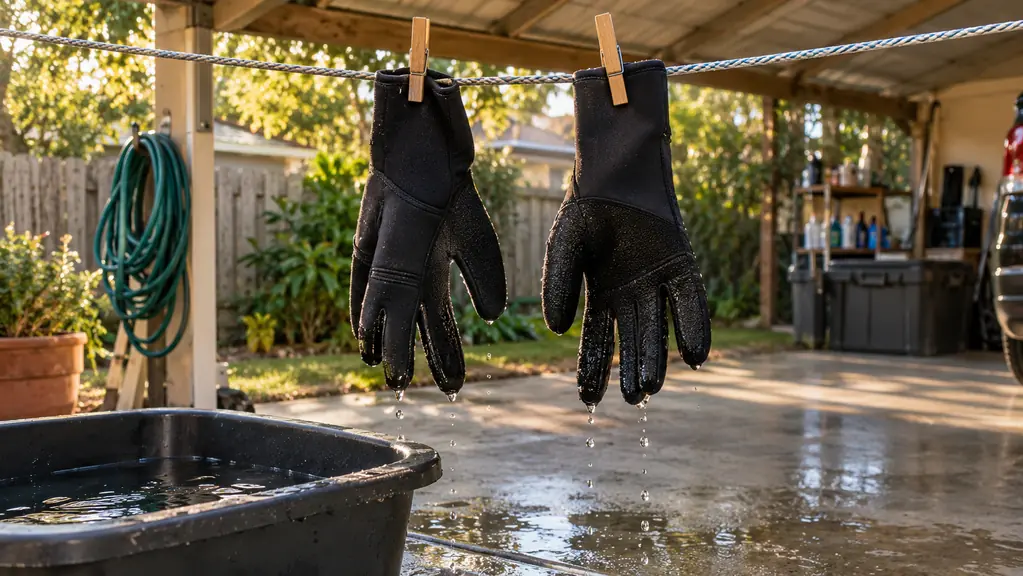
Drying is where people ruin them. Hang them by the fingers on a line in shade with air moving. Mine go on the clothesline under the carport next to the boots. Direct Florida sun bakes neoprene until it goes stiff, and a stiff glove tears at the seam the first time you pull it on.
Store them flat, not crumpled at the bottom of a bag with weights sitting on top. My Bulex duffle drains, which helps, but I still lay the gloves on the pile rather than under it. Once a season, turn them inside out and do the seam check again. That is the whole maintenance routine and it takes four minutes.
What Else Helps
Gloves are one link in a chain and the other end of that chain is your feet. I wear zippered neoprene boots with an anti-slip rubber sole on every dive now. On wet limestone the difference a real sole makes is bigger than the difference a glove makes. Thin surf booties look like enough until you try to walk down a rock ramp in them.
Entry technique beats gear every time. Three points of contact, always. Turn your body sideways to the swell instead of facing it. Carry your fins by the straps rather than in a closed fist, so you can drop them and grab rock with the same hand. Watch where the water drains off the rocks, because that is where the algae grows and that is where you will go down.
Cal goes down the rocks first and calls the sets for me. That is worth more than anything I can buy. A light helps too, and I use a rechargeable one on night dives and for looking under ledges in daylight. It does not replace looking. Gloves protect skin. They do not protect you from an urchin you never saw.
One thing I will say plainly. Gloves are for ladders, lines, limestone and sand. They are not a licence to put a hand on the reef. I do not touch coral, gloved or not, and neither should you.
What These Gloves Do Not Do
They are not a cold water glove and they are not dry. Three millimeters is a shoulder season thickness almost everywhere. Here in the Keys it covers me from November through April. If you dive cold water year round you want the 5mm version at minimum, and a dry glove system if the water is genuinely punishing.
They will not keep your hands dry. Water gets in. That is what a wet glove is, and after every dive in them my hands come out wet and wrinkled. What they do is keep the wet off the sharp things.
They will not give you back fine dexterity. Split rings, camera housing latches, the small screw on a fin strap. I take a glove off for some of that, or I do it on the surface before I put them on. Anybody who tells you a 3mm glove leaves their hands as good as bare is selling something.
And they do not last forever. Neoprene stiffens, seams give, and the hook and loop strap is usually the first thing to stop sticking. A pair used hard will get a couple of seasons. Mine are at 18 months and about 90 dives and still going, but I rinse them every time and I do not leave them baking in the sun.
Who This Is For
Recreational divers doing shore entries, boat ladders and sand hunting in water that is cool rather than seriously cold. Hunters who need their fingers to sweep sand and work a pinpointer. Anyone who has come home from a dive with a cut they cannot account for. If that is you, the 3mm XUKER is where I would start, in a size that fits snug, over the suit cuff, rinsed after every dive.
If you dive cold water all year, buy thicker. If you need to work small fittings underwater, plan on taking a glove off for the fiddly parts. That is the honest answer and it has not changed in 14 years of doing this.
Your hands are the only pair you get
3mm XUKER water gloves. Five finger, glued and blind stitched, hook and loop wrist, XS to 2XL. Rinse them, hang them in the shade, and they will outlast the trip.
Amazon Check Today's Price on Amazon →