
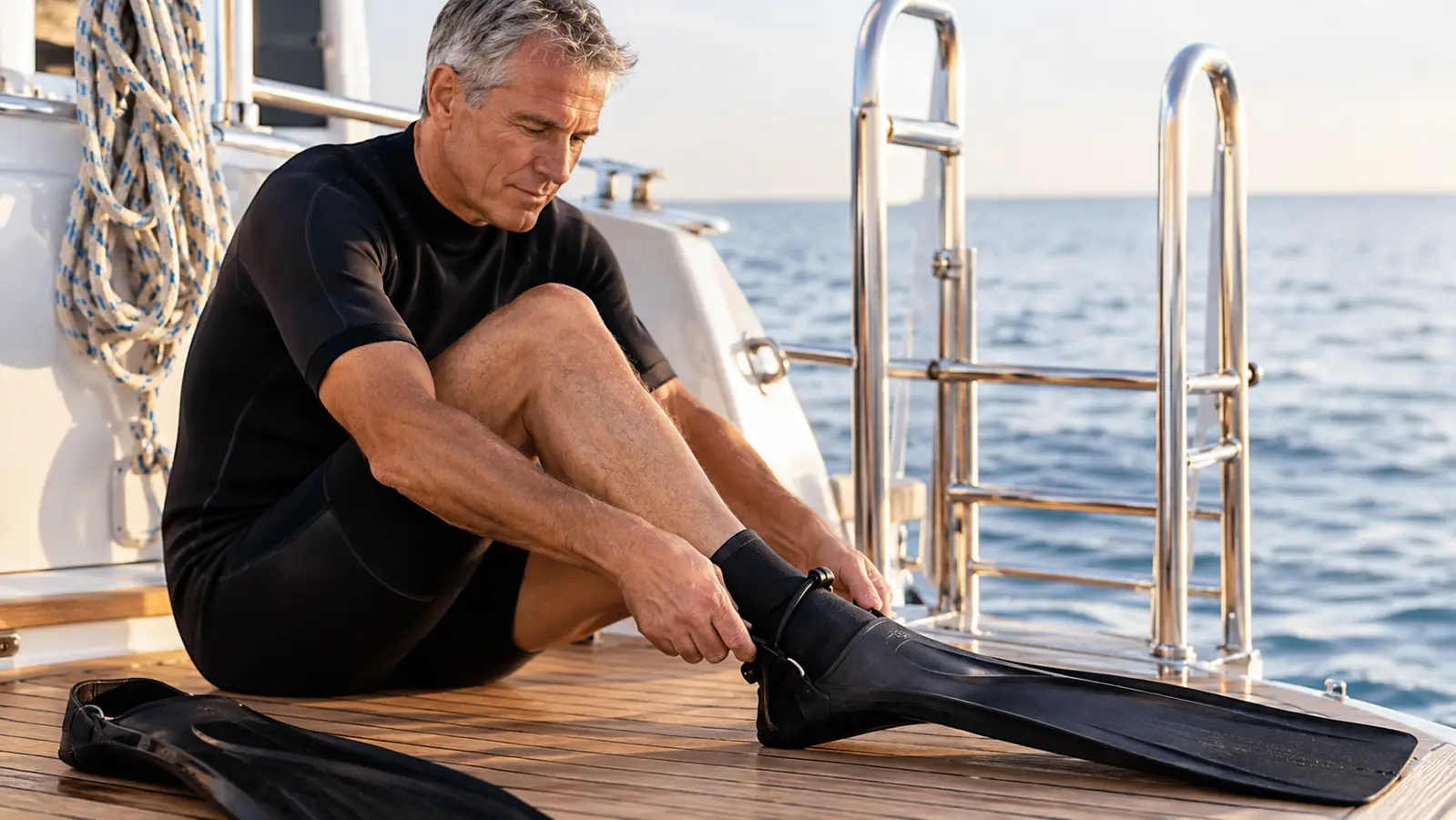
Open heel fins over dive boots should take about ten seconds once you know the order. Most divers fight them because they start with the fin instead of the boot, then crank the strap until the heel stops moving. That works for about one dive. After that the boot creeps forward, the strap rubs the Achilles, and the fin starts to feel like a shoe two sizes wrong. I use the Mares Avanti Quattro + with my Cressi 3mm boots on every scuba dive, and the sequence below is the one I have settled into over about 60 dives with this fin.
I am 61, retired from marine electrical work, and I dive 20 to 60 feet off Tavernier. I am not a gear tester and I do not get free fins. The Mares fin is the one I bought about 12 months ago, after the boots, because I was tired of fighting buckle straps with cold hands. The bungee strap is the reason it came home with me. The fit is still the part that matters most, and a good fin in the wrong boot pocket will still hurt.
The fin is not the place to solve a boot problem. If the boot slides, the fin will slide. If the boot pinches, the fin will press the pinch. I check the boot first every time, and I check it again when the water turns cold and the neoprene stiffens.
Fit the boot first, then let the fin do its job
The Mares Avanti Quattro + is the open heel fin I use with 3mm boots. Check the current size options and today's price before you commit.
Amazon Check Today's Price on Amazon →Step 1: Put the boots on before you touch the fins
Start on the bench, the swim step or the tailgate of the 4Runner. Put both boots on and stand up. A 3mm boot should feel snug around the ankle and heel without pinching the toes. If the heel lifts when you press your weight down, the fin will lift too, no matter how tight the strap is.
Walk a few steps. The anti-slip sole should grip the deck. The zipper should sit flat and the boot should not bunch under the arch. I have had boots that felt fine sitting down and turned into a problem the moment they were wet. The deck is the first test.
The first time I put this fin on was a two-tank charter out of Tavernier on a bright morning with the water sitting at 74 degrees. I had the boots on ten minutes before we tied off, walked the deck twice and sat down. What I found was that the boot's heel seam, not the fin, was the thing to watch. If that seam sits low and flat against the heel, the pocket takes it without complaint. If it rides up even a little, you feel it before the strap is anywhere near the back of your foot.
Keep the zipper pulls and any loose boot material out of the way. A lump under the heel of the foot pocket will make the fin feel short. If you wear a thicker boot in winter, check the fit again. The same fin can feel right with a 3mm boot and tight with a 5mm boot.
Step 2: Open the bungee strap wide, not halfway
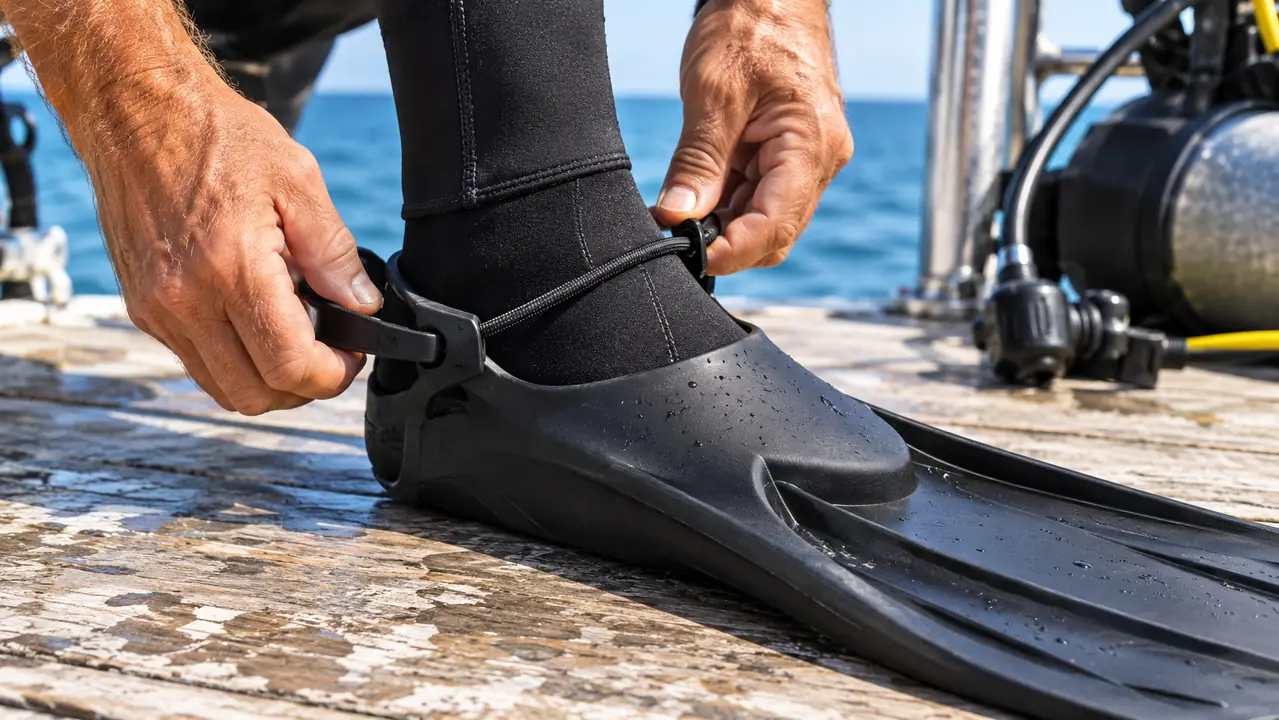
The Mares Avanti Quattro + has a bungee strap. Open it wider than you think you need. The mistake is trying to pull the fin on with the strap already near its working tension. That stretches the foot pocket across the top of your foot and makes the boot bunch at the heel.
I learned that part the hard way. On my first charter with these fins I sat on the bench and shoved. The boot went in crooked, and I had to pull the whole thing off and start over while the boat sat on the mooring. Two minutes I did not need to spend. Now I set the fin across my knee and only then bring the boot down into the pocket.
On a charter I sit on the bench, rest the fin on my knee and open the strap with both hands. On a shore entry I do the same thing in waist deep water, with the fin floating in front of me. I do not stand on one leg in the surf and wrestle it on. That is how people lose fins and turn ankles.
My old fins had buckle straps, about 26 inches long, and those are the ones that gave me trouble with cold hands. The Mares bungee is a different job. It still needs to be opened before the boot goes in. A bungee that is already tight will not slide over a neoprene heel.
Step 3: Seat the toe first, then push the heel down
Point your toe and slide it into the pocket until the toe touches the end. Then press the heel down with your palm. The perforated foot pocket on the Mares fin lets water out as the boot goes in, which is why it does not balloon when you push.
Check where the heel sits. It should be down in the pocket, not perched on the edge. If the heel is high, the strap will feel tight even when it is loose. Pull the fin off and start again. Do not fix a bad seat by tightening the strap.
Before I settled on this order I tried pulling the fin on with the strap already hooked over the heel. It can be done. It also folds the boot's heel seam under the strap and leaves a ridge under your arch, and you will feel that ridge on the first kick of the day. Toe first, heel down, strap last is the order that holds up.
The four channels in the blade start behind the foot pocket. You should feel the pocket hold the boot around the instep and the heel, not just across the toes. If one spot burns before you are in the water, that is the spot that will rub at 40 feet. The fit is regular, and the boot has to match it.
Step 4: Set the strap across the back of the heel, not the Achilles
The bungee strap should sit low, across the back of the heel, holding the boot down in the pocket. It should not ride up on the tendon. If you feel it on the tendon, it is too high or too tight.
Check it with a thumb before you commit. Slide your thumb under the bungee at the back of the heel. If it will not go under at all, the strap is too tight. If it slides in to the knuckle, you are close. That test is not exact and it does not replace how the fin feels in the water, but it catches the obvious mistake on the deck while your hands are dry and you are not holding a regulator in your teeth.
Snug is enough. The strap is there to keep the fin from sliding off, not to clamp the boot to your foot. I set mine on the first dive with this fin, made one adjustment, and have not moved it since. That is not a brag. It is what a bungee does when the boot fits the pocket.
Test it before you stand up. Lift the fin with your hand and see if the heel stays down. Flex your ankle. If the strap digs in when you point your toe, loosen it one step. If the fin rocks side to side, the pocket is too wide for the boot, and no strap tension will fix that.
The strap holds the boot in the pocket. It does not hold the fin to your foot. If you feel it across the tendon, it is too tight.
Step 5: Test the fit in the water and change one thing at a time
On a shore entry I walk in wearing the boots, stop in waist deep water and put the fins on there. On a charter I sit on the bench or the swim step. I do not walk backward into the water in fins if I can help it. The first fin goes on, then the second, then I check both heels with my hands.
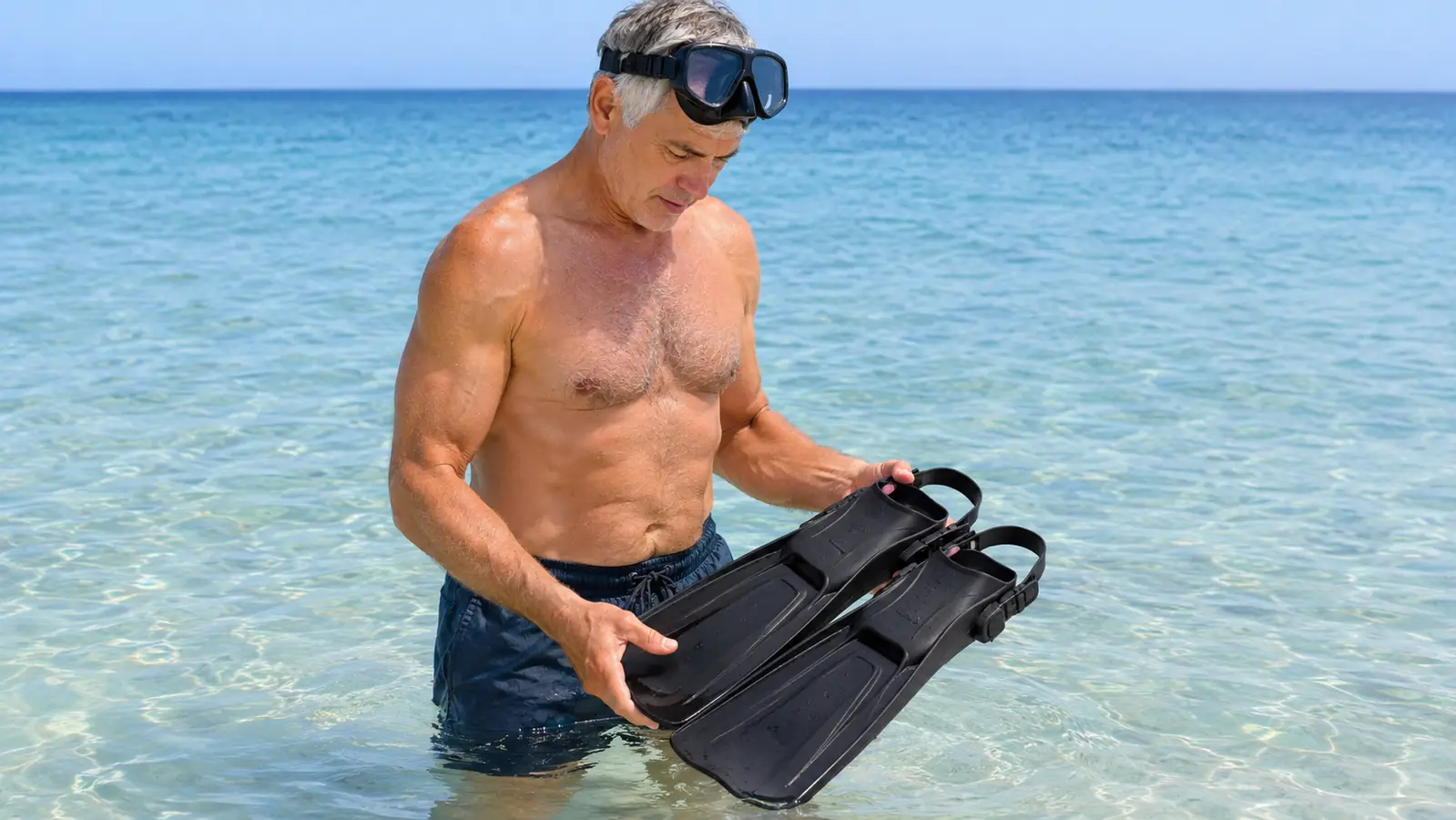
One more check before you drop. Hold both fins out in front of you and look at the heels side by side. If one boot sits deeper than the other, one strap is tighter or one boot is seated wrong. I do this on a shore entry with the mask on my face and the fin tips resting on the sand. It takes five seconds and it has caught a folded heel more than once, always on the second fin, the one I put on faster because I thought I already had the hang of it.
Start with a slow frog kick. The Mares blade has a four-channel design and a fair amount of surface. It will move you with a slow kick if the boot is seated. If the fin feels like it is fighting you, check the heel before you blame the blade. A heel that is not down makes a good fin feel dead.
If the heel lifts, the strap needs taking up. If your toes go numb or the instep burns, the strap is too tight or the boot is too thick for the pocket. Change one thing, swim a minute, then decide. Do not make three changes at once and then wonder which one worked.
At the end, take the fins off in the water, pass them up and climb the ladder in your boots. I never climb a ladder in fins. On the boat, the fins go in the bag, and the boots come off last.
What Else Helps
The boot is half the fit. A 3mm boot that is too loose will slide inside the pocket, and a boot that is too thick will jam the instep. My Cressi boots have a zippered closure and an anti-slip sole. They are about 18 months old now, and they have softened a little but not packed out. If your boots are new, give them a few dives before you decide the fin is wrong.
Boot thickness changes the fit more than anything else you can control. Mine are 3mm, which is what this pocket likes. If you dive a thicker boot in cold water, take the fins with you when you buy the boots, or measure the boot you own and compare it before you order. It is a dull way to spend twenty minutes and it saves a return. I also check my boots for a compressed heel every few months, because a heel that has packed out behaves exactly like a strap that has gone loose.
Fin technique matters after the fit. The Mares Avanti Quattro + is stiffer than a soft snorkel fin. It is not the fin I would pick for a long surface swim, and it is more work on tired legs. With a slow frog kick and a straight ankle, it moves me fine at 20 to 60 feet. With a fast flutter, my calves tell me about it the next day.
Rinse the fins in fresh water at the carport tub after every salt water day. Sand in the foot pocket is the quiet fit killer. I shake them out, rinse the pocket, and hang them on the clothesline under the carport. They do not go in the 4Runner wet if I can help it. The bungee strap does not need oil or grease.
They are heavy in the hand when you carry them down a dock, and the blade is stiff enough that you feel it on a long kick. That is the trade for a fin that moves a diver in current. If you want a light travel fin for warm water and bare feet, this is not that fin. This is a boot fin for working dives.
I keep my old long fins as the spare pair. They have buckle straps and they are not the fins I reach for, but they fit the same boots and they get me in the water if something happens to the Mares pair. A spare fin that fits your boots is worth more than a spare fin that does not.
Get the boot pocket and the strap right, and the fin disappears
The Mares Avanti Quattro + has been my main open heel fin for about 60 dives with 3mm boots. If your boots fit the regular pocket, start with the current size options and today's price.
Amazon Check Today's Price on Amazon →