

There is a moment on a shore entry south of Tavernier where the sand drops away and you have to get your fins on in waist deep water. One hand holds the mask against your face. The other hand holds a fin. The swell is pushing you toward the rocks and you are not standing on anything you want to damage. My old pair of long open heel fins had buckle straps, and every entry turned into a wrestling match with a buckle I could not see. I bought a pair of Mares Avanti Quattro + fins about a year ago to end that fight, and it worked.
They are open heel, standard size, with a bungee strap instead of a buckle. I wear them over my 3mm Cressi boots on every scuba dive and I have about 60 dives on them now. The boots came first, about six months earlier, so they were already softened up when the fins arrived. What Mares got right is the part you touch four times on every dive: the strap. What they got wrong is nothing dramatic, but the weight and the stiffness are real, and a diver with tired legs will feel both.
The Quick Verdict
The bungee strap ends the entry fight and the four channel blade still moves water on a slow kick, but these are heavy, stiff fins and your calves will know it on the second tank.
Amazon Check Today's Price →The strap goes on in one pull. The blade still moves water when you ease off.
Open heel, bungee strap, four channel design, perforated foot pocket. Built for divers who put fins on at the swim step and in waist deep water, not in a parking lot.
Amazon Check Today's Price on Amazon →How I've Used It
Every scuba dive I have made in the past year has been in these fins. Charter boats out of Tavernier, mostly, plus a handful of shore entries and a few night dives on guided trips where the only thing I care about is that a strap goes on in the dark without a fight.
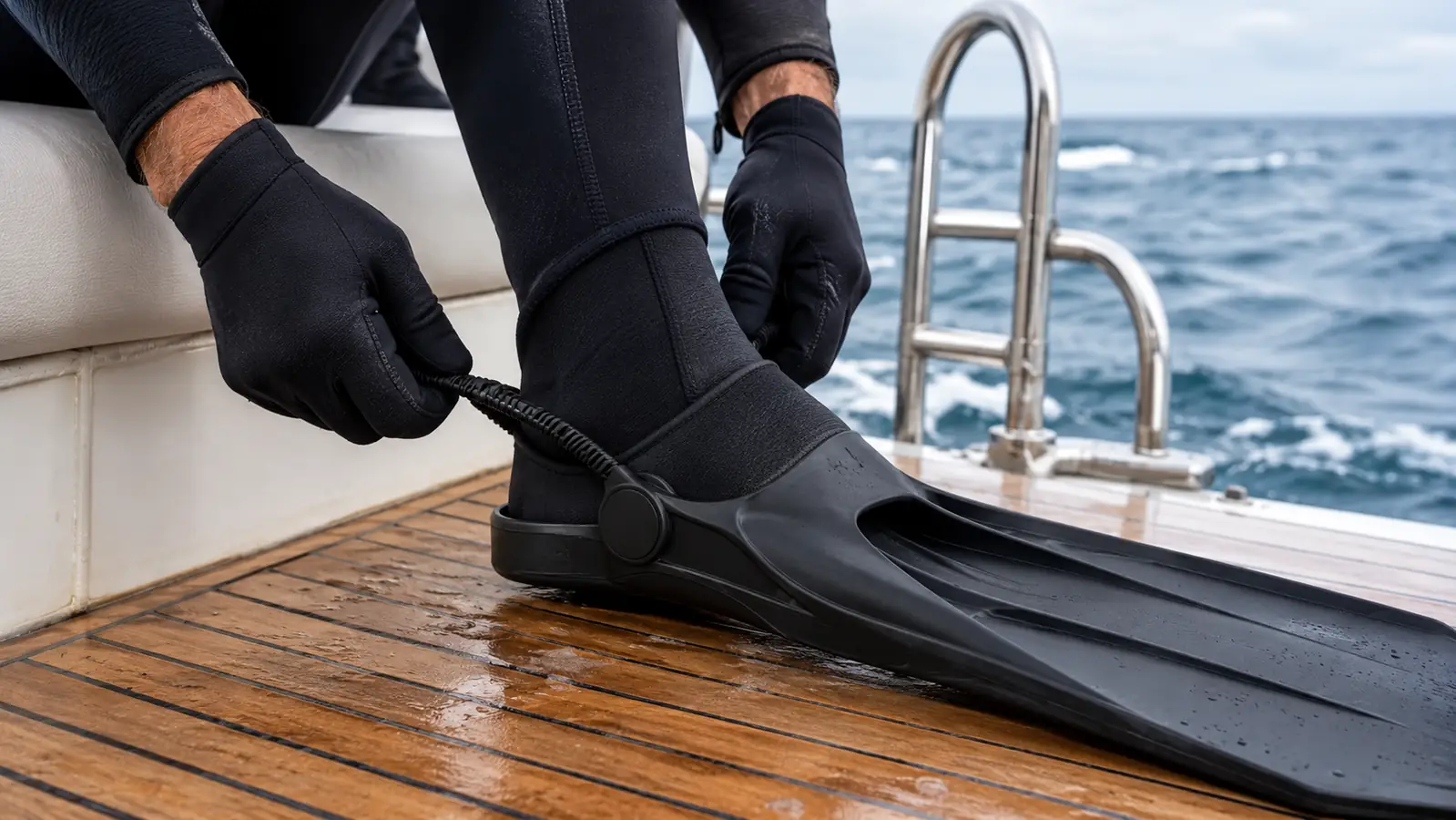
On a charter I sit on the bench or the swim step to put them on. I do not stand and hop. On a shore entry I walk in wearing the boots and pull the fins on in waist deep water, which is the whole reason I wanted a strap I could grab with cold hands. I take them off in the water, pass them up, and climb the ladder in boots. Sixty dives in and I have never once climbed a ladder wearing them.
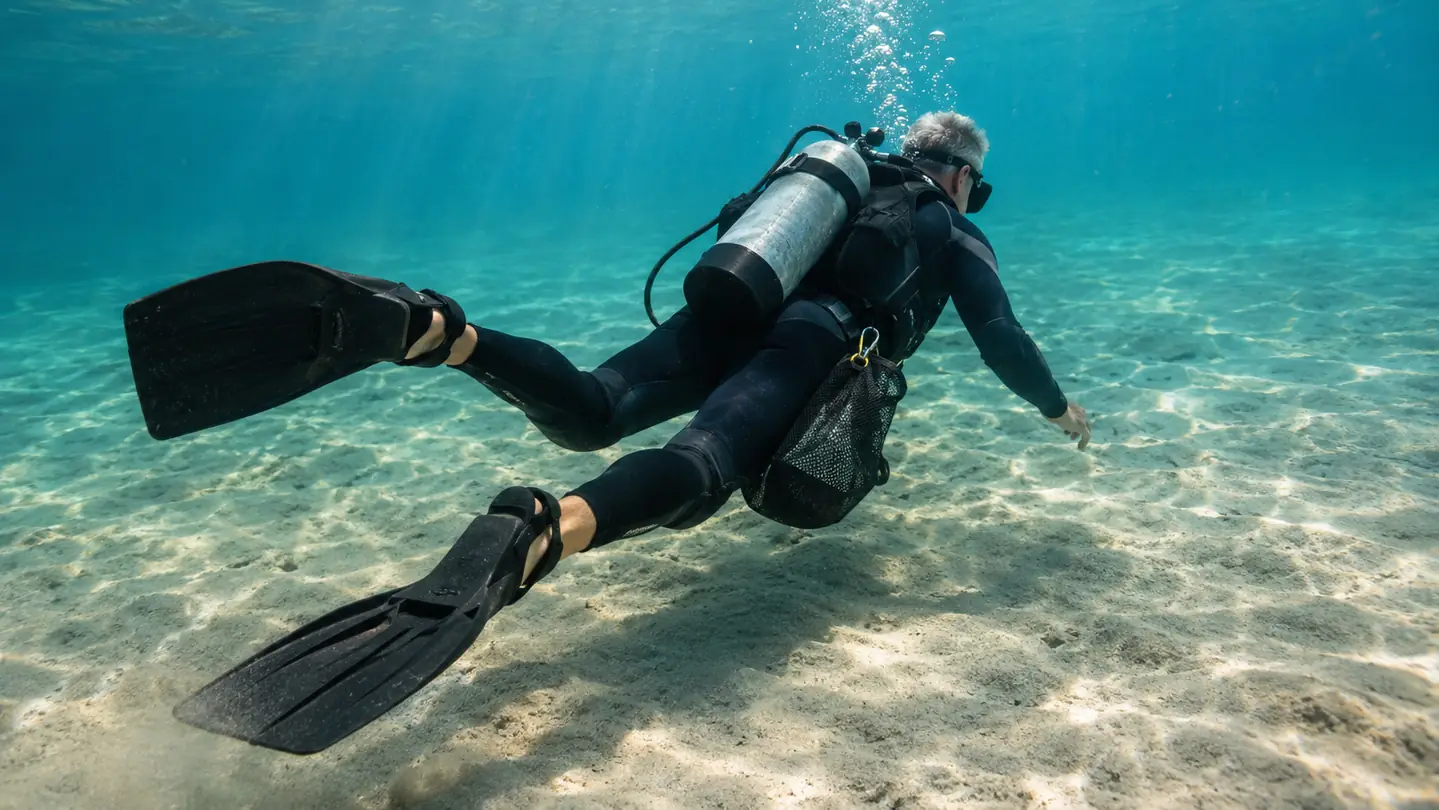
The sand hunts are a different job. Wading waist deep gets no fins at all. When I work a stretch of bottom in 20 to 30 feet looking for lost metal, the Mares go on over the boots and I hold a slow frog kick so I do not fan the sand and lose what I was looking at. A slow kick in a stiff blade still covers ground, and that is the whole argument for a fin like this one.
One morning in March is a fair sample of the rest. The air was cool enough at the dock that I wore a windbreaker over the wetsuit, the water was still in the low seventies, and the charter ran out to a mooring on the outer reef. I sat on the swim step, pulled both fins on, rolled in, and was breathing off the regulator before the rest of the group finished gearing up. Nothing on the fin needed touching. Three years earlier, on a similar morning with the old pair, I had a buckle open a notch, close it wrong, open it again, and the divemaster waited on me at the gate. That difference is the whole purchase. By the third dive the fins stopped being something I thought about at all, which is what you want from a piece of gear you use every week.
Two tank days are where I notice them. The first dive, they feel like nothing. The second dive, my calves have an opinion. That is not a fault exactly, it is what a stiff blade does, but it is the honest reason a diver with bad knees should read the rest of this carefully before buying.
The Four Channels, and What They Do on a Slow Kick
The blade carries four channels down its length. The listing calls them Channel Thrust inserts, and the fin is built around a four rib structure meant to keep the blade from folding away from the water. I cannot measure any of that. What I can tell you is how it behaves on a slow kick in 30 feet of water with a detector in one hand.
It pushes. Not dramatically, but the blade holds its shape through the whole stroke instead of flattening out at the end. When I am easing along a sand line trying not to stir it up, that matters more than top speed. A soft fin at that tempo does almost nothing and you end up kicking harder to cover the same bottom.
Here is the specific case. Last September I worked a line of sand in about 25 feet, moving toward a boat ramp where the bottom is packed shell, bottle caps and the occasional brass fitting off an old dock. A slow frog kick in a stiff blade let me hold a heading over that bottom instead of drifting with the surge, and I covered roughly a hundred yards of it in a little under half an hour without my legs complaining. With the soft fin I keep for snorkel swims I would have kicked twice as often for half the ground, and every one of those extra kicks would have lifted silt onto whatever signal I was following. The blade also recovers well. When I stop kicking to kneel and dig, the fin does not float up behind me and pull at the pocket, which the old long pair did any time I went vertical. That is the perforated pocket and the shorter profile doing their job without being asked.
The back kick is where a stiff four channel blade asks for technique. It works, but you have to keep the blade flat and push rather than flick. The old 26 inch pair I came from were long enough that a back kick went wherever it wanted. These are more predictable, and on a reef wall where I am keeping my distance from the coral, predictable is the only thing I want.
I do not sprint in them and I would not pretend they are a racing fin. They are a working fin, and the four channels are the reason a slow kick still moves a diver carrying a detector, a catch bag and a mask on his face.
The Bungee Strap After a Year
I bought these because of the bungee. My old pair had buckle straps, and the buckles were the part that failed first, usually with cold fingers on a moving deck. The Mares strap is a bungee, and it went on over the boot in one pull from the first dive.
I set the strap once, on the first dive, and I have not moved it since. It felt a little different from what I was used to for about three dives, then it felt normal. A year of salt water, sun on the clothesline under the carport and about 60 dives later, it is still on that same setting.
Cold hands are the real test. I dive January water at about 71 degrees, which is not cold enough for a dry suit but cold enough that fingers stop working properly after twenty minutes. On a guided night dive in February I put both fins on at the swim step without looking at them, in the dark, with a light in my mouth. One pull each and the loop sat where it always sits. That is the reason I bought them and the reason I would buy them again. My old pair with the buckles needed two hands, a light and a flat place to stand, and on a moving deck in the dark that is not always available. The bungee is the small detail that makes the whole thing work, because it does not care whether your hands are wet.
Two things I will say plainly. If the bungee wears out, that is on me, and I keep an eye on it for fraying at the loop. And a bungee does not adjust itself the way a buckle does, so a diver who switches between a thin sock and a thick boot will be resetting it. I wear the same 3mm boots every dive, which is why the setting has never needed touching.
The Perforated Foot Pocket and the Boots I Wear With Them
The foot pocket is perforated, with holes through the sides. That is not decoration. On a shore entry the pocket fills with sand and water and drains out through those holes instead of sitting in there and ballooning. On a charter it means the pocket is not fighting the boot for space when you pull it on wet.
There is no heel pull tab on these, and that is my one small complaint about the design. Getting them off in the water is a two hand job, one on the pocket and one on the heel, and with 3mm gloves on in January it takes an extra second. Not a deal breaker, just the truth.
Fit is listed as regular and that matches what I found over a 3mm boot. There is no slop, no side to side movement and no spot where the pocket rubs. My boots are zippered with an anti slip sole, and the pocket takes them without a struggle. These are not light in the hand when you are carrying two of them down a dock with the rest of your kit.
What a Year of Salt Water Has Done
A year in salt water is a fair test for anything. These have been rinsed at the carport tub after every trip, dried on the line, and thrown in the back of the 4Runner more times than I can count. The blade has not cracked, the pocket has not split at a seam and the channels have not come apart. I expect several more years out of them.
Care is not complicated and I do not baby them. They come off in the water, get passed up, and ride home in the back of the 4Runner wet. At the carport they get a rinse from the tub, a shake, and they hang over the line under the carport until they are dry. Twice I have pulled the bungee loop out to look for fraying where it passes through the fitting, and twice I found nothing. The blade has picked up a few scuffs on the leading edge from limestone entries, which is cosmetic and expected. Nothing has gone chalky, nothing has gone sticky, and the pocket still holds its shape over a boot. If I were diving every day instead of a few times a month I might think differently, but at 60 dives I see no reason to change anything.
They are the second most expensive thing in my kit, after the detector, and I say that as a man who does not spend freely on gear. Whether that is worth it depends on how much you dive. At 60 dives a year they have already earned their place. At 10 dives a year, a cheaper open heel fin would do the same job and you would not notice the difference.
The tradeoffs are real. They are heavy compared to a soft full foot fin, they take up room in the 4Runner, and they are more fin than a snorkel swim needs. When I swim a long line of beach in summer to look over a stretch of sand before I come back to hunt it, I do not wear these. I wear a pair of soft blue full foot fins and I come home without sore calves.
What I Liked
- Bungee strap goes on over a boot in one pull and has not needed a second adjustment in a year
- Four channel blade holds its shape on a slow kick, which is what sand hunting and reef cruising actually need
- Perforated foot pocket drains sand and water instead of ballooning on a shore entry
- Open heel pocket fits a 3mm boot with no slop and no rubbing
- A year of salt water, sun and 60 dives with no cracks, splits or separation
Where It Falls Short
- Heavier and stiffer than a soft full foot fin
- Calves feel it on the second tank of a two tank day
- Second most expensive item in my kit after the detector
- No heel pull tab, so they come off with two hands
- Takes up room in the 4Runner and on the boat bench
I set the strap once on the first dive. A year of salt water later it is still on the same setting.
Who This Is For
This fin suits a recreational diver working 20 to 60 feet from charter boats and from shore, who wears boots and is tired of fighting a buckle at the transom. It suits a diver who hunts sand and needs a slow kick to still move water, and a diver who would rather buy one pair and keep it five years than buy three cheap pairs. If you are strong enough in the legs for a stiff blade, the Mares Avanti Quattro + is the last fin you will think about for a while.
Who Should Skip It
Skip it if you snorkel and nothing else. A soft full foot fin is lighter, packs flatter and costs less, and you will not miss the blade. Skip it if you have knee or ankle trouble that a stiff fin makes worse, or if you dive a few times a year on vacation and want something that drops into a suitcase. And skip it if you switch between bare feet and thick boots, because you will be resetting that bungee every time.
If the entry is the part of the dive you dread, this is where it stops
One pull on a bungee strap, a four channel blade that still bites on a slow kick, and a perforated pocket that drains on the way out. Check the listing, confirm your size, and read the returns policy before you buy anything.
Amazon Check Today's Price on Amazon →