
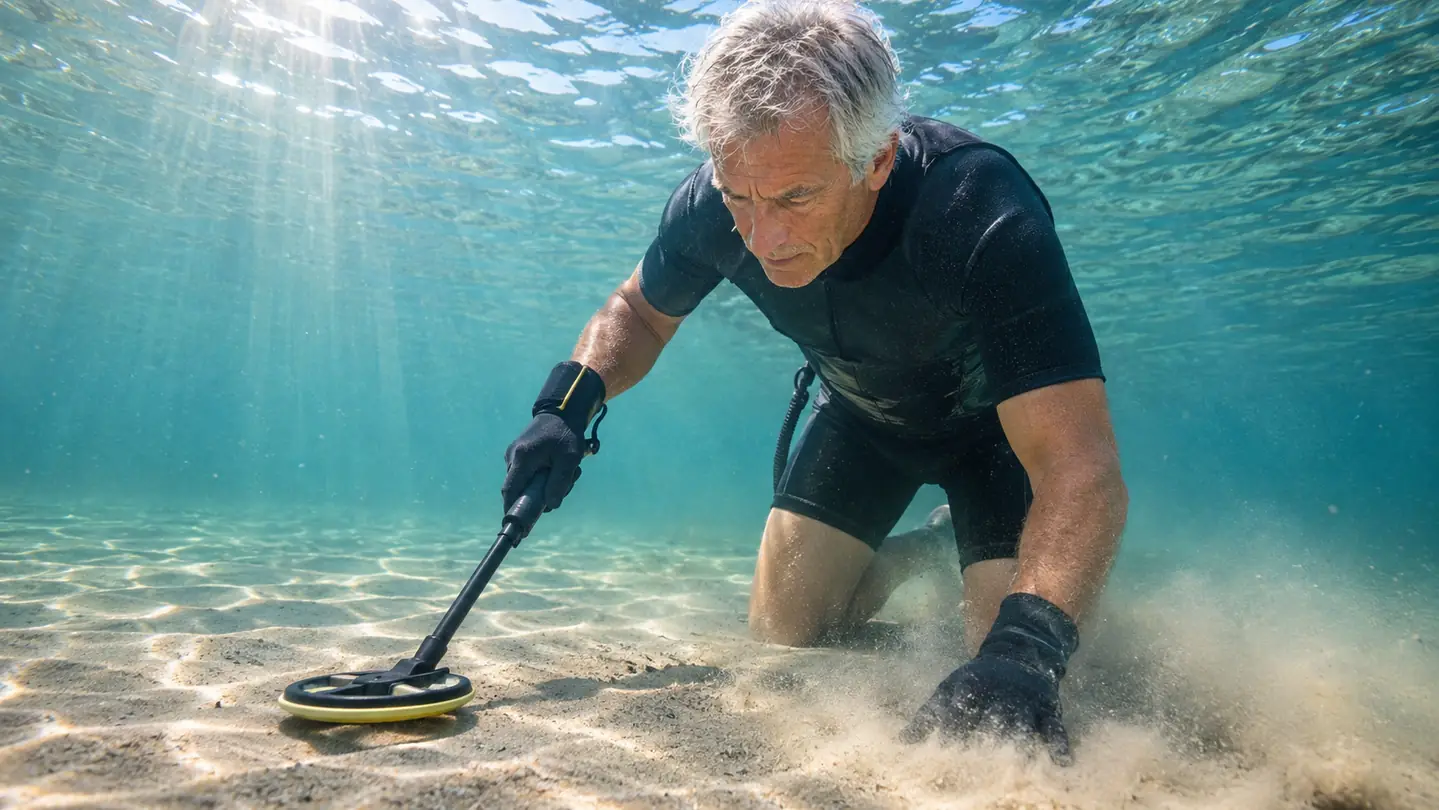
There is a particular sick feeling that shows up when a ring slides off a finger in waist-deep water and disappears into the sand. I watched my dive buddy Cal do exactly that at a public swim beach a few summers back. The first thing I told him was to stop moving. Not to swim around searching. Not to dig. To stand still and mark the spot, because the sand under your fins is the one thing in that water you cannot rewind.
I have been hunting lost metal in sand for five years, at swim beaches, around docks and boat ramps, and only in places where the rules allow it. Eighteen months ago I bought the Nokta PulseDive, made by NOKTA DETECTION TECHNOLOGIES, after a full season of carrying a land pinpointer in a dry bag and pretending that counted as an underwater detector. It did not. A land pinpointer in a dry bag is just a heavy thing you carry down to the water. The PulseDive is a tool I use on every sand hunt, from waist deep out to about 30 feet, and it has roughly 90 dives on it now. What follows is the procedure I actually run, in the order I run it, and the parts of it that cost me time to learn.
The coil finds it. The pointer recovers it. One tool does both jobs.
The Nokta PulseDive from NOKTA DETECTION TECHNOLOGIES is a 2-in-1 hand-held detector and pinpointer with a 5.5 inch search coil, 3 kHz pulse induction, four programs, an LED display and an IP68 rating that keeps it waterproof to 200 feet. It is the tool I carry on every sand hunt.
Amazon Check Today's Price on Amazon →Step 1: Mark the Spot Before You Move a Single Fin
Panic is what loses the item, not the water. The moment a ring or a watch clasp comes off, the person starts sweeping the sand with both hands, and every sweep pushes the target deeper or sideways. I have watched a man turn a lost wedding band into a forty minute search that way, and he found it a full arm's length from where it went down.
So the first job is not recovery, it is position. Get the diver standing or kneeling exactly where the loss happened, fix a line on shore, and take two bearings. A dock piling and a particular palm tree will do. On a shore entry I plant a small marker weight on a short line right where the item went down, then work outward from that weight in circles. If you have a buddy with you, they hold the surface position and keep boat traffic off you while you work.
One more thing before you touch the bottom. Check whether you are allowed to be there. Public swim beaches usually are fine. Many state parks are not. Anything inside a protected wreck, a sanctuary or a historic site is off limits, no matter what is lying in the sand. A ring is not worth a citation, and the owner will still be glad you called to say where you last saw it.
Step 2: Set It Up on Land and Prove It Works Before You Get Wet
I do the setup in the carport at home, then again on the cargo floor of the 4Runner before a shore dive. Fresh batteries in. Coil cover seated flat with no sand trapped under the lip. Coil cable secured so it cannot loop and snag on a line. The unit is battery powered and rated IP68, waterproof to 60 meters, but that seal only holds if the cover is seated and undamaged.
Then test it against a known target. I keep a brass washer in the bag for exactly this. Lay it on the concrete, pass the coil over it, and listen. If the tone is ragged or the LED display is doing something you do not recognize, stop and sort it out on dry land. Four programs are there to be selected, and I would much rather find out which one I am in while standing barefoot on concrete than at 30 feet with a stranger's ring somewhere in the sand below me.
A word on depth ratings, because I have heard them abused. The PulseDive is rated to 200 feet. I have never taken mine past 60. My diving sits between 20 and 60 feet, my hunting happens in the top 30, and I do not test gear against numbers I have no reason to visit. A rating is a ceiling, not an invitation.
Step 3: Sweep a Slow, Overlapping Grid
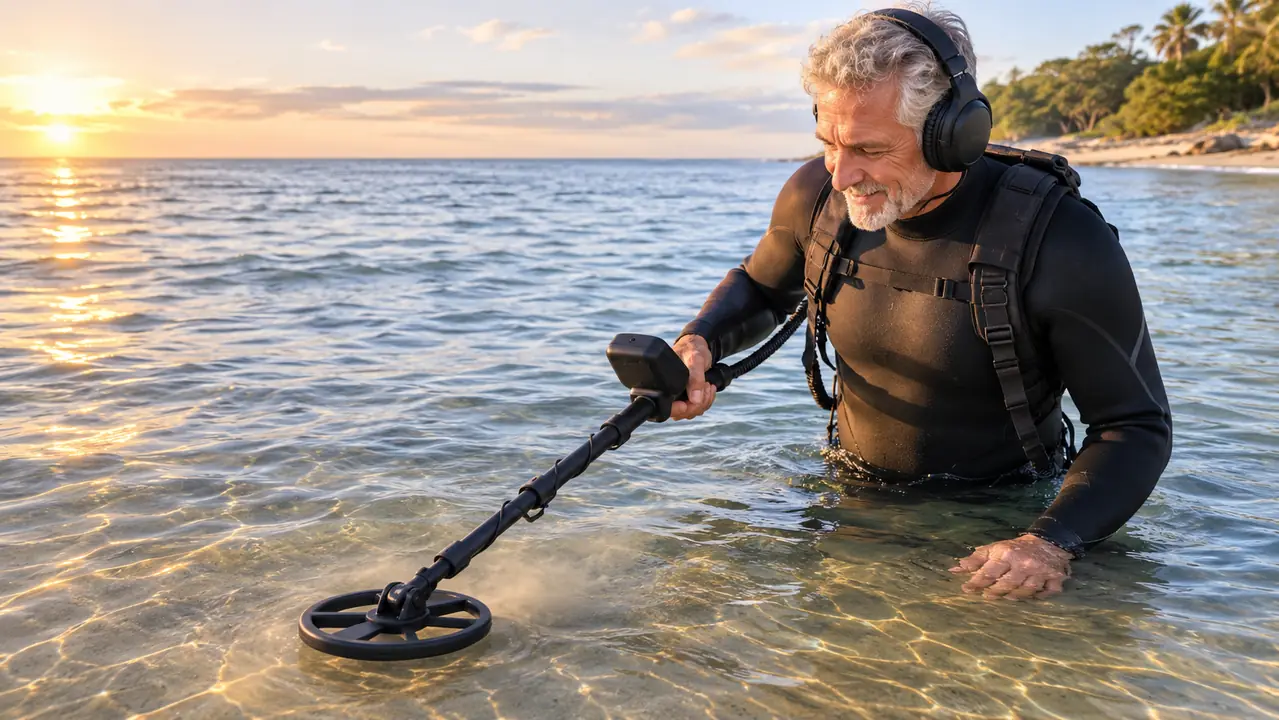
The unit runs at 3 kHz pulse induction with a 5.5 inch search coil. Pulse induction is the right circuit for salt water and wet sand, because it does not get confused by the salt the way a conventional land detector does. What it does care about is speed. Sweep too fast and you will pass straight over a thin gold band without a sound.
Keep the coil level and close to the bottom, maybe an inch above it, and move it at a walking pace or slower. Then step forward half a coil width and come back. Half, not a full width. The overlap is the whole game. I run a box pattern off the marker weight, about ten feet by ten feet to start, then widen it if the first pass comes up empty. When the tone changes, stop the coil where it sits and note that position against your marker before you dig anything.
Docks and pilings deserve their own approach. Metal hardware, nails and old brass live in the sand right against the structure, so the detector will scream at you constantly. Work away from the piling first, find the clean sand, and only then come back in close with short sweeps. Chasing a loud signal six inches from a barnacle-covered post is how people spend an hour on a boat cleat.
A 5.5 inch coil running at 3 kHz pulse induction will find a thin band six inches down in wet sand. It will not find it if you sweep past at the speed of a man who is in a hurry.
The other reason to go slow is simple arithmetic. You are usually working in poor visibility with one hand on the unit and one in the sand, and slow is the only speed at which you can keep track of where you have already been. Twice over the same patch beats once over the whole beach.
Step 4: Recover the Target Without Losing It Again
Once you have a repeatable signal, stop sweeping and switch to the pinpointer job. That is the half of the 2-in-1 set people underrate. Fan the sand with a gloved hand into your other palm, pass the unit over each handful, and dump the empty sand behind you so you are not scanning it twice. When the signal is loudest in the pile and then disappears from it, the target is either in your hand or sitting on the surface.
Do not dig a crater. On a swim beach a crater only widens the hole, the target slides to the bottom of it, and the surge fills it back in while you are reaching for your bag. Fan, lift, check, dump. I have watched Cal lose the same target twice in one afternoon by digging with both hands at once.
Gloves matter here more than most divers expect. The XUKER 3mm pair I wear from November through April and on every sand hunt is thick enough that I can fan rough shell hash without opening a finger, and thin enough that I can feel the edge of a band before I close my hand on it. Cotton work gloves, which is what I used to wear, are useless the moment they are wet.
If the target is wedged under a rock or a lump of limestone, mark it, come up, and think about it. Prying blindly in low visibility with a bare hand is how people get cut and how targets get pushed deeper into a crevice. A second pass from a different angle usually beats force.
Step 5: Rinse It Fresh, Store It Dry, and Let the Lost Alarm Earn Its Keep
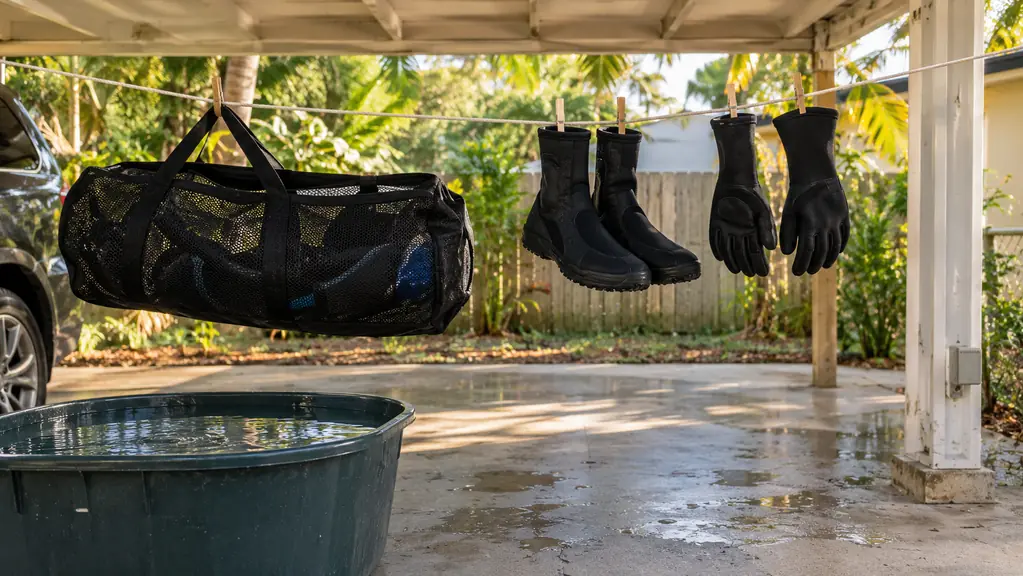
Salt is patient. The IP68 rating keeps water out of the housing during the dive, but the coil cover, the battery compartment lip and the buttons all collect salt crystals that work at the seals over a season. The moment I am back at the carport the unit goes into the rinse tub of fresh water, gets a good shake, and then dries on the clothesline under the carport rather than baking in the 4Runner.
The feature that has saved me the most money looks like a gimmick until the day it is not. After 5 minutes of inactivity the PulseDive sounds an audible alarm and the LED starts flashing. I have set mine down on a sandbar, turned to answer Cal, and walked away from it. That alarm is the reason the unit is still in my kit and not somewhere off Tavernier.
Battery out if it is going to sit for a few weeks. Coil cover off and rinsed separately, since grit trapped under it is what eventually wears the coil face. Bag drained rather than sealed. That is the whole routine and it takes about four minutes, which is a lot less than a replacement.
What Else Helps
The detector is the tool, but the rest of the kit is what makes a hunt actually work. The Bulex mesh duffle is 37 inches long with two side zipper pockets, and it holds fins, boots, gloves, mask, wetsuit, light and detector in one lift. It is not water resistant, and that is the point. It drains on the walk back to the 4Runner instead of holding a puddle against your gear for two days.
The Cressi neoprene boots go on for limestone shore entries and hot docks as well as for the dive itself, and the anti-slip rubber sole is what keeps you upright on a wet ladder with a detector in one hand. The Genwiss light earns its place on guided night charters, when the sand reads as a flat dark sheet and you are working the coil largely by sound. A decent glove and a light do more for a nighttime sand hunt than a bigger coil ever will.
Before any of that, check the rules for the water you plan to hunt. Ask the beach patrol, read the park sign, and stay out of protected wrecks and sanctuaries. I sell what I find at weekend flea markets, and I still give a ring back when the initials inside it trace to a name. That part is not gear advice, but it is the reason I have never had a bad conversation with a ranger.
I am not brand loyal by nature, and I have owned plenty of gear that did not survive a season in this salt. NOKTA DETECTION TECHNOLOGIES built the one item in my kit that does two jobs with one hand, and it is still the tool I reach for first when someone on the beach asks me to find something they dropped.
If you hunt sand, buy the tool that comes back out of the salt
The Nokta PulseDive from NOKTA DETECTION TECHNOLOGIES searches and pins in one hand-held unit: 5.5 inch search coil, 3 kHz pulse induction, four programs, IP68 waterproof to 200 feet, and a lost alarm that sounds after 5 minutes of inactivity. Eighteen months and about 90 dives in, mine still lives in the mesh bag and still finds what I point it at.
Amazon Check Today's Price on Amazon →