

I bought the Cressi Matrix about three years ago, on the way to a two-tank charter out of Tavernier. My old mask had a single big window and it had started seeping at my right cheek on every dive, not enough to flood, just enough to make me stop and clear it. I had put up with that for about six years. The Matrix was not an impulse buy. I wanted a low-volume mask with a wide lower view so I could read my gauge console without tilting my head back. That is the short version. The longer version is that the mask has been on about 180 dives since, and it has earned most of the praise it gets, but not all of it.
This is an honest review, not a victory lap. The Cressi Matrix does two things better than the mask it replaced: it lets me see down toward my gauges and the sand, and it takes less air to clear because the internal volume is low. It also has faults. It sits above the budget masks on cost, the lenses sit close to your eyes, and it will not seal on every face. If you want a single big window and a lot of room, this is not that mask. If you want to know where it actually earns its place, keep reading.
The Quick Verdict
A low-volume two-lens mask with a wide lower view and a reliable skirt, held back by cost, close lenses and a fit that will not suit every face.
Amazon Check Today's Price →See the Cressi Matrix at today's price
Check the current listing and the 2-year limited warranty before you buy.
Amazon Check Today's Price on Amazon →How I've Used It
I am 61, a retired marine electrician, and I dive 20 to 60 feet, about 400 logged dives. The Matrix has been my main mask for the last three years and about 180 of those dives, on charter boats and shore entries. It has been in the 4Runner, in the mesh duffle, rolled in a towel, and rinsed at the carport tub after the drive home. Most of my diving is ordinary recreational stuff: ledges, sand, a few guided night dives. I also hunt lost metal in the sand, and the Matrix goes on any hunt deeper than 20 feet. On wading hunts in waist-deep water I am not wearing a mask.
Its first day was a two-tank charter. I set the strap once between tanks, across the crown of my head and above my ears, snug but not tight. I have not touched the strap since. That is not a brag about my setup skills. It is the main reason the mask stayed on my face. A mask that needs a new adjustment every dive is a mask that is going to leak at the worst time. The Matrix has not done that. The only seep I have had since was a little water under the skirt when hair got caught. I check for that now before I roll in.
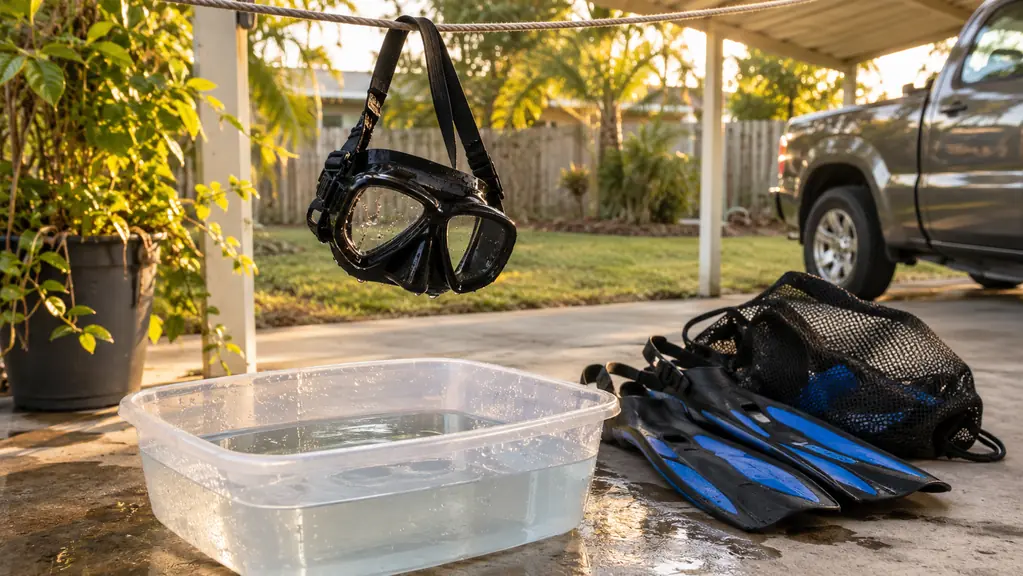
It rides in the bag with no hard case. I roll it in a towel before it goes in the bag. At home it gets a fresh water rinse and dries in the carport. I do not baby it, but I do not toss it in a bucket with weights either. Three years in, the skirt is still soft and the buckles still work. I have not had a strap failure, a cracked frame or a lens come loose. That is a low bar, but it is the bar that matters in salt water.
I have used it on guided night charters, where the boat is on a mooring and the mate handles the lights. The mask has been fine in the dark. The low volume is not a night feature, but a clear mask is. I have also used it on shore entries in daylight, walking in wearing boots and putting fins on in waist-deep water. I do not take the mask off in the water. I do not lend it either. Nobody else has worn it. That is not a rule I expect you to follow. It is just how I keep track of my own gear.

What the Matrix Does Well
The feature that sold me is the lens shape. The Matrix uses two inverted tear-drop lenses, and the listing says the design improves downward visibility. That matches what I see. I can look down at my gauge console with a small tilt of my head, not a full chin-to-chest move. On a sand hunt, that same view lets me scan the bottom without lifting my whole torso. The field of view is wide laterally and in the lower zone. I am not a tech diver and I do not need a panoramic window, but I do need to see my SPG and my depth without fumbling.
The low internal volume is the second thing. The listing says it is on par with free diving masks, and I believe the volume is low because it takes very little air to clear. That matters at 60 feet when you are already thinking about your gas. It also matters on a shore entry when the water is cold and you want to get the mask settled fast. Low volume means less air to clear. That is the whole claim.
The skirt is soft silicone, and the listing calls it hypoallergenic with a wide sealing surface. I have a clean-shaven face and no beard, so I am an easy fit. The seal has been reliable. The skirt has not gone stiff or gummy after three years. The frame is silicone too, and the whole mask weighs 6.4 ounces per the listing. That is light enough that I do not notice it on the boat, and heavy enough that it does not feel like a toy. The 2-year limited warranty is there, though I have not needed it.
The buckles are the quiet part of the design. They are adjustable, and they have not slipped or corroded in three years. I rinse them with fresh water after every saltwater dive, which helps. The strap sits where I put it. I have not had to replace it. On a mask, that is the difference between a tool and a nuisance. I have had nuisance masks. This is not one of them.
Where It Falls Short
The first shortfall is the fit. A mask either seals on your face or it does not, and no review can promise that for you. The Matrix has a wide sealing surface and a soft skirt, but it is still a two-lens mask with a defined nose pocket. If you have a narrow face, a high nose bridge or a mustache, try the seal test before you buy. Hold it to your face without the strap and see if it holds. If it leaks, it leaks. I have a face that fits it. That is luck, not a product guarantee.
The second shortfall is the lens position. The lenses sit close to your eyes. That is part of why the volume is low and the view is wide. It is also why the first two or three dives felt a little cramped. I was used to a big single window with a lot of air between my eyes and the glass. The Matrix made me feel like I was looking through a pair of close-set windows. It went away by the third dive. If you hate that feeling, you will hate this mask.
The third shortfall is the cost. The Matrix sits above the budget masks, and it is not the cheapest way to get a dive. I am not going to pretend it is a bargain. What you get for the money is a low-volume two-lens mask with a soft skirt, a wide lower view and a 2-year warranty. If that is what you want, the cost is easier to justify. If you just need a mask that keeps water out for a dozen dives a year, a cheaper single-lens mask may do the job. I am not going to talk you into the upgrade.
The Matrix earned its place on my face because I can read my gauges without tilting my head back, and because it stopped the seep my old mask gave me at the right cheek.
The Stuff Nobody Tells You
Nobody tells you that a low-volume mask is a trade, not a free upgrade. You get a smaller air space and a wider downward view, but you also get lenses closer to your face and less room to look around inside the mask. I do not mean you can see around the lenses. I mean the view feels closer in at first. The Matrix is not a big-window mask. If you like the open feel of a single lens, this is a different animal. It took me a few dives to stop noticing.
Nobody tells you that the strap is not the seal. The skirt is the seal. I see divers crank the strap down until it leaves a mark, and then they wonder why the mask leaks. A tight strap pulls the skirt away from the face in odd places. I set mine across the crown of my head, above the ears, snug and not tight. That is where it has stayed. The buckles are adjustable and I have not had to fight them. I also check for hair under the skirt, because that is the one thing that has caused a seep since the first week.
Nobody tells you that the lenses need a proper clean before the first dive. I scrub a new lens with plain toothpaste, not a flame, and I rinse it well. I defog with a drop of mild dish soap and a fresh water rinse. That is not a Cressi-specific trick. It is what I do with any mask. The Matrix has not fogged worse than any other mask I have owned. It also has not fogged less. If you are buying this mask to solve fogging, you are buying the wrong thing.
I keep a second mask in the bag for my own strap or lens, not as a loaner. That is a personal habit. A spare mask is cheap insurance on a charter boat. The Matrix is my main mask, not my spare. I would not hand it to someone else to try. If you dive with a buddy, tell them to bring their own spare. That is the plain advice. It has nothing to do with the Matrix and everything to do with how a day on the water goes wrong.
How It Compares to Other Masks
I have not owned the ScubaPro Spectra. I am going by its listing, and I will say that plainly. The Spectra uses two mirrored lenses, a double-sealed silicone skirt and pushbutton buckles. It weighs about 8 ounces, comes with a plastic storage case and carries a one-year warranty. It sits higher on cost than the Matrix. If you want a mirrored lens, a case and pushbutton buckles, the Spectra is the more feature-rich mask. If you want a low-volume two-lens mask without the mirrored lens, the Matrix is the simpler choice. I am not going to rate how the Spectra fits because I have never had it on my face.
The Cressi F1 is the other comparison that comes up. It is a single-lens frameless mask that folds flat, with quick-adjust buckles and a 2-year limited warranty. The listing says it is designed by Cressi and made in Taiwan. It is a different job. The F1 is a packable spare or a simple single-window mask. The Matrix is a low-volume two-lens mask with a defined frame and a wide lower view. I keep a spare mask in the bag, and I would pick the F1 for flat packing before I would pick the Matrix. For my main mask, I want the Matrix's lower view and low volume. That is the honest split.
What I Liked
- Wide lower view for gauges and sand
- Low internal volume clears with little air
- Soft silicone skirt seals well on the right face
- Adjustable buckles and strap have held for three years
- 6.4 ounces and a 2-year limited warranty
Where It Falls Short
- Sits above budget masks on cost
- Lenses sit close and take a few dives to get used to
- Will not seal on every face, so test the fit
- Not a single-window feel and not the mask for a big open view
Who This Is For
The Matrix is for the recreational diver who wants a low-volume two-lens mask with a wide lower view, and who is willing to pay a little more than the budget masks to get it. It suits a diver who reads gauges, checks a compass, looks down at a sand bottom or wants a mask that clears with little air. It suits a clean-shaven face with a medium to wide build. It also suits a diver who wants a 2-year limited warranty from a brand that has been making masks for a long time. If you are that diver, the Matrix is a sensible main mask.
Who Should Skip It
Skip it if you want a single big window. Skip it if you have a narrow face or a mustache and you cannot get a seal. Skip it if you are on a tight budget and a basic mask will do. Skip it if you want a mirrored lens or a storage case in the box. Skip it if you hate the feeling of lenses close to your eyes. And skip it if you expect a mask to do more than keep water off your eyes and give you a clear view. It will not. The Matrix is a good tool for the right face and the right diving. It is not a universal fit and it is not the cheapest way to get wet.
If the fit sounds like yours, check today's price on the Cressi Matrix
Read the current listing, confirm the 2-year limited warranty and do the seal test before you dive.
Amazon Check Today's Price on Amazon →