

The first thing that fails on a shore entry is never the dive. It is the walk. Thirty yards of wet limestone in a pair of thin surf booties, and by the time I reached the water I had felt every notch in the rock through the sole of my foot. That was eighteen months ago, in the spring my old mesh bag split and I rebuilt the whole kit in one go. The boots I bought with it were the Cressi Neoprene Adult Anti-Slip Sole Boots. I am 61, I dive out of Tavernier, and I have roughly 400 logged dives behind me. I am past the age where sore feet get folded into the cost of a good day on the water.
Here is the short version of what these are. Neoprene and rubber, zippered closure, anti-slip rubber sole, tall boot, sold as a pair. The listing puts the weight at 1.9 pounds and the package at about 11 by 16 by 12 inches. I have worn them on roughly 90 dives since, off charter boats out of Key Largo and on the rock and sand entries I do on my own, plus a fair amount of hot dock walking in between. What follows is what they do well, what they do not do, and who I would hand them to.
The Quick Verdict
Buy them for the sole and the zipper. They are the pair I put on for every dive, shore or boat, and eighteen months of salt water has not given me a reason to look at anything else.
Amazon Check Today's Price →The pair that turned a rocky entry back into a walk
Anti-slip rubber sole, zippered closure, neoprene build, and an adjustable strap that keeps the boot where you set it. What I wear with open-heel fins on every dive, from a wet charter deck to a limestone shore.
Amazon Check Today's Price on Amazon →How I've Used It
Two kinds of diving make up my year. The first is a charter boat out of Key Largo, a giant stride off the stern, forty minutes on a reef at 30 to 50 feet, and then the ladder. The second is a shore entry I do on my own when the wind lies down, rock and sand and then the long walk back to the 4Runner with wet gear hanging off me. The boots go on for both. They also go on for the twenty minutes of hot dock before the boat even leaves, which the listing does not mention and which matters more than you would think in July.
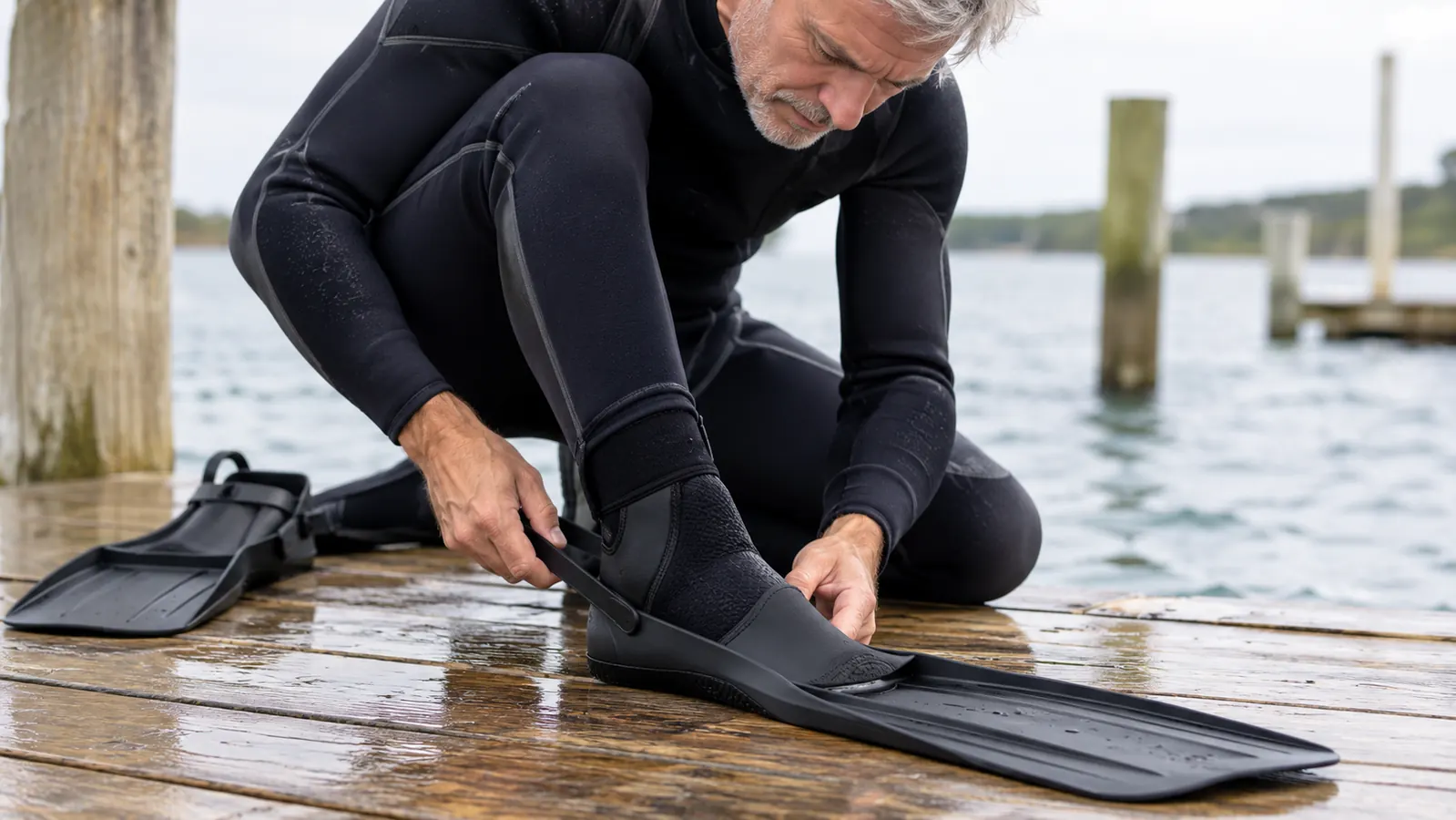
The fin fit is the part I did not expect to improve. My old thin booties left the pocket of an open-heel fin loose enough that I cranked the straps down hard to keep the fin on my foot, and after an hour my instep let me know about it. These boots fill the pocket. The fin strap now sits where it was designed to sit, over neoprene rather than over bare skin, and I run it snug instead of tight. The boots carry their own adjustable strap as well, which does for the boot roughly what the fin strap does for the fin, and I set it once at the start of a dive and forget it.
Break-in was not a story worth telling. They were a little stiff at the zipper for the first two dives and then they were not. I have had no hot spots, no rub on the ankle bone, nothing that needed a sock to fix. That is the full report. Gear that disappears on your foot is gear that is working, and these disappeared faster than anything else in the kit I rebuilt that spring.
They also come along on the sand hunts, which is a different job entirely. When I am working a public swim beach with the detector, I am on my feet in wet sand for three hours, kneeling and standing, and the boots are what I am standing in. The gloves handle the digging. The boots handle the sand and the shells and the odd piece of broken glass that the rake never got. On that ground, a sole that grips and does not transmit every lump up into the arch is the difference between finishing the morning and quitting at ten.
What the Zipper and the Sole Actually Do
Wet neoprene grips whatever it touches, including your own foot, so a pull-on boot becomes a wrestling match at the end of a dive when your hands are cold and the deck is moving under you. The zipper changes that. Open it, step in, close it, and the boot is on. Coming off is the same operation in reverse. On a rolling deck with a camera housing in one hand, that difference is worth more than any feature printed on a box, and it is the reason I stopped dreading the ladder.
The zipper is also the part that will eventually end these boots, whenever that day comes. It is the only mechanism on the product. Sand works into the teeth, salt dries in the slider, and a zipper that gets put away wet will seize solid. So I rinse the zipper before I rinse anything else, work the slider through a few times while the fresh water is running, and leave it open to dry. Eighteen months in, it still closes with one pull, and I put most of that down to the rinse habit rather than to luck.
The sole is the other half of the reason I bought them. Anti-slip rubber, textured, thick enough that a limestone ledge does not come straight through it. On the wet aluminum of a boat ladder it holds. On the ramp at the end of a dock it holds. Standing in the rinse tub at home it holds. I am not going to tell you it turns a rock shore into a sidewalk, because it does not, but it turns a rock shore into something I will still do at 61 with a tank on my back, and that is the honest claim.
Set them next to the thin surf booties they replaced and the difference is not subtle. Those booties were a second skin with a token sole, and they were fine for a boat dive with a short walk. They were not fine for anything with rock in it, and they did nothing at all for a fin strap that needed something to bite on. The Cressi boots are a heavier piece of gear, and you feel that on the first walk and appreciate it on every one after.
The build is neoprene with rubber at the sole, and the care instruction on the listing is hand wash only. I have never machine washed them and I would not. They run tall, past the ankle, which is exactly why the fin strap lands on neoprene instead of on skin. Cressi lists the weight at 1.9 pounds, and they pack flat enough to sit at the bottom of the duffle without eating the space a regulator bag needs.
Eighteen Months of Salt Water
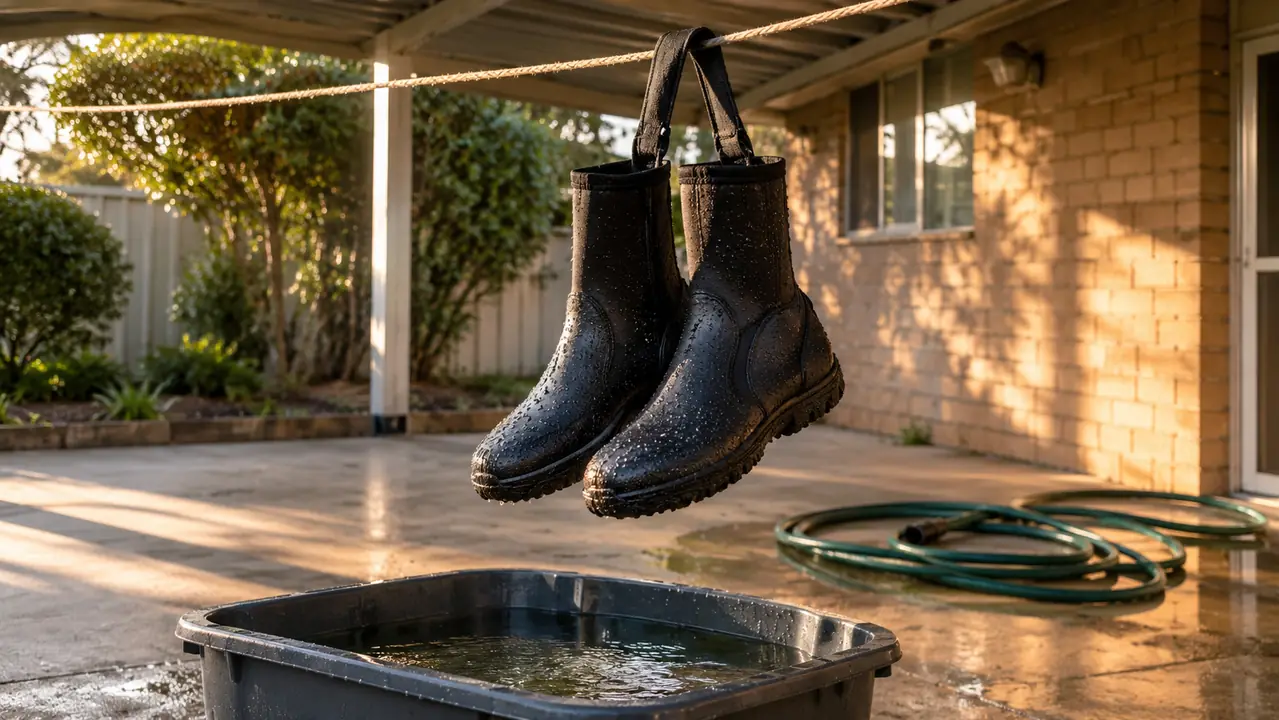
My routine has not changed since the first week. They come home in the duffle, they go into the rinse tub under the carport, they get a flush inside and out, the zipper gets worked, and then they hang by their straps on the line under the carport until they are dry. No soap unless they have been in sand, and then a little dish soap and a soft brush around the sole edge. That is the entire maintenance schedule, and it takes about five minutes.
After 90 dives, here is the condition. The neoprene has softened where my ankle bends, and there is a crease at the back of the heel that was not there in the first month. No seam has opened. The stitching around the sole is intact on both boots. The zipper pulls clean and the slider has not started to wander. The inside has taken on the shape of my foot, which on a boot is a good sign and not a bad one.
The sole shows wear at the outside heel edge, which is where every sole wears first if you walk like a normal person. The texture is still there under the ball of the foot, which is the part that matters on a ladder rung. Nothing is separating from the upper. I have not had to glue anything, and I have not had to trim a flap, which is more than I can say for the booties these replaced after a single season.
Storage matters more than people think. These ride in the mesh duffle with the fins, the mask and the light, and the duffle drains, so nothing sits in a puddle between trips. If you throw wet boots into a closed plastic tub and leave them in the Florida heat for a week, the zipper will tell you about it the next time you try to close it. That is not a fault of the boot. That is a fault of the tub.
Fit, Sizing, and the One Annoyance
The listing calls the fit regular, and I would agree with it. I ordered my usual shoe size and got a boot that is snug without pinching across the top of the foot. If you are between sizes, or you plan to wear a thin sock when the water drops, go up. I wear a thin sock from November through April and my usual size still works with it, but a heavier sock would not, and I would rather tell you that now than have you find out on a boat.
The annoyance is sand. After a morning on the sand bottom at a public swim beach, there is grit inside the boot and grit in the zipper, and the boot does not empty itself out. I turn it upside down, flush it in the tub, and work the zipper until it runs clean. Five minutes of work at the end of the day. If you only ever dive off a boat and never touch a beach, you will never notice this at all.
The other thing to be clear about is warmth. These are neoprene, and neoprene keeps you warm by holding a thin layer of water against the skin, but a boot only does so much. In January here, when the water sits around 71, I feel it in my feet by the end of the second dive. That is not a defect. It is what a boot of this type does. If you are diving in water that makes your hands ache, you need a different boot and a thicker one, and no amount of strap adjustment will change that.
What I Liked
- Anti-slip rubber sole holds on wet ladder rungs, dock ramps and limestone
- Zippered closure goes on and off with cold hands on a moving deck
- Fills an open-heel fin pocket so the fin strap runs snug instead of crushed
- Eighteen months and 90 dives with no seam failure and no glue
- Adjustable strap locks the boot down without a death grip
Where It Falls Short
- Not a cold water boot, I feel January water in my feet by the second dive
- Sand and grit work into the zipper and have to be flushed out
- The zipper is the only mechanism and will seize if they are stored wet
- Fit is regular, so wide feet and heavy socks need a size up
Ninety dives, one zipper, no glue. The sole holds on a wet ladder and the strap stays where I set it, and that is the whole case for these boots.
Who This Is For
This is for the recreational diver who does both kinds of diving, the charter boat and the shore, and wants one pair of boots to cover them. It suits open-heel fins, which is most of what a recreational diver wears. It suits warm water and mild water, the 70s and up. It suits anyone who has been picking their way down a rock entry in thin booties and pretending it was fine. And it suits the diver who hunts sand in the shallows, because that is a job where you are on your feet for hours and the ground is never level.
It also suits the diver who does not want to think about gear. These are not fussy. Rinse them, hang them, wear them. There is no liner to dry out, no insole to lose, no buckle to replace. I have owned enough gear over 33 years of working on boats to know that the pieces I keep are the pieces that ask nothing of me, and after eighteen months Cressi has built one of those.
Who Should Skip It
If you dive cold water, skip these and buy a thicker boot built for it. A drysuit diver should not be looking at this page at all. Neither should anyone diving in water in the 50s, or anyone who needs a boot that fits inside a heavy rock boot. These are a warm water and mild water boot, and no amount of layering a sock inside them turns them into something else.
Skip them too if you want a pull-on boot with no zipper, because the zipper is the whole design. Skip them if you are the diver who leaves gear in a closed bin for a month, because you will kill the zipper and blame the boot. And skip them if you are doing technical work with long deco and precise fin control, where a stiffer, more specialized boot is the right tool. For the rest of us, on a reef at 40 feet with a tank on our back, they are enough.
One pair, every dive, eighteen months and still closing with one pull
Zippered neoprene boot with an anti-slip rubber sole and an adjustable strap. What I wear from a wet charter deck to a limestone shore entry, and what I will buy again when these finally quit.
Amazon Check Today's Price on Amazon →