
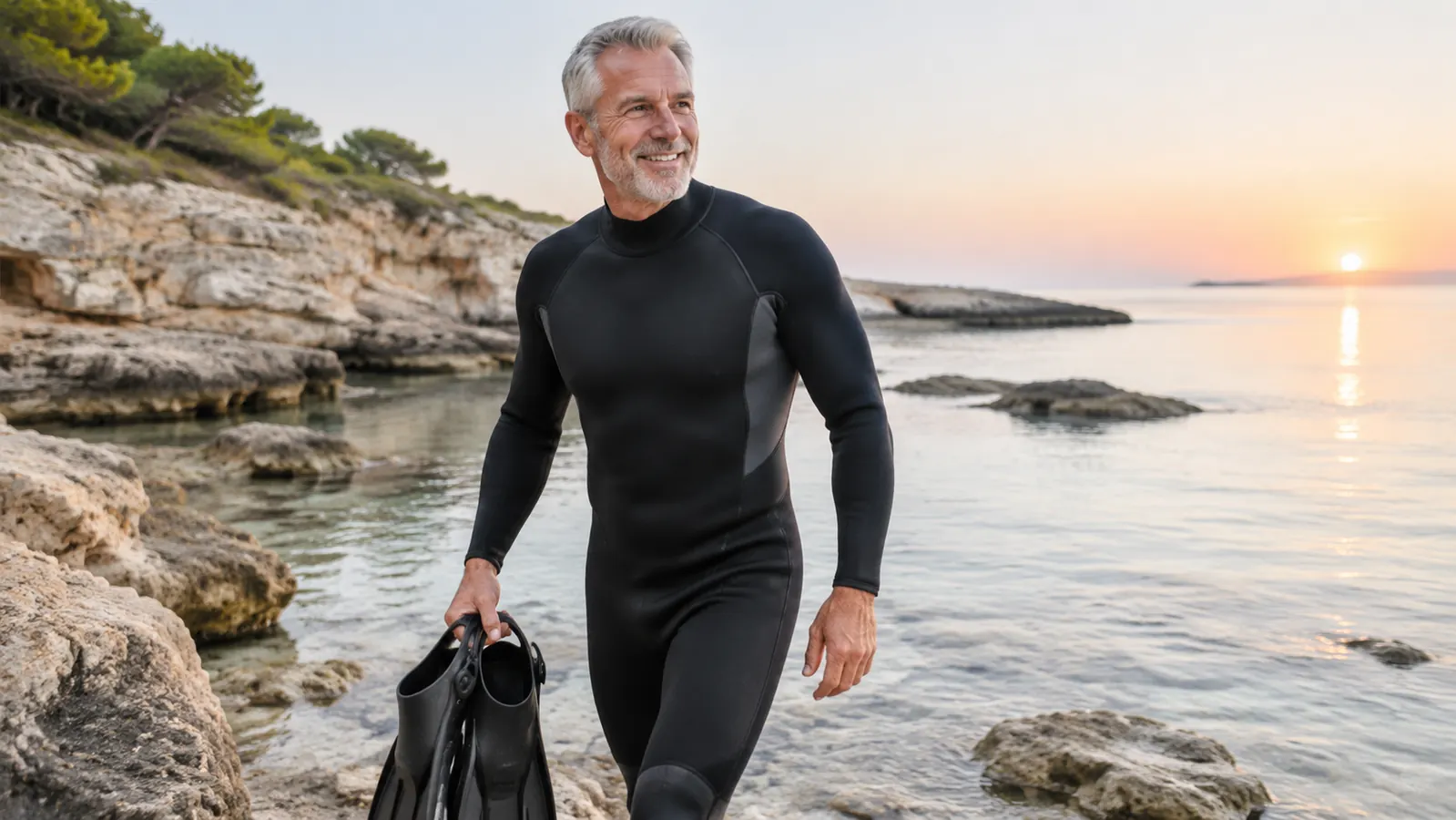
There is a stretch of shoreline south of Tavernier where the rock is pocked with holes and the first ten feet of water is loose rubble that rolls under your weight. I waded in barefoot for my first two years of diving and told myself it was simpler. It was not simpler. It was cheaper by one pair of boots and more expensive by two trips to a walk-in clinic.
About 18 months ago my old mesh bag split down the seam and I rebuilt the kit in one order. The Cressi neoprene boots were part of that order. They have roughly 90 dives on them now, plus every hot dock, boat ladder and limestone entry in between. I did not expect much from them. Here is what actually changed, in the order I noticed it.
The pair I put on before the fins, not after
Cressi neoprene boots with an anti-slip rubber sole and a zipper closure. Mine have about 90 dives on them and the seams are still closed.
Amazon Check Today's Price on Amazon →The limestone entry stops being a decision you make with your feet
The shore south of Tavernier is not sand. It is limestone with holes in it, and the first ten feet is rubble that shifts when you load it. Barefoot, every step was something I had to think about. With the boots on, I walk in like it is a sidewalk. The rubber sole spreads the load and the neoprene takes the knocks that used to land on the top of my foot. I still shuffle rather than stride, because a rolled ankle in dive gear ruins an afternoon, but I am not picking my way anymore. My feet come out unmarked.
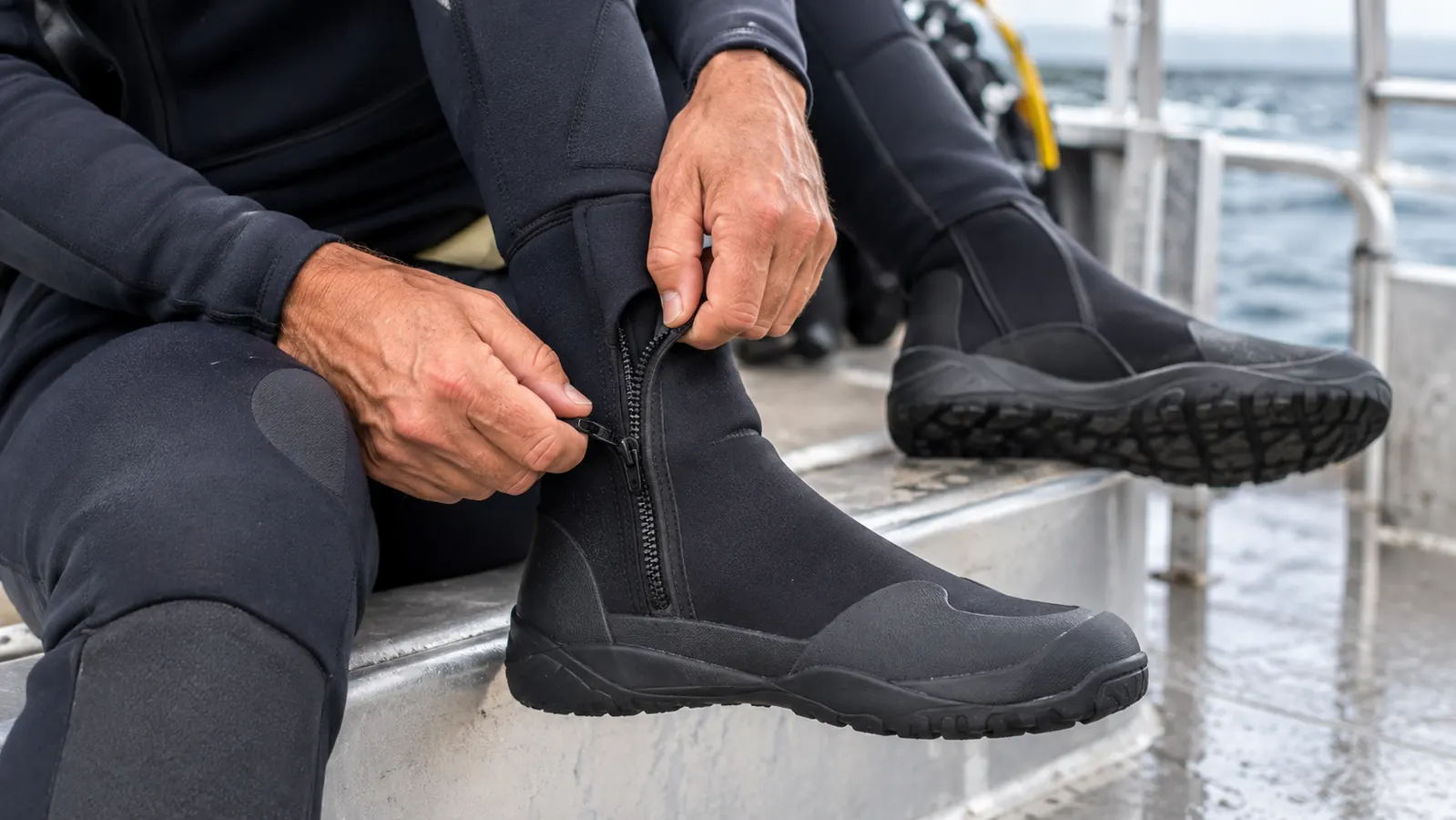
An anti-slip rubber sole grips wet aluminum boat ladders
A boat ladder is wet aluminum with a tread pattern worn smooth by a thousand pairs of fins. I have watched people lose the bottom rung in a swell. The anti-slip rubber sole on these boots holds that rung, and it holds wet rock, which a thin bootie with a smooth bottom does not. The moment it matters most is coming back aboard with a tank on your back and one hand on the rail. I have not had a foot slide out from under me since I started wearing them. On a rolling deck, that is the entire argument.
A zipper gets them on over a wet foot in a moving boat
Neoprene and a zipper closure mean I can pull these on over damp skin while the boat is still settling at the mooring. Thin pull-on booties fight you when your feet are wet, and you end up hopping on one leg while the divemaster waits with the headcount. I set the boot on my knee, pull the zipper, and I am done. Across a two-tank charter with a surface interval, that adds up to real time. The zipper has not seized or corroded in 18 months of salt water and hose-downs, which for a metal closure is the only test I trust.
Open-heel fins actually fit when there is a boot inside them
An open-heel fin is cut to be worn over a boot. That is not a preference, it is how the pocket is shaped. When I wore bare feet or thin socks, the pocket was loose and the strap had to be cranked down to keep the fin from walking off, which is how you get foot cramps and a strap mark you can still see the next morning. With the boots filling the pocket, the strap sits where it was designed to sit and I can run it looser. My finning got quieter and my air consumption settled down over a season.
Seventy-one degree January water stops being a decision
Water at home runs about 71 degrees in January. At 61, I feel that. Bare feet in January means the first ten minutes of a dive are spent thinking about my feet instead of the reef. Neoprene boots take that off the table. I am not going to pretend this is a cold-water boot, because it is not one, and a diver in a 55 degree quarry will want something heavier. But for a Florida winter and a two-tank day it is enough. Warm feet also mean I am not hurrying the dive to get out of the water, which is a safety point as much as a comfort one.
The first ten feet of a shore entry is where gear earns its keep, and bare feet never do.
Fin straps stop cutting a raw line across your instep
The fin strap crosses the back of the heel, and if there is nothing between the strap and your skin it will find the same spot every single dive. I carried a red line across my instep for a whole season and thought that was just part of it. The boot gives the strap something to press against, and the adjustable strap over the foot snugs the whole thing down without pinching. Small thing. It is the difference between a dive you enjoy and a dive you spend adjusting in the water.
Sand hunting stops costing you skin
Hunting lost metal in the sand means fanning, kneeling and digging with a scoop for two hours at a stretch. Barefoot, that is a cut waiting to happen, because a public swim beach is full of broken glass, bottle caps and the odd fish hook. I wore work gloves for my hands and nothing on my feet for the first year, and I paid for it. The boots stay on for the whole hunt now. Sand rinses out of them, the sole protects the bottom of my foot, and I am not stopping to check whether something is bleeding.
Hot docks and July parking lots are the reason, not the objection
People argue against boots because July in the Keys is a hot parking lot, a hot dock and a hot boat deck. I think that is backwards. The blacktop and the dock are exactly why I put them on before I leave the 4Runner. Walking from the car to the water barefoot across a sunbaked marina lot is not a small thing at my age. They are warm. I am not going to tell you otherwise. But I am also not going to cross hot asphalt to prove a point about simplicity.
A rough entry with a full kit on needs footwear you do not think about
Walking into the water with a full kit is a different animal than a stroll. You have 40 pounds of gear, you are breathing through a regulator, and you cannot see your feet. You need footwear you do not have to manage. These are tall enough that they stay put when the fin goes on, and the rubber sole gives you something to trust on uneven bottom. I have walked out through surf with a camera housing in one hand and never once worried where my feet were landing. That is what gear is supposed to do for you.
Eighteen months and 90 dives later, they are still the same boots
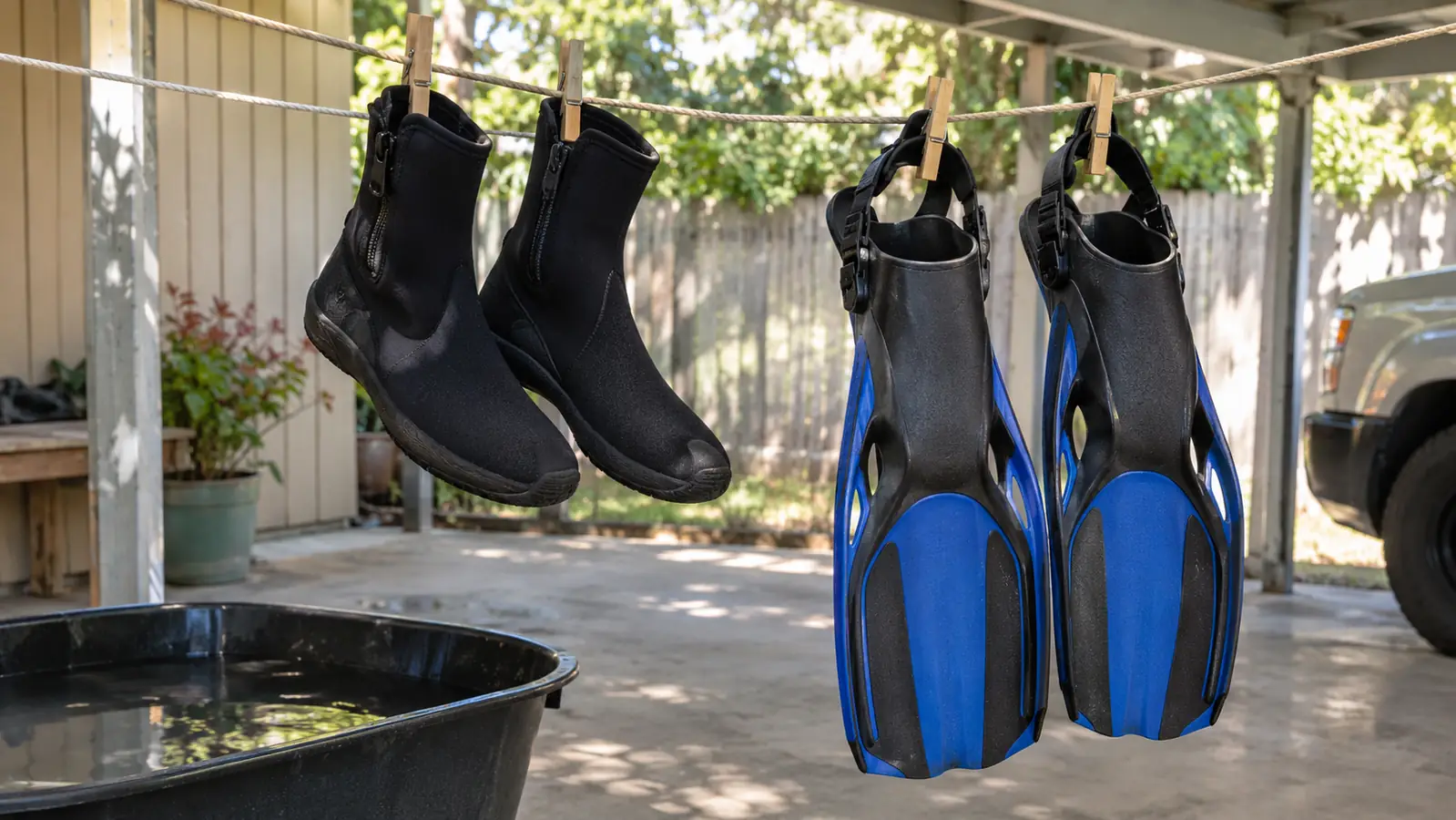
The neoprene has softened a little at the ankle, which is normal and honestly better. No seam has opened. The sole is still bonded to the upper. I hose them after every trip, hang them on the line under the carport, and hand wash them when they need it, which is the care instruction and the only one. Cressi lists these for scuba, snorkeling, rafting and windsurfing. I have used them for two of those plus a lot of digging in sand, and they have not given me a reason to look at anything else.
What I'd Skip
If I were rebuilding the kit again, the thing I would skip is the thin surf bootie. I started there because it was what the shop had in my size, and it cost me a season of cold feet and strap rub. I would also skip buying a size up on the theory that neoprene stretches. It stretches a little, and then the boot moves on your foot and the fin pocket goes loose again. Buy the fit you measure into. I would skip any smooth sole for a shore entry, and I would skip machine washing them. Hand wash, hang them in the shade under the carport, done. Nothing on these boots has surprised me in 18 months, and for salt water gear that is the highest compliment I have.
About 90 dives on my pair, and the seams are still closed
Cressi neoprene boots with an anti-slip rubber sole, a zipper closure and an adjustable strap over the foot. Hand wash only. Mine have been hosed and hung on a clothesline for 18 months.
Amazon Check Today's Price on Amazon →