
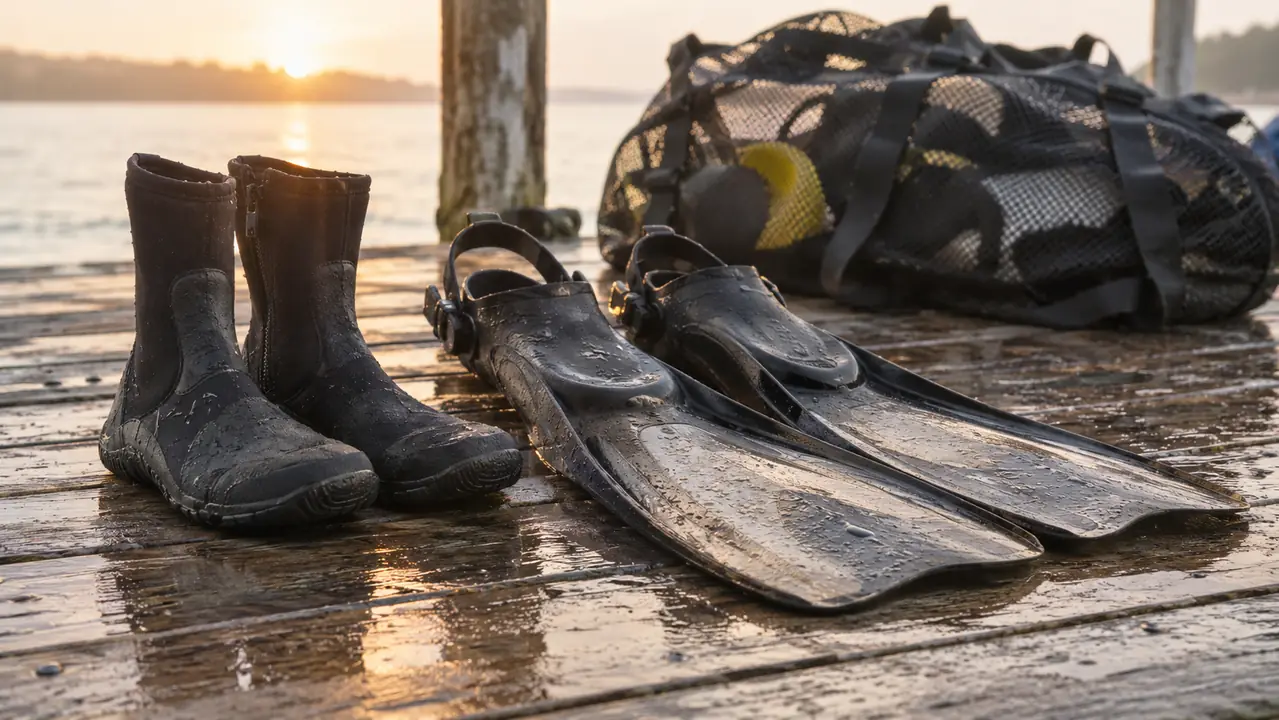
An honest review of a dive boot starts with the boring part. The boot will not make you a better diver. It keeps your feet off the ladder rungs, off the limestone and out of the rub that a fin pocket puts on your ankle. I bought a pair of Cressi neoprene boots about 18 months ago when I rebuilt my whole kit in one go, and I have put roughly 90 dives on them since. Here is what the listing leaves out.
Boots are the least glamorous thing in the bag and the first thing that fails if you buy badly. A split seam on a deck at six in the morning ends your day before it starts. A sole that goes slick on a wet aluminum ladder turns a heavy kit into something you carry with your arms instead of your legs. I have watched both happen to other divers on boats where I was standing in the same rinse line. That is why I care more about boots than the shelf price suggests I should.
The Quick Verdict
Honest boots that do the two jobs that actually matter, grip and warmth, and give up ground on drying time and on the fit lottery of ordering online.
Amazon Check Today's Price →Ninety dives in, the sole still bites the ladder
Zippered neoprene, anti-slip rubber sole, built for open-heel fins. Measure your fin pocket before you order and check the size chart against it.
Amazon Check Today's Price on Amazon →What Nobody Tells You About Dive Boots
The first thing nobody tells you is that a dive boot is sized like a shoe and worn like a sock inside a fin. Those are two different measurements and the listing can only give you one of them. Your street size gets your foot into the boot. The outside of the boot has to fit the pocket of your fin. A boot that fits your foot perfectly can still be too bulky to slide into a snug fin, and a boot that drops into the fin easily can be loose enough to rub your heel raw on a long swim out. I measured the fin pocket on my open-heel fins with a tape before I ordered. The Cressi boots came in under it with room to spare, and that tape measure did more for me than any review I read.
The second thing nobody tells you is that neoprene holds water and boots are the slowest item in your bag to give it back. A wetsuit drains because you hang it. Boots sit in the bottom of a duffle in their own puddle. Zip them wet into a closed bag and drive home in the Florida heat and they will smell like a bait bucket by the weekend. That is not a defect in the boot. It is a defect in the way most of us store boots, and I was guilty of it for years before I started paying attention.
The third thing is the sole. Nearly every boot complaint I hear comes down to the rubber and not the neoprene. Neoprene either fits or it does not, and there is not much to argue about. The sole is what meets the ladder rung, the boat deck, the parking lot and the limestone shore. It is the part that wears out first if it is soft, and it is the part that puts you on your back if it is hard and slick.
The fourth thing, the one that generates most of the returns, is that a size chart is a starting point and not a promise. Feet swell in warm water and shrink in January water. A boot that is snug in the shop is a boot you will fight at the end of a 45 minute dive when your hands are cold and the zipper is wet and your patience is gone.
How I've Used These Boots
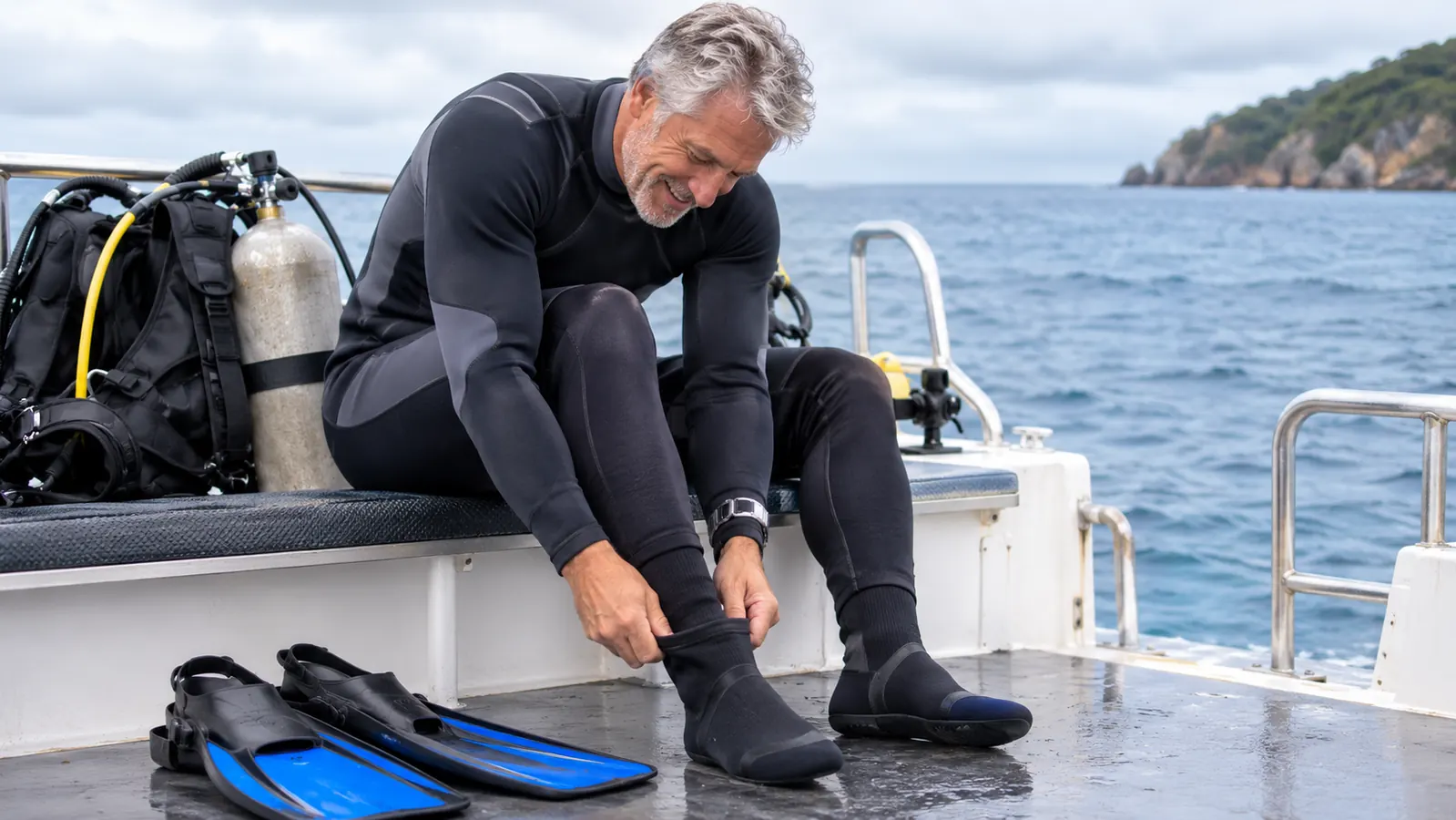
I bought them in the spring of last year along with a mesh duffle, a pair of gloves, a light and a detector, all in one order, because my old gear was a collection of things that mostly worked and I was tired of it. That is about 18 months ago now and roughly 90 dives on the boots. My diving is ordinary recreational work. Twenty to 60 feet, charter boats out of Tavernier, shore entries off the limestone, and a night dive now and then on a guided trip. I have never taken them past 60 feet and I have no technical credentials to wave at you.
The boots go on every single dive, in open-heel fins, which is the only way I dive. They also go on hot docks in July, because the concrete at the ramp gets to a temperature that will convince you to wear something, and on the limestone at the shore entry, which is rougher than it looks from the parking lot and will cut a bare foot without much effort.
The routine after every dive has not changed in 18 months. Rinse the boots in fresh water in the tub under the carport, work the zipper open and shut a few times while the water is running, then hang them on the line in the shade rather than the sun. Hand wash only, per the care instructions, and I have never put them near a machine. The one time I skipped the zipper rinse, I paid for it the next morning with a pull that felt like it had sand in it. It did.
My buddy Cal dives a different brand and rinses his boots roughly never. His are two years old and look it. Mine look like they have another two seasons in them, and the difference is not the boot. It is the ten minutes at the tub.
What I Liked
- Anti-slip rubber sole holds on wet aluminum ladder rungs and on algae-slick limestone
- Tall neoprene cut covers the ankle, which is where a fin pocket does its rubbing
- Zipper plus adjustable strap makes them easy to get on and off with cold, wet hands
- Warm enough for 71 degree January water through a 45 minute dive
- Ninety dives in, no seam separation and no sole peel
Where It Falls Short
- Slow to dry, two full days on the line in humid weather
- Zipper needs a fresh water rinse and a working after every dive or it stiffens
- Hand wash only, no machine, no shortcuts
- Sizing is a guess if you order online without having worn the brand
- Soft sole rubber wears at the toe if you walk far on pavement
Fit: What the Cressi Boots Get Right
I wear a 10 and a half street shoe and I ordered the size the chart pointed to. The fit is regular, as the listing says, and the boot closes with a zipper plus an adjustable strap that I set once in the first week and have not touched since. The neoprene gives a little over the first few dives, maybe half a size of give, and then it stops. That give is exactly why I would not size up. If you are between sizes, the smaller one is the one that will still fit you in month three.
The tall cut matters more than I expected it to. It covers the ankle, which is where the top edge of a fin pocket does its work. With thin surf booties I used to get a hot spot on the outside of my ankle after two days of back to back diving, and I assumed that was just part of the sport. It stopped when I moved to these. That is not a feature the listing advertises, and it is the one I would miss most.
The strap is the part I use least and would miss second most. It holds the boot snug across the top of the foot so the heel does not lift inside the fin pocket on a flutter kick. I snug it once at the dock and forget about it until the rinse.
One caution on packing. The listing puts the weight at 1.9 pounds, and the shipping dimensions are given as 11.22 by 15.75 by 12 inches, which tells you these are not featherweight tropical booties. They are boots with rubber on the bottom. If you are counting ounces for a fly-away trip with a soft bag, weigh them against whatever you were using before and decide honestly.
Ninety dives on both boots. No seam separation, no sole peel, and the zipper is still the zipper I bought.
The Zipper Is the Whole Design
A zippered boot lives or dies on the zipper, and this is where an honest review has to slow down. The zip is what makes the boot usable. Without it you are peeling wet neoprene off a wet foot with cold hands while the boat waits, and that is a small humiliation you only need once. With it, the boot comes off in two seconds and goes on in three.
The cost of that convenience is maintenance. Salt water and neoprene grit work into the teeth. If you rinse the boot but not the zipper, the pull gets stiff, then stiffer, and one morning you will tug and feel something give that should not have. Mine is 18 months old and still smooth because it gets worked under fresh water every single time. I am not gentle with gear. I am just consistent with that one thing.
The other half of the design is the sole unit. There is a rubber sole bonded to the neoprene, and where those two meet is the seam that fails on cheap boots. On mine that junction is still tight at the toe and the heel, with no lifting at the edge. If you buy a pair, look at that seam first thing out of the box and check it again at the end of the first season. It is the earliest warning you will get.
Grip: Wet Ladders, Limestone and Boat Decks
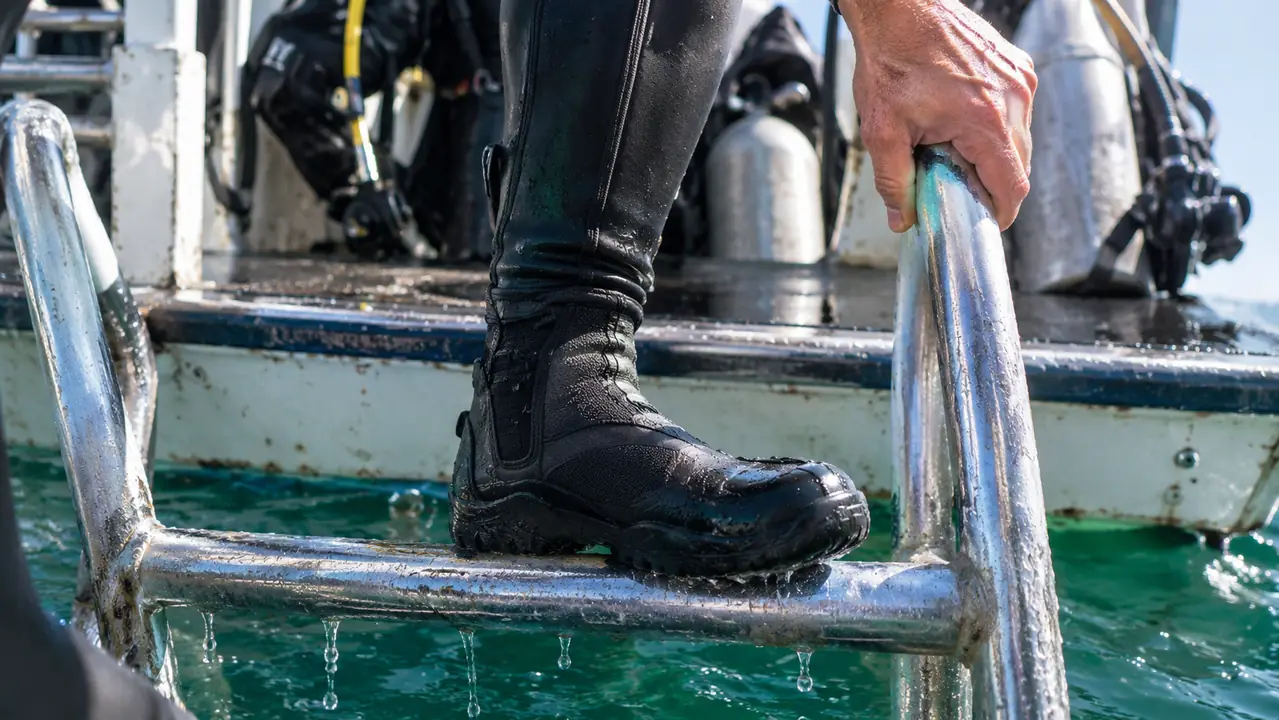
The anti-slip rubber sole is the reason I would buy these again. A wet aluminum ladder rung at the stern of a charter boat is one of the more honest tests of anything you put on your foot. It is round, it is slick with growth and seawater, and you are carrying weight when you step onto it. The rubber on these boots bites. I come up the ladder in them rather than barefoot or in the thin booties I used before, and I come up without thinking about it, which is the highest compliment I can pay a sole.
Limestone shore entries are the other test. The rock at the water line around here is pitted, sharp, and slick with algae right at the edge. The sole grips it well enough that I am not looking at my feet while I carry my kit down. I still go slowly. Grip is not the same as invincibility, and a 61 year old man with a tank on his back does not need to learn that lesson twice.
On a hot dock in July the rubber does what rubber does, which is get warm and stay warm. That is not a fault. It is the trade for a sole that holds wet metal. I have walked a quarter mile of pavement in them after a shore dive and the sole survived it, though the toe wore a shade faster than I would like. These are boots for the last 50 yards, not for a hike.
Warmth, and What These Boots Will Not Do
Water at home runs about 71 degrees in January and into the mid 80s by summer. At 61 I feel that January water in my hands and my feet before I feel it anywhere else. Thin surf booties were not enough. My feet would ache by the end of the second dive of the day and I would be done before I wanted to be. The Cressi boots fixed that. I noticed it on the first January trip after I bought them and I have noticed it every winter since.
What they will not do is make up for a cold core. If your torso is cold, no boot on earth saves the dive. They also will not keep water out. They are not dry boots and they are not meant to be. Water comes in over the top when you wade in, it warms against your skin, and it stays there. That is how a wet boot is supposed to work, and if you are expecting otherwise you will be disappointed by every boot you ever buy.
I cannot give you a neoprene thickness because the listing does not state one and I am not going to invent a number to sound authoritative. What I can tell you is what 71 degree water felt like on my feet for 45 minutes with these on, which was fine, and what it felt like in the booties I had before, which was not. If you dive in the 50s, you want a heavier boot than this and probably a different suit entirely, and no boot review is going to change that arithmetic.
The Parts That Annoy Me
They dry slowly. That is the honest headline and I will not dress it up. Two days on the line in humid September weather and the inside is still cool and damp to the hand. A boot dryer helps and I bought one. The zipper needs a rinse and a working every time, because salt gets into the teeth and the pull stiffens, and a stiff zipper with cold hands at the end of a dive is a small misery that compounds over a trip.
The fit is a lottery if you order online and have never worn the brand. There is no half size adjustment once the boot is in the water, and returns from a small town in the Keys are a chore I would rather not repeat. If you can try a pair at a shop before you buy, do that. If you cannot, measure your foot and your fin pocket and order with the tape measure in your hand rather than hope in your heart.
Who This Is For
Recreational divers who wear open-heel fins, dive in water from the high 60s upward, and want a boot that grips a wet ladder and does not fall apart in a season. Shore divers on rough entries. Sand hunters who spend an hour on their feet in shallow water working a detector over a public beach. Anyone who has been making do with thin surf booties and is tired of cold feet and sore ankles at the end of the day. If that is you, the Cressi boots are a straightforward buy, and mine show no sign of quitting at 90 dives.
Who Should Skip It
Skip them if you dive in genuinely cold water and need a heavy sole with real insulation. Skip them if you dive warm tropical water in full-foot fins, where you do not need a boot at all and a boot will only make the fin fit worse. Skip them if you want something that packs to nothing and dries overnight, because these are the opposite of that in every way. And skip them if you know in your heart you will not rinse and hang them, because a neglected pair of neoprene boots turns on you faster than any other piece of gear you own.
Eighteen months and 90 dives is not the end of a long test, but it is past the point where a bad boot reveals itself. Mine have not. The zipper works, the sole holds, the neoprene has kept its shape, and my feet are warmer in January than they were before I bought them. That is the whole review, and it is more than most gear earns.
If cold feet are why you cut the second dive short
Rinse them, hang them in the shade, work the zipper under fresh water, and they will outlast the fin they sit in. Check the current size chart before you order.
Amazon See Today's Price on Amazon →