
Salt is patient. It gets into the mesh, into the zipper teeth, into the seam tape on a wetsuit, and it keeps working while you drive home with the windows down. I have watched a good mask strap go chalky in a single season because I left a wet bag sitting in the back of the 4Runner overnight. Fourteen years of diving out of Tavernier and about 400 logged dives have taught me the same lesson twice: rinsing is not the chore. Drying is the chore. The rinse takes four minutes and the drying decides whether your gear lasts four years or fourteen.
Eighteen months ago my old mesh bag split along the seam on the way back from a charter, and I replaced it with a 37 inch Bulex mesh duffle. The bag is 37 by 15 by 15 inches, which works out to 136 liters, and it swallows fins, boots, gloves, mask, wetsuit, light and detector with room left over. It is polypropylene mesh with a zipper closure, a nylon shoulder strap, two side zipper pockets and no wheels. The reason it works is not clever. It is open. Air moves through it and water falls out of it instead of pooling in the bottom. What follows is how I make that openness count.
Get the bag that drains instead of the bag that holds
The Bulex mesh duffle is 37 inches long, 136 liters, polypropylene mesh with a zipper closure and two side zipper pockets. It carries up to 60 pounds and it is not water resistant, which is the entire point. Rated 4.6 from 2,721 reviews on Amazon.
Amazon See the Bulex mesh duffle on Amazon →If you already own a bag that holds water, these steps still work, just slower and with more towel. Most dive bags are built like luggage: coated fabric, sealed seams, a solid bottom panel. They keep rain off your gear and they hold a half inch of salt water against your wetsuit for the whole ride home. Mesh does the opposite. It is a poor bag for an airplane and a very good bag for a car and a boat, which is the only two places mine ever goes.
Step 1: Rinse It While the Salt Is Still Wet
Salt crystals form as water evaporates, and once they form they pull moisture out of the air and hold it against neoprene and metal. That is why a dry bag of gear smells like a bait cooler by Thursday. Rinse before that happens. Most charters out of Tavernier have a fresh water hose at the dock and a few have one on the boat. Use it while the gear is still dripping. If you wait until you get home, you are not rinsing salt, you are dissolving a crust.
The order I use: mask and regulator first, because those are the pieces where salt does real damage, then boots and fins, then the wetsuit, then the bag itself. Keep the dust cap on the first stage and do not blast the hose into it. Rinse a second stage with the mouthpiece pointed down so water runs out and not into the case. If the regulator is going to sit for a month, that one rinse is the difference between a service and a rebuild.
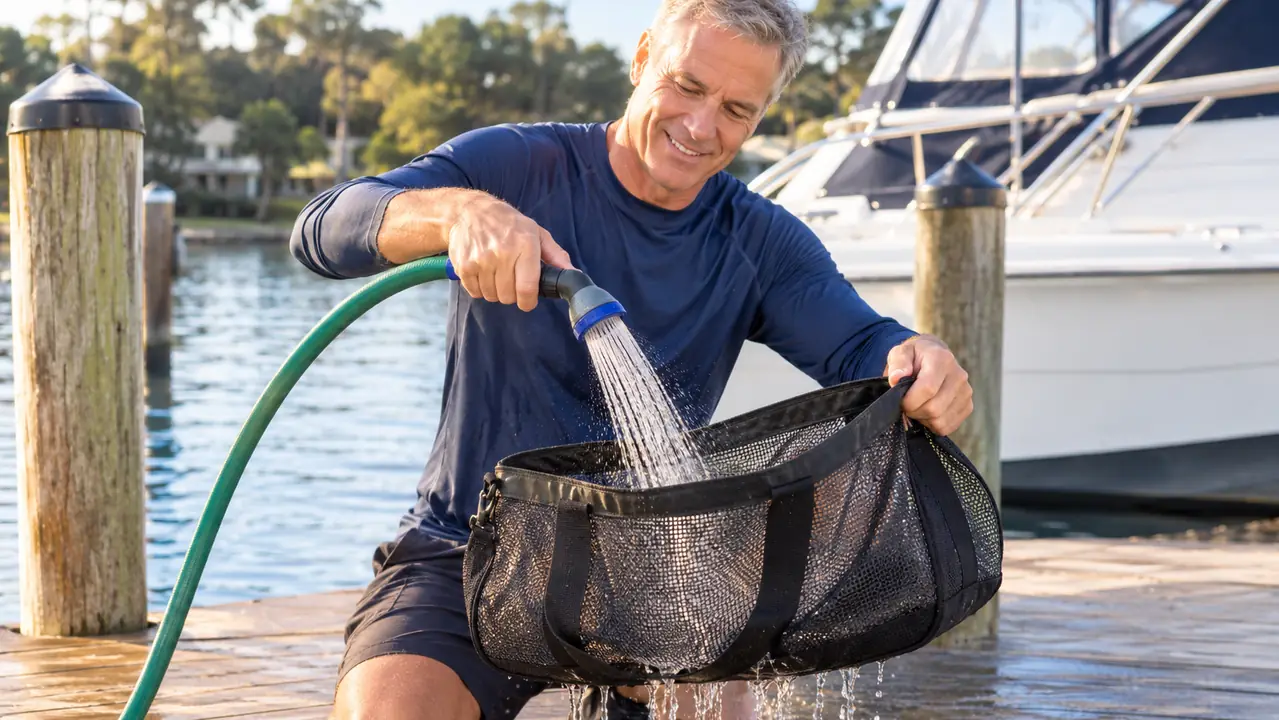
Then do the bag. Turn it as inside out as the mesh allows, hose the inside, hose the outside, and run a hand along the bottom seam. At 136 liters, the bottom is where everything settles, sand included. Sand in the mesh is not a defect, it is what happens when you set the bag down on a beach. Rinse it out and it stops being an abrasive grinding against your wetsuit all season.
Step 2: Pack It So the Water Can Actually Leave
A mesh bag stuffed into a ball is a solid object. The mesh only works when air and water have a path, so pack loose. Boots in the bottom, since they are heaviest and the bottom is where weight belongs. Fins laid along the length, which is the whole reason to own a 37 inch bag, because long fins do not fit in a 30 inch duffle without bending. Wetsuit folded once, not rolled tight. Mask in one of the two side zipper pockets where a boot will not crush it.
Leave the main zipper partway open while the bag rides in the cargo area of the 4Runner. It will not spill, because the load is packed flat, and the open zipper gives water somewhere to go before you even get home. My bag lives on a rubber mat back there and by the time I pull into the carport there is a wet patch on the mat and less water in the bag. That is water that is not sitting against my wetsuit for the next two days.
The Bulex is rated to carry 60 pounds and the shoulder strap is nylon. A full recreational kit sits well under that. A weight belt does not, so I carry lead separately in a plastic milk crate. Loading a mesh duffle until the strap digs a groove in your shoulder is not a test of the bag, it is a test of your back at 61.
Step 3: Hang It Under the Carport, Not in the Sun
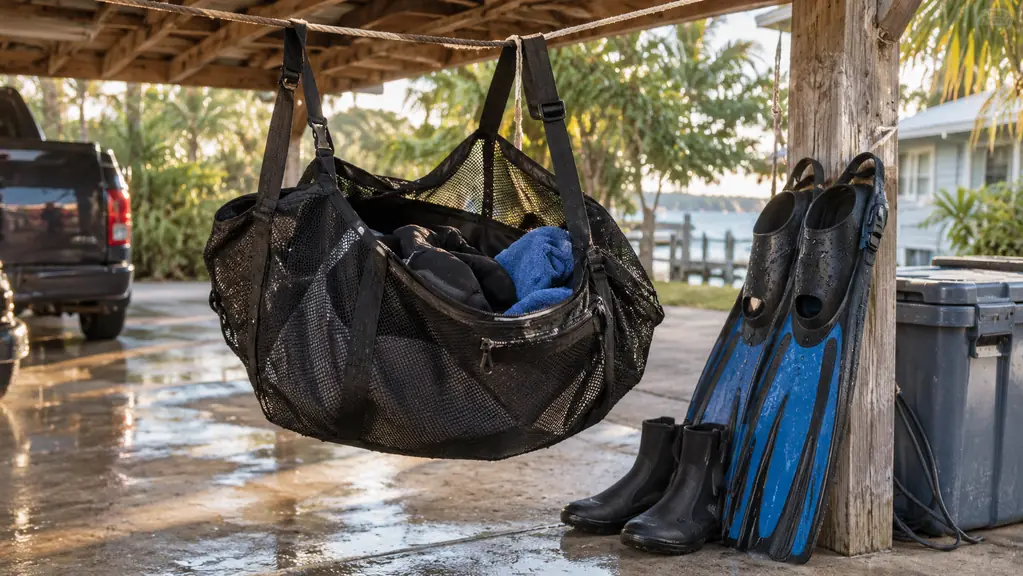
I hang mine from the clothesline under the carport. Loop the shoulder strap over the line and let the bag open into a trough. The mesh does the rest. Water leaves through the sides and the bottom, air comes in the top, and the bag is not sitting in its own puddle the way it would on a driveway or a garage floor. This is the step people skip, because a bag on the ground looks like it is drying. It is not. It is marinating.
Do not hang it in direct Florida sun. Sun does more damage to neoprene and to mesh than salt does, and it does it faster. Shade with moving air beats full sun every time. My carport is open on two sides and there is almost always a breeze through it. On a still August day I put a box fan on the concrete pointed up at the bag for the first few hours, and that cuts most of a day off the dry time.
In January the water at home runs about 71 degrees and the air is not much warmer, so gear that dries overnight in July takes a full day and a half in January. Plan for it. A wetsuit still damp at the cuff on the morning of a dive is not a disaster, it is just cold. A wetsuit that has been sitting damp for three days is a smell you will not get out.
Mesh does not protect your gear from water. It protects your gear from staying wet, which is the thing that actually ruins it.
Step 4: Pull the Hard Pieces Out and Dry Them Separately
Mesh dries fabric. It does not dry a light, a detector or a mask skirt. Those come out and get their own treatment. The Genwiss light gets wiped with a fresh water rag, dried with a towel, and left on the shelf with the switch off. Five modes and a lithium-ion battery, and none of that enjoys a week in a damp bag. The detector gets rinsed, towel dried and checked for chirping, because the lost alarm sounds after five minutes of inactivity.
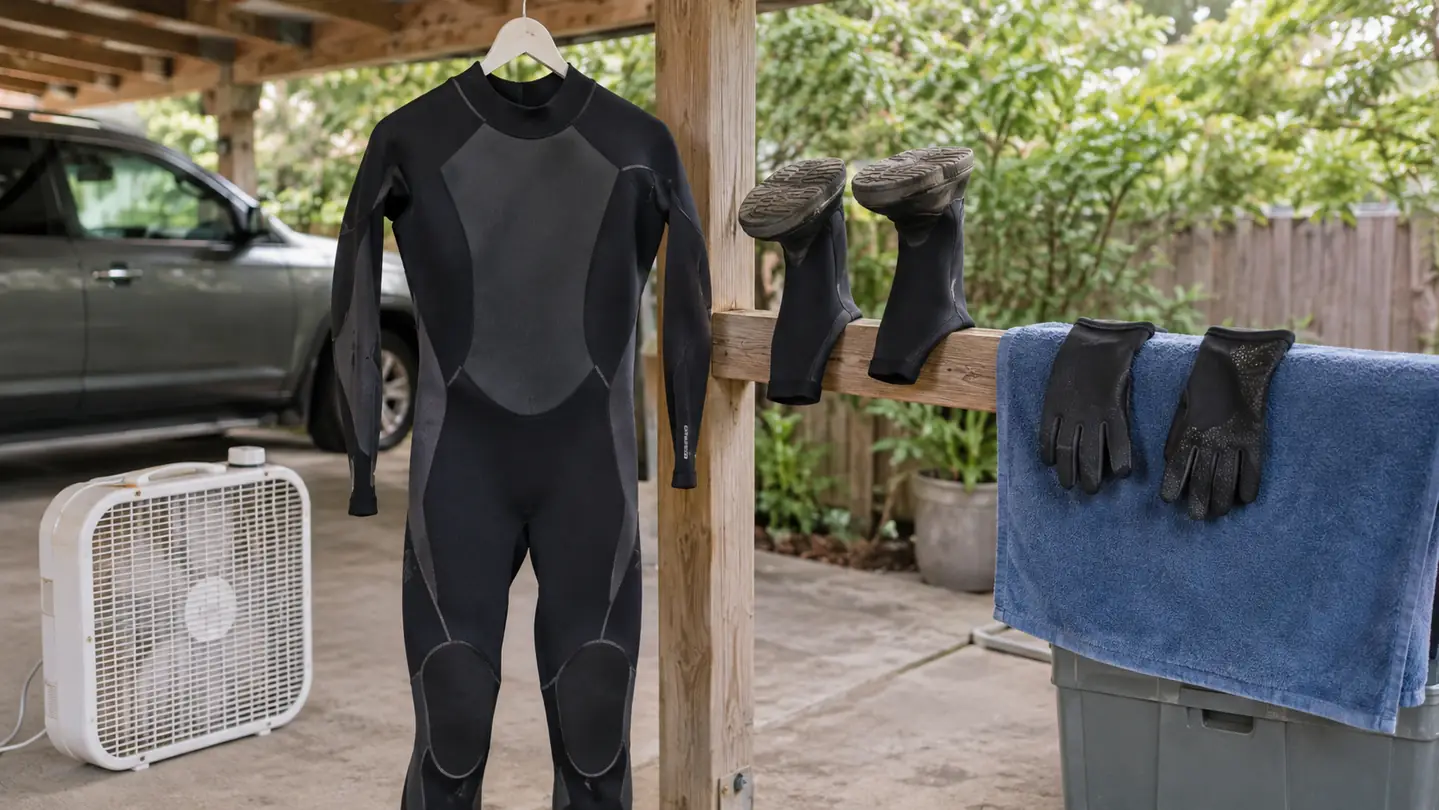
Boots go upside down. I set mine over the ends of a broom handle laid across two sawhorses, or over the rail of the rinse tub. A boot that dries right side up holds water in the toe and grows things. Gloves get laid flat on the mesh of the bag, not wadded into a pocket. The mask gets its own spot on a towel, lens up, so the skirt does not take a crease.
The wetsuit goes on a wide plastic hanger, never wire. Wire puts a point in the shoulder that never comes out. I hang it inside out for the first few hours and then turn it right side out to finish. If you have thick neoprene and no patience, drape it over two lines so the weight is spread instead of stretching the shoulders.
Step 5: Store It Open and Check the Mesh Before the Next Trip
When everything is dry, the bag goes back on the line, empty and unzipped, and it stays there until the next dive. Polypropylene mesh does not rot and does not hold odor, which is another reason it beats a coated duffle, but mesh does abrade. Store it open so it is not creased along the same line every time, and so air keeps moving through it between trips.
Before each trip I run a hand over the mesh at the corners and along the bottom seam, then look at the zipper and the stitching where the Bulex strap meets the body. Both side pockets get checked too, because that is where the small expensive things live. A pinhole becomes a tear once 60 pounds of gear is pulling on it, and a tear in a bag carrying a detector is a bad afternoon on the water.
And nothing goes into storage wet. Not the bag, not the wetsuit, not a single glove. The whole point of mesh is that it lets you skip the towel and go straight to hanging. The whole failure mode is trusting it to dry gear that is still inside it. Empty it. Hang it. Leave it.
What Else Helps
A five gallon bucket of fresh water at the dock does most of what a hose does when the hose is taken. I keep one in the 4Runner. Dunk the mask and the gloves and let them soak while you rinse the wetsuit. Do not dunk a regulator in a bucket, because you cannot control where the water goes and the dust cap will not save you.
Use mild soap if you use anything. Detergent leaves a film that neoprene holds onto, and fabric softener is worse. A capful of plain soap in a bucket of fresh water once a month, then a clean water rinse, handles the buildup that sunblock and sweat leave behind on a hood and cuffs.
Cal keeps a spray bottle of fresh water in his dive bag and hits his mask and boot zippers on the boat ramp before he ever gets to a hose. Small thing, works. The other small thing is a rubber mat and an old towel in the cargo area. My 4Runner is 11 years old and the carpet back there still does not smell like a marina, and that is not luck.
Your gear does not wear out on the dive. It wears out in the bag on the way home.
37 inches long for long fins, 136 liters for a full kit, polypropylene mesh so water leaves instead of pooling, two side zipper pockets for the mask and the small parts, nylon strap rated to 60 pounds. The Bulex mesh duffle has done about 90 dives with me and it is still the simplest piece of gear I own.
Amazon Check today's price on Amazon →