
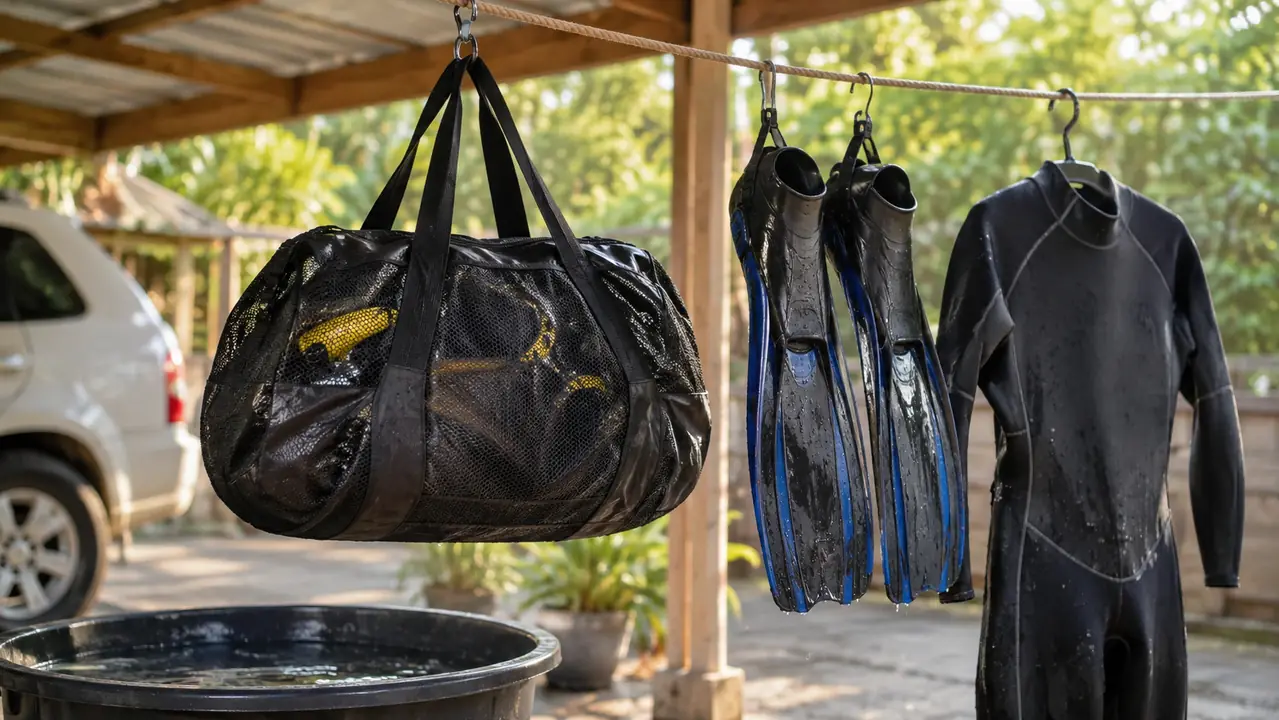
Two mesh duffles come up every time a recreational diver asks what to carry gear in: the Bulex 37 inch mesh duffle and the Fitdom mesh duffle. I own the Bulex. It has been on roughly 90 dives over the last 18 months, from charter boats out of Tavernier to limestone shore entries, and it is where my fins, boots, wetsuit, light and detector live between dives.
I do not own the Fitdom. I compared it from its published listing, plus a look at one on a boat, and I have marked the places where I could not verify a claim. That matters more than a tidy verdict. A mesh bag is a simple object, so the differences come down to length, fabric weight, pockets, and what the thing does to your gear after the dive. The Bulex takes more of those rows. The Fitdom takes two of them honestly, and one of those two is the reason a lot of divers buy it in the first place.
| Bulex 37 Inch Mesh Duffle | Fitdom Mesh Duffle | |
|---|---|---|
| Size and fin fit | One size, 37 inches long, listed as long enough for long fins | Sold as a line of sizes, which gives you a shorter option for travel |
| Volume | 136 liters, listed at 37 x 15 x 15 inches | Not stated on the listing, so measure against your kit before ordering |
| Fabric and abrasion | Light polypropylene mesh, open and airy so gear dries | Heavier mesh build, which is the better bet against abrasion |
| Pockets | Two side zipper pockets plus the main compartment | Single main compartment, check the photos for pocket layout |
| Carrying | Nylon shoulder strap and handles, listed to carry 60 pounds | Shoulder strap, no wheels |
| Water resistance | Not water resistant, on purpose, because it drains | Mesh body, so the same |
| Price | Check today's price before you commit | Check today's price before you commit |
How I Compared Them
My old mesh bag split along the bottom seam in the spring of last year. Same week, the plastic tote I used for rinse water cracked at the corner. I replaced both at once and rebuilt the rest of the kit with them, which is why every piece of gear I write about carries the same 18 months of use. The Bulex went straight into service: charter boat decks, the cargo area of an older 4Runner, and a clothesline under the carport at home where it hangs beside the rinse tub.
Before I bought either bag I spent a month trying to avoid buying one. First attempt was a lidded plastic tote, which held water instead of draining it, so the wetsuit came out of it smelling like a bait bucket by the second week. Second attempt was a mesh laundry bag from the hardware store. It let the gear breathe fine, but the drawstring pulled the whole load onto one seam, and that seam let go on a Tuesday in April while I was walking the bag down a dock ramp. I chased my fins back up the ramp, carried the rest in my arms, and started reading listings that afternoon. That is the honest reason I own a purpose-made bag at all.
The Fitdom I know from its listing and from one I handled on a boat. I did not want to write a comparison off a photograph, so the Fitdom column only says what the listing says and what I could see with my own hands. Where a number was missing, I left it missing. That is not a knock on the bag. It is what I actually know.
What I judge a mesh bag on is a short list. Does it drain. Does the seam at the closed end hold the weight of wet gear. Do the zippers survive salt. Does it hang on a line without turning into a bag-shaped puddle of cloth. Fin length matters more than all of it, because a bag that will not take your fins is a bag you will not use.
Where the Bulex Wins
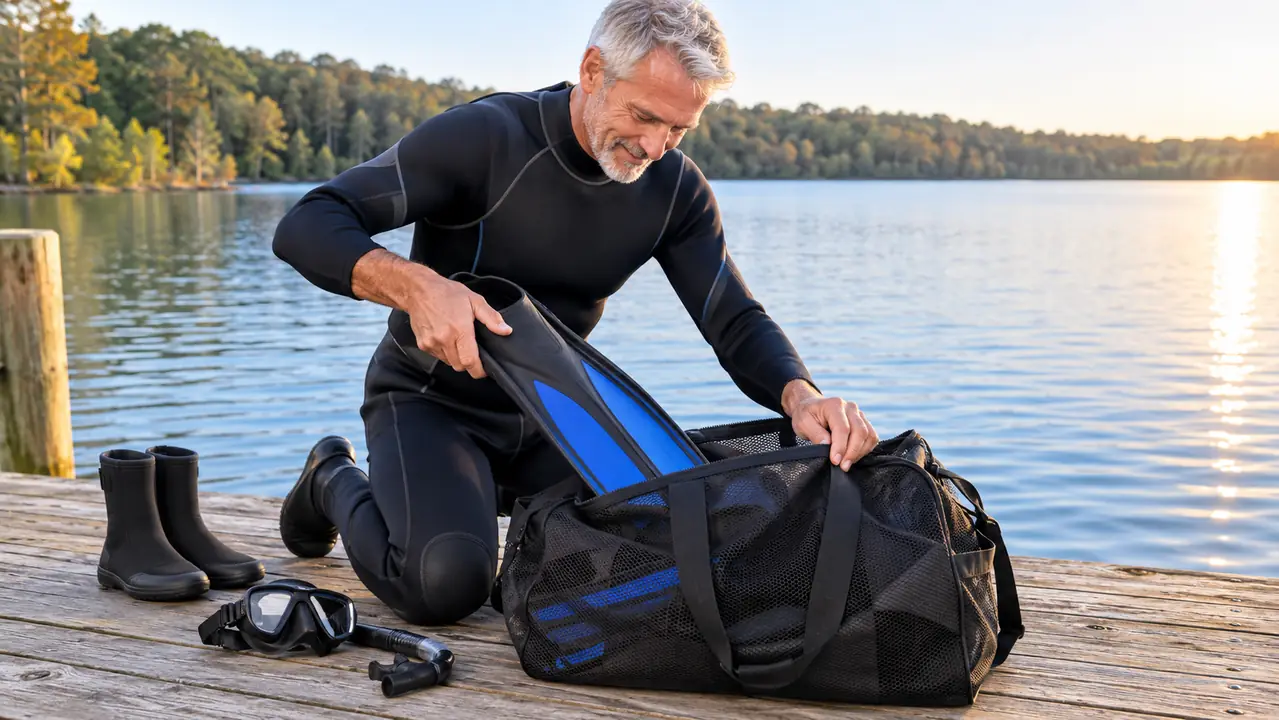
Thirty seven inches is the whole argument. My fins are long, and the Bulex swallows them with the boots still attached to the foot pockets. The listed dimensions are 37 inches by 15 by 15, 136 liters of open space, and that space is shaped like a wetsuit: flat, long, and willing to take a folded suit without a fight. I load it in a fixed order now. Wetsuit first, folded once. Boots on top of that. Fins down one side. Mask, light and detector in the last gap.
One measurement I check on any bag before I trust it: lay it flat and run a tape from the inside of the closed end to the open end. The Bulex lists 37 inches and mine measures 37, which sounds like nothing until you have owned a bag that lists 36 and delivers 33 because the end seam eats the difference. My fins run 26 inches from blade tip to the back of the heel pocket. That leaves about 11 inches of slack, and 11 inches is exactly enough to drop the boots in the bottom, close the top, and still have room for a mask box without folding anything in half.
The two side zipper pockets do more work than the listing suggests. One carries a small save-a-dive kit: O-ring pick, spare strap, a couple of zip ties. The other holds a spool of line and a mask defog. Neither is big. Both keep small hard objects from migrating to the bottom of the bag and pressing a crease into a mask skirt.
The shoulder strap is nylon and it is stitched at both ends rather than looped through a single grommet, which is where cheap duffles fail first. The listing says the bag will carry 60 pounds. I have never loaded it past about 35, a wet wetsuit, boots, fins and the detector, and I would not want to. At 35 pounds it is a two-hand carry up a boat ladder, and that is fine, because the handles sit exactly where my hands want to be anyway.
The last thing in its favor is boring. Polypropylene mesh does not hold water. I lift the bag off the deck after a dive and it stops dripping in under a minute, which means the deck box stays dry and the wetsuit is already partway to drying before I get home.
Thirty seven inches is the number that matters. If your fins will not fit, nothing else on this page is worth reading.
Where the Fitdom Wins
The Bulex is built light on purpose and its own listing says so: light weight mesh material, open and airy so the gear can dry. That is the right call for drying and the wrong call for abrasion. If your last bag died sliding across a truck bed, over limestone, or against a dock cleat, heavier mesh is the answer, and the Fitdom is the heavier bag of the two. I would rather tell you that than pretend the light fabric is a virtue in every situation. It is not. It is a trade.
How I came to handle one at all: a friend of my dive buddy Cal turned up on a charter with a Fitdom, and I asked to look it over while we waited on the second tank. Three things I could check in two minutes. The stitching where the shoulder strap meets the body looked heavier than mine. The mesh itself was a denser weave, and you could feel the difference through a thumb, with less give when I pushed a fist into a side panel. The zipper pulls looked ordinary. What I could not check in two minutes is whether the closed end is reinforced, or how any of it behaves after 50 dives of salt, so I am not going to guess. On abrasion I am going on fabric weight and construction I saw myself, nothing more.
Fitdom sells theirs as a line of sizes rather than one bag. The Bulex comes in one length. Thirty seven inches is lovely on a boat with deck space and awkward in a shared bunk room, in the back seat, or in a small car carrying three people and three kits. If you want a shorter bag for travel, that option exists on one side of this comparison and not the other. Check the current size chart against your actual fin length before you order, because fin lengths vary more than people expect.
There is a third point that is not about the bag at all. A heavier mesh bag hung on a line dries nearly as fast as a light one. The weight buys you abrasion resistance and costs you a few extra minutes of drying, not a day of it. If I were starting over and my gear spent more time in the back of a vehicle than on a boat deck, I would weigh that more heavily than I did.
The 37 Inch Bag That Swallows Long Fins Whole
136 liters, two side zipper pockets, and a mesh body that drains on the deck instead of in your trunk. It has been my only dive bag for 18 months and about 90 dives.
Amazon Check Today's Price on Amazon →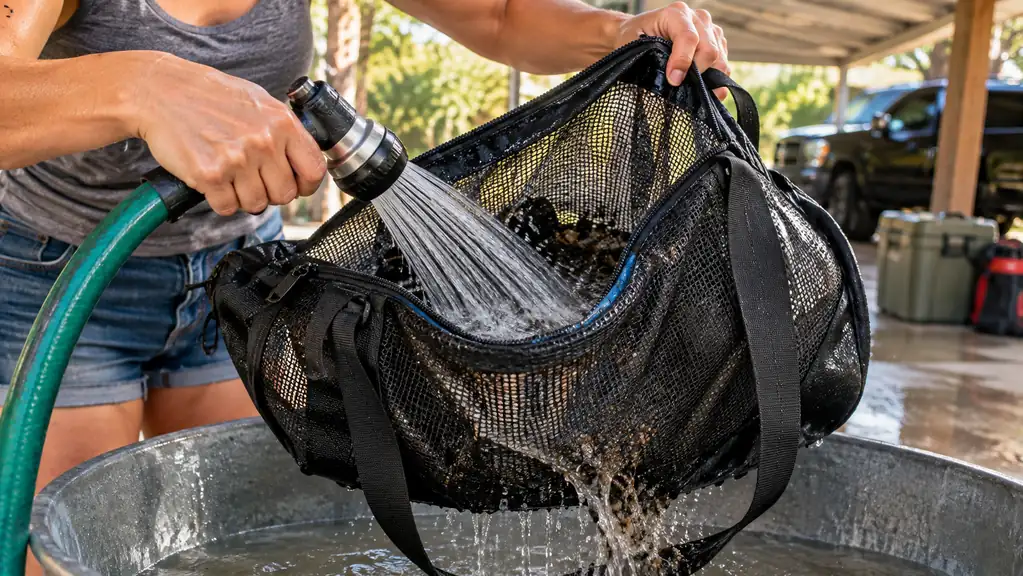
What the Specs Do Not Tell You
The listing says not water resistant, and that is not a defect, it is the design. A mesh bag is a colander with a strap. Water leaves, air moves, gear dries. What the listing does not say is that a wet mesh bag in a closed vehicle for two hours in July will make the whole car smell like a low tide. I hang mine under the carport before I do anything else, even before I rinse the regulator.
Here is the day that taught me the rinse routine. A Saturday in August at a public swim beach, working the sand between the swim boundary and the lifeguard stand. I dug better than 60 targets and came out with a handful of clad coins, a brass snap hook and a child's earring, plus what felt like a pound of sand sitting in the bottom of the bag. The detector rides wrapped in a towel for a reason: the coil housing collects grit in every seam, and the towel keeps that grit out of the zipper teeth. That afternoon I turned the bag inside out over the rinse tub, hosed it from the inside, and hung it. By Sunday morning it was dry and the sand was in the tub, not in the weave.
Salt kills zipper sliders. The main closure and both side pocket zippers get rinsed with fresh water after every saltwater day, and I run each slider open and closed a few times while it is still wet. Eighteen months in, all three still move freely. I have thrown away bags where the zipper went stiff inside a season because I never bothered to do that.
Sand works into mesh and stays there. Rinsing from the outside does nothing at all. Turn the bag inside out, hose it from the inside, and let it hang so the grit falls out the open end. If you hunt the sand the way I do, that is a weekly job, not a seasonal one. It takes two minutes and it is the difference between a bag that lasts and a bag that grinds itself apart from the inside.
What I Liked
- 37 inches takes long fins without a fight
- Drains fast and dries on a line
- Two side zipper pockets keep small gear off the bottom
- Nylon strap stitched at both ends, listed to carry 60 pounds
- 136 liters swallows a full wetsuit kit
Where It Falls Short
- Not water resistant, so wet gear in a closed car is a problem
- One size only
- Light mesh is not the most abrasion resistant choice
- No wheels, and a loaded bag is a two-hand carry
Who Should Buy Which
Buy the Bulex if you dive from boats and from shore, wear long fins, and want one bag that takes the whole kit and then hangs on a line. Mine has done about 90 dives and the seams and all three zippers are intact. It is the bag I would buy again tomorrow.
Look at the Fitdom if your last bag failed on abrasion rather than on seams, if you want a shorter bag for travel and small vehicles, or if you simply want the heavier mesh. Those are real reasons and I would not argue with any of them.
Buy neither if you fly with checked gear. Mesh does not protect a mask or a regulator from an airport baggage system, and no mesh duffle on either side of this page is going to do it. That is a padded travel bag job, and it is a different purchase.
One Bag, Ninety Dives, Fins Still Fit
37 inches by 15 by 15, 136 liters, two side zipper pockets, and a mesh body that drains before you reach the dock box. If you want the lighter bag that takes long fins and dries fast, this is it.
Amazon Check Today's Price on Amazon →