
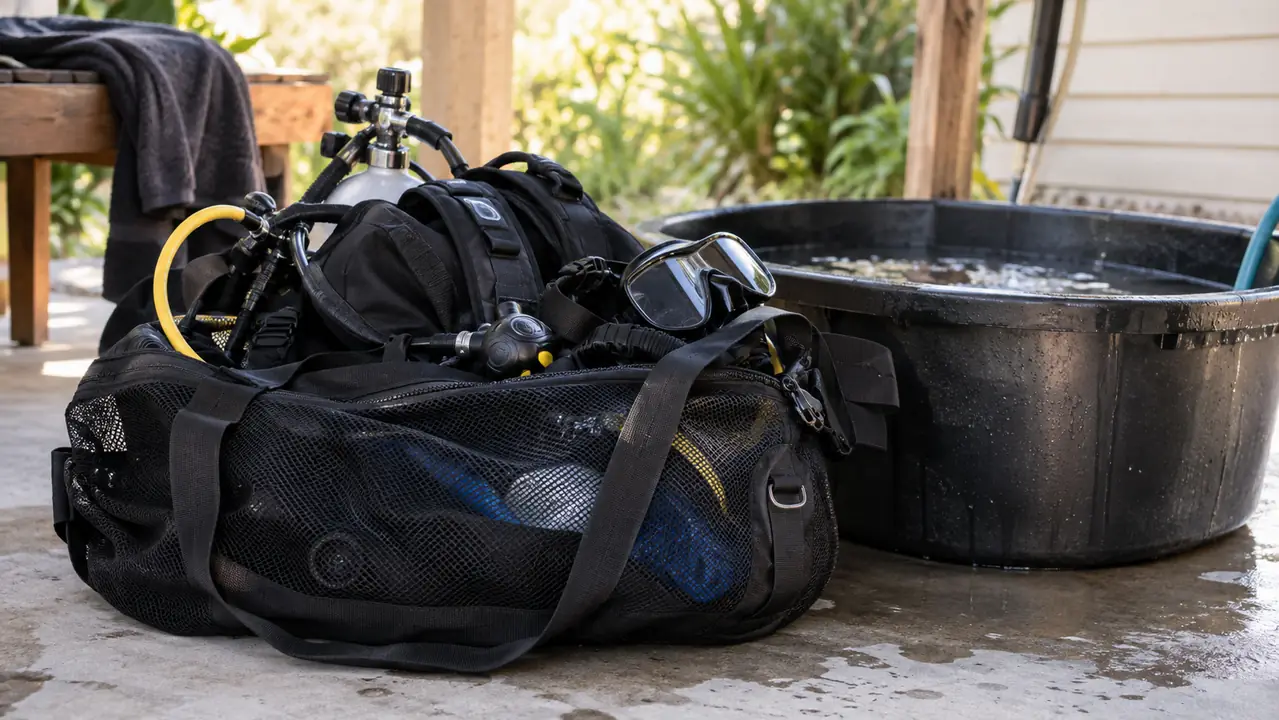
The Bulex mesh duffle bag is the least exciting piece of dive gear I own, which is why I trust it. My old mesh bag split along the seam in the spring of last year, and I replaced it with this 37-inch bag at the same time I rebuilt the rest of my kit. I am 61, I live in Tavernier, and I have been diving for 14 years, about 400 logged dives from charter boats and from shore. I do not own a boat. My gear rides in the cargo area of an older Toyota 4Runner, gets rinsed in an outdoor tub under the carport, and dries on a clothesline. A bag has to survive that routine, not a photo shoot.
The bag is simple on purpose. It measures 37 by 15 by 15 inches, holds 136 liters, and is made of polypropylene mesh with a zipper closure. There are two side zipper pockets and two zippered compartments, plus a stash pocket. The shell is soft, the strap is nylon, and the handles and shoulder strap are the whole carry system. It has no wheels. It is also not water resistant. That last point is not a defect for this job. A mesh duffle is supposed to let water out and air in, and the listing says the material is open and airy so gear can dry. If you need a dry bag, keep looking.
The Quick Verdict
A 37-inch mesh hauler that drains, dries and carries up to 60 pounds of gear. Buy it for the boat, the shore entry and the carport, not for the airline.
Amazon Check Today's Price →The bag that lets salt water out instead of holding it in
See the current Bulex listing for the 37-inch size, the two side zipper pockets and the 60-pound rating.
Amazon Check the Bulex Listing on Amazon →How I've Used It
I bought the Bulex bag about 18 months ago, in the spring of last year, when my old mesh bag split and I rebuilt my kit in one go. Since then it has been on roughly 90 dives. It has ridden in the 4Runner to shore entries, sat on the deck of local charter boats, and hung under the carport after a rinse. I have never checked it on a plane. It is not a travel case. It is the bag that goes between the vehicle and the water.
On a normal day it holds my fins, neoprene boots, gloves, mask, wetsuit, dive light and the detector I use on sand hunts. The detector rides wrapped in a towel. The 37-inch length is the reason I bought this size. My long fins fit without being folded into a U. The two side zipper pockets take a spare mask strap and a small save-a-dive kit. The main compartment takes the wet, bulky stuff. The bag is soft, so it slumps when empty and fits into the 4Runner without a fight.
I lift it by the handles when it is heavy and use the shoulder strap when I am walking from the parking lot to the water. The listing rates it to 60 pounds. I have not weighed my kit wet, but I know when I have packed too much, and I stop before the bag looks strained. The mesh drains on the deck. By the time I get home, most of the standing water is gone. That is the whole reason I went back to mesh.
The Mesh Does the Work
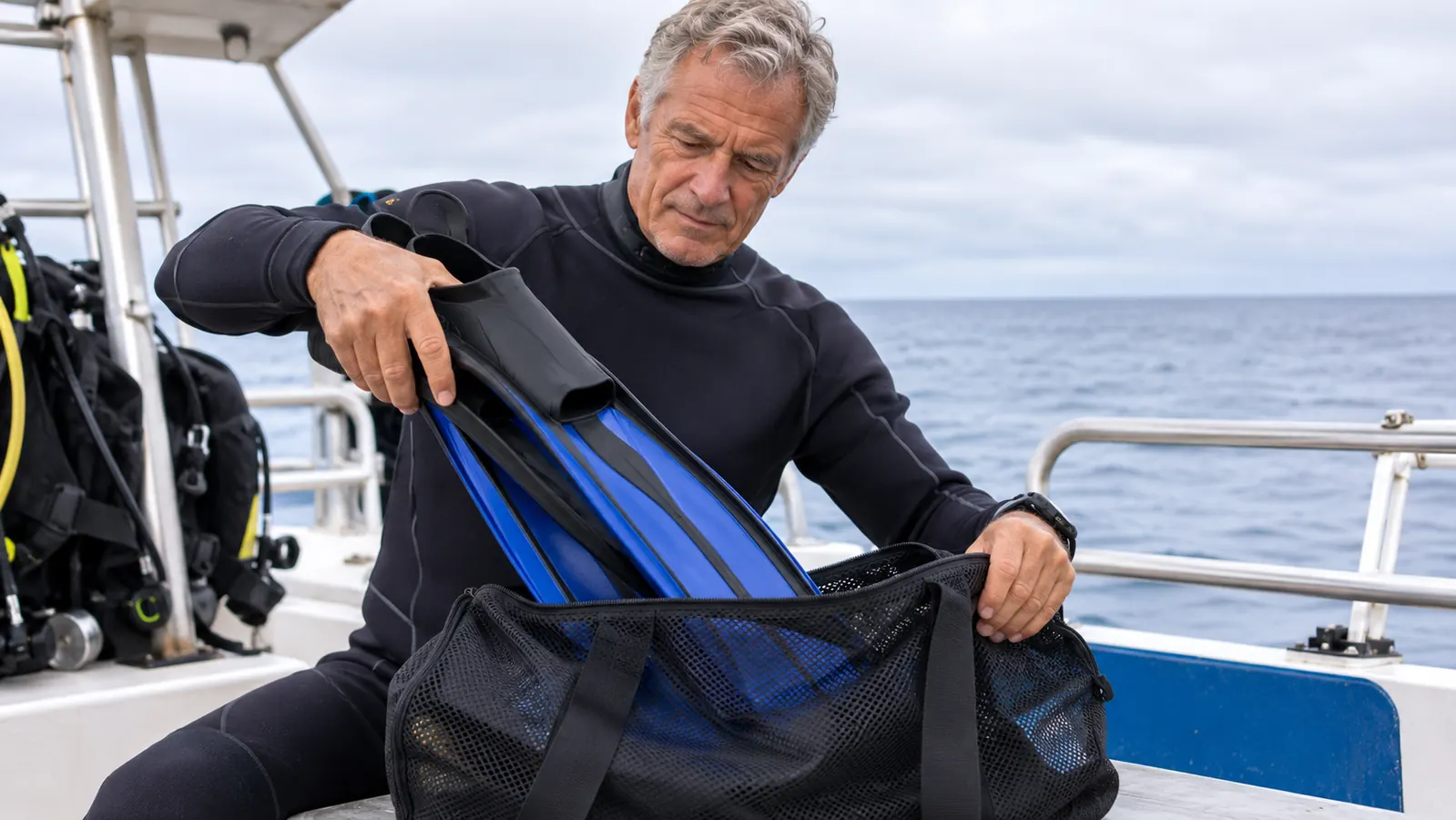
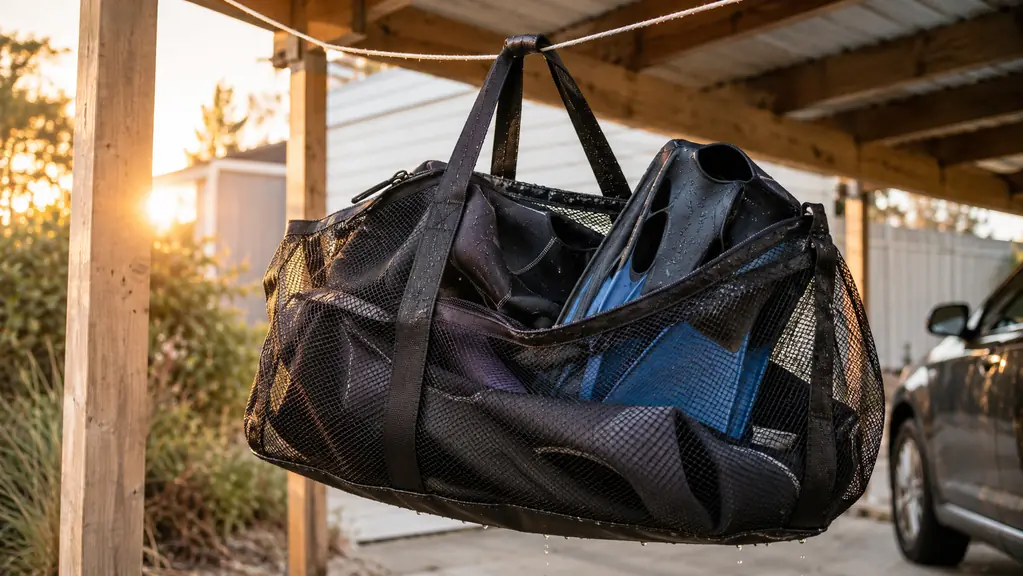
A wet bag that cannot breathe is a bag that smells like low tide by Thursday. The Bulex bag is not water resistant, and I want that stated plainly. Rain will go through it. A puddle will go through it. Splash from a rinse will go through it. My buddy Cal uses a hard duffel. After a rainy boat ride, he opens it and pours the water out. I do not have that problem. What this bag does instead is let the water out. The polypropylene mesh is open and airy. I set the bag in the rinse tub, hose the gear, lift it by the handles, and hang it on the clothesline under the carport. Air moves through the whole bag.
That matters more in Florida than it did when I worked on boats in cooler places. My water at home is about 71 degrees in January and in the mid 80s in summer. Neoprene that stays wet in a closed bag gets a smell that never quite leaves. The mesh bag gives it a way out. I have left this bag hanging overnight with a damp wetsuit inside and found the suit drier in the morning than it would have been in a plastic tote. The bag is not a dryer. It is a way to stop holding water against the gear.
The tradeoff is obvious. If you want to keep gear dry in the back of a vehicle, this is the wrong bag. If you want to carry wet gear home without a puddle in the trunk, this is the right bag. I put a towel under it in the 4Runner. That is the only concession I make. The mesh is light, and the bag does not add much weight of its own. That helps when I am already carrying 60 pounds of wet gear.
I also use the bag as a rinse container of sorts. I put the gear in, set the whole bag in the tub, and let the fresh water run through. The mesh lets the water move through instead of pooling. I do not scrub the bag. I do not use soap. I just let it soak for a few minutes, lift it, and hang it. That routine takes less time than filling a plastic tote and trying to pour it out without spilling half of it on the carport floor.
Size, Pockets, and What Fits
The 37 by 15 by 15 inch size is the number to check against your own kit. The listing calls it XXL, and it is large. I can put my wetsuit, boots, fins, mask, gloves, light and detector in the main space with room to spare. The two zippered compartments help me separate the dry-ish items from the wet ones. The two side zipper pockets are where I keep small things I do not want at the bottom of the bag. I use the stash pocket for a spare mask strap. If you wear short fins, this bag will look huge. If you wear long fins, it will look normal.
The bag is a soft shell, so it does not stand up on its own when empty. It has no wheels. It has a shoulder strap and handles, and that is it. I do not drag it over limestone or pavement. I carry it. The listing says it can carry 60 pounds, and I treat that as a ceiling, not a target. The material is polypropylene mesh, which is light and does not hold water. The zipper closure is the one part I check before I lift the bag. A zipper is a zipper. It needs a rinse and a little attention.
Packing it is not a puzzle. The wetsuit goes in first, then boots and fins along the sides, then the mask and small items in the pockets. Because the bag is soft, it takes the shape of the gear. That is a help in the 4Runner and a problem if you want the bag to stand open while you load it. I load it on the ground or on the tailgate. I do not try to hold it open with one hand and pack with the other. That is not the bag's fault. It is a duffle.
I also use the bag for kayaking and swimming gear, which the listing names as sport types along with diving. That is not why I bought it, but it is useful. A wet swimsuit and a towel go in the bag, and the bag goes on the clothesline. The same open mesh that dries a wetsuit dries a towel. It is a simple tool. It does one job well, and it does not pretend to be a suitcase.
How It Has Held Up
After 18 months and about 90 dives, the bag is still doing what it did on the first trip. The mesh has not torn. The nylon strap has not frayed. The handles are still attached. The zipper still closes. I rinse the bag with fresh water after every saltwater trip, hang it to dry, and put it away dry. I do not leave it sitting in the sun for days. I do not overload it past the 60-pound rating. I do not use it as a ground mat. That is not a hard life for a bag, but it is a wet, salty life, and the bag has handled it.
The one thing I watch is the zipper. Salt gets into everything. After a few months, the main zipper felt a little gritty. I rinsed it, let it dry, and it smoothed out. I have not had a failure. I have not had a seam let go. I have not had a pocket tear. The bag is not a piece of heavy hauling equipment. It is a mesh duffle with a 60-pound rating. If you treat it like a cargo net, you will probably break it. If you treat it like a bag, it holds up.
I have had one small issue, and it is not a failure. The mesh picks up sand. It is mesh, so sand goes into the weave and stays there until you rinse it. I shake the bag out after a beach entry and rinse it at home. If you hate sand in your gear bag, this bag will give you something to think about. I do not mind it. The sand comes out with water.
The bag has faded some from sun and salt, which is normal for anything left on a clothesline. The mesh still has its shape. The pockets still close. The strap still adjusts. I cannot tell you it will last 10 years. I can tell you it has lasted 18 months of regular diving without a repair. For a mesh bag, that is the test I care about.
Where It Falls Short
The Bulex bag is not water resistant, and that is the first limitation. It will not keep your gear dry in the rain. It will not protect a camera or a phone. It has no padding. It has no wheels. It does not stand up on its own. The shoulder strap is nylon, not a padded harness, and a 60-pound load on one shoulder is still a 60-pound load. If you have a long walk from the parking lot, you will feel it. The two handles are better for heavy loads, but you need two hands.
The bag also does not organize small items well. The two side zipper pockets and the stash pocket help, but the main space is one big mesh room. If you want compartments for every item, this is not that bag. I use small mesh stuff sacks for the light and the detector. That is my fix, not the bag's. The zipper is the only closure, and it is not covered by a flap. Sand and salt will find it. Rinse it.
Finally, this is not a travel bag. I have never checked it on a plane, and I would not. A soft mesh bag with no wheels and no structure is not something I would hand to an airline. It is a vehicle-to-water bag. If you need a bag that goes in the overhead bin or survives baggage handling, look at a different product. This one is for the boat, the shore and the carport.
What I Liked
- 37-inch length takes long fins without folding them
- Open polypropylene mesh drains water and lets gear dry
- 136 liters and a 60-pound rating handle a full recreational kit
- Two side zipper pockets and two zippered compartments keep small items separate
- Soft shell fits into the 4Runner and hangs on a clothesline
Where It Falls Short
- Not water resistant, so rain and puddles go straight through
- No wheels and no padding, so a heavy load is carried by hand or shoulder
- Main compartment is one open mesh space with limited organization
- Zipper needs rinsing after salt water
- Not suitable as checked airline luggage
Ninety dives in, the zipper is still the only part of this bag I check before I lift it.
Who This Is For
This bag is for the recreational diver who comes home with wet gear and no good place to put it. It suits someone who dives from a charter boat or from shore, who rinses gear in a tub, and who has a carport, a garage or a clothesline where a wet bag can hang. It suits long-fin users because the 37-inch length is real. It suits kayakers and swimmers who want a cheap, light way to carry wet gear and let it dry. It suits a diver who already has a dry bag for the things that must stay dry, and who wants a separate bag for the wet, heavy stuff.
It also makes sense for a dive club or a family with several sets of gear. The 136 liters and the 60-pound rating mean one bag can carry a lot. I would not put weights in it, and I would not carry tanks in it, but for soft gear it is a lot of room. The two side zipper pockets keep small items from disappearing into the main space.
Who Should Skip It
Skip it if you need a bag that keeps water out. Skip it if you are flying with your gear and checking a bag. Skip it if you want wheels, padding or a structured bottom. Skip it if you carry more than 60 pounds of gear, or if you like a place for every small item. Skip it if you will leave it full of wet neoprene in a closed vehicle for a week, because no mesh bag can save you from that. This is a simple drain-and-dry bag. It is not a luggage system.
If your gear comes home wet, let the bag breathe
Check the current Bulex listing for the 37-inch mesh duffle, the two side zipper pockets and the 60-pound rating before your next boat trip.
Amazon Check the Bulex Listing on Amazon →