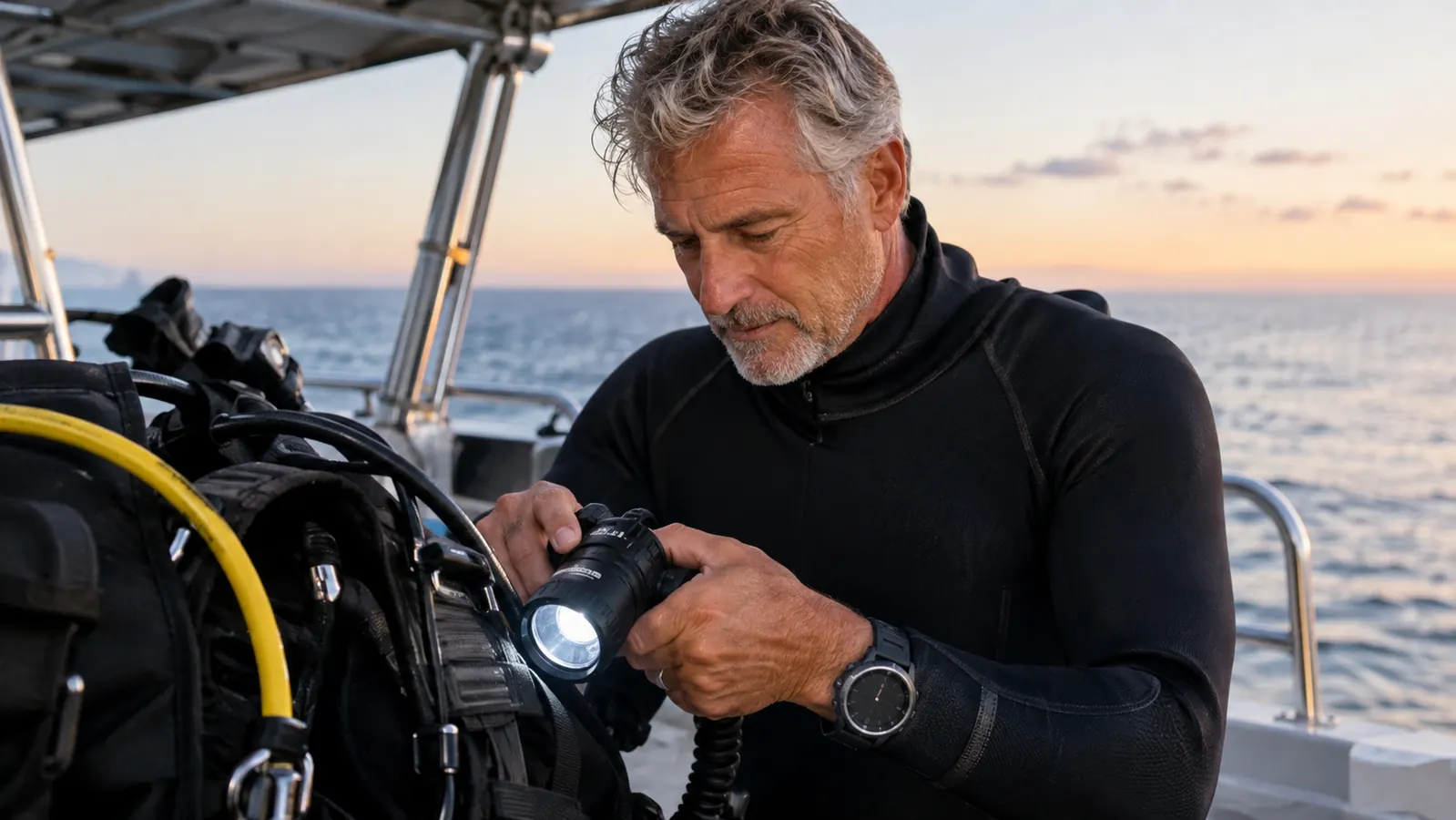
The Genwiss dive light is the piece of gear in my kit that gets the most questions and the least accurate answers. I bought it about 18 months ago when I rebuilt my dive kit, and it has been on roughly 90 dives since, mostly night dives from charter boats and daytime looks under ledges on the outer reef. It is a rechargeable lithium-ion light with five modes, an aluminum alloy body, and a spec panel that says 1000 lumens. It is not a cave light, it is not a technical primary, and it is not the brightest thing you can clip to your wrist. For the recreational diver who needs a reliable beam for a 45 minute night dive and does not want to babysit a fussy charger, it does the job. But there are a few things the listing does not make clear, and those are the things I would want to know before I spent my own money.
Most dive lights sold to recreational divers are sold on a number. The number goes in the title, the number goes in the bullet points, and the number is usually the most generous reading of a test on a fresh battery. The Genwiss listing is no different. The title carries a bigger number than the spec panel does. The spec panel says 1000 lumens, and the feature bullet says the maximum output is 1000 lumens. That is the figure I have used for every comparison in this review. I would rather tell you what the light does at 1000 lumens than repeat a number the manufacturer's own data does not support. That is not a knock on the light. It is just the first honest thing I can tell you about it.
The Quick Verdict
A dependable 1000 lumen recreational light with a real aluminum body and five simple modes. It is not a technical primary, and the listing overstates what the spec panel supports.
Amazon Check Today's Price →The spec panel is the honest part of this listing
The Genwiss page lists the 1000 lumen output, the five modes, the aluminum body, the battery and the USB charger in one place. Read that panel before you read the title.
Amazon Check Today's Price on Amazon →What the Spec Sheet Actually Says
The Genwiss GN-T42 is listed as a 10 watt LED dive light with a white brightness of 1000 lumens. It runs on 4.2 volts of direct current from one lithium-ion battery, and the package includes the battery and a USB charger. The light measures 7.8 inches deep by 3.86 inches wide by 1.85 inches high and weighs 331.12 grams. The body is aluminum alloy with an anti-abrasive coating, and the light is listed as waterproof. It has a switch for five modes: high, medium, low, strobe and SOS. Those are the facts from the listing, and they are the only facts I am going to use when I describe what this light can do.
The most important missing line is depth. The spec sheet says waterproof, but it does not give a depth rating. That is not a small omission on a dive light. I treat it as a shallow recreational light because that is how I use it, from the surface to about 60 feet. I have had it to 60 feet on night dives and it has stayed dry. I have not taken it deeper, and I would not take it deeper just to see what happens. A diver who needs a printed depth rating for a wreck or a cave has a different job than I do, and this is not the light for that job.
The 331.12 gram figure is honest, and it tells you something the photos do not. This is not a featherweight backup that disappears in a pocket. It is 7.8 inches long, so it takes up real room in a mesh duffle. I like the heft on a night dive because it feels solid in a gloved hand, but I do not like it on a daylight reef dive where I am already carrying a detector or a camera. The aluminum body has taken scuffs on limestone entries and on the deck of a charter boat, and the coating has held up. The switch is easy to find with a 3mm glove, though it takes a firm press to move through the modes.
How I've Used It
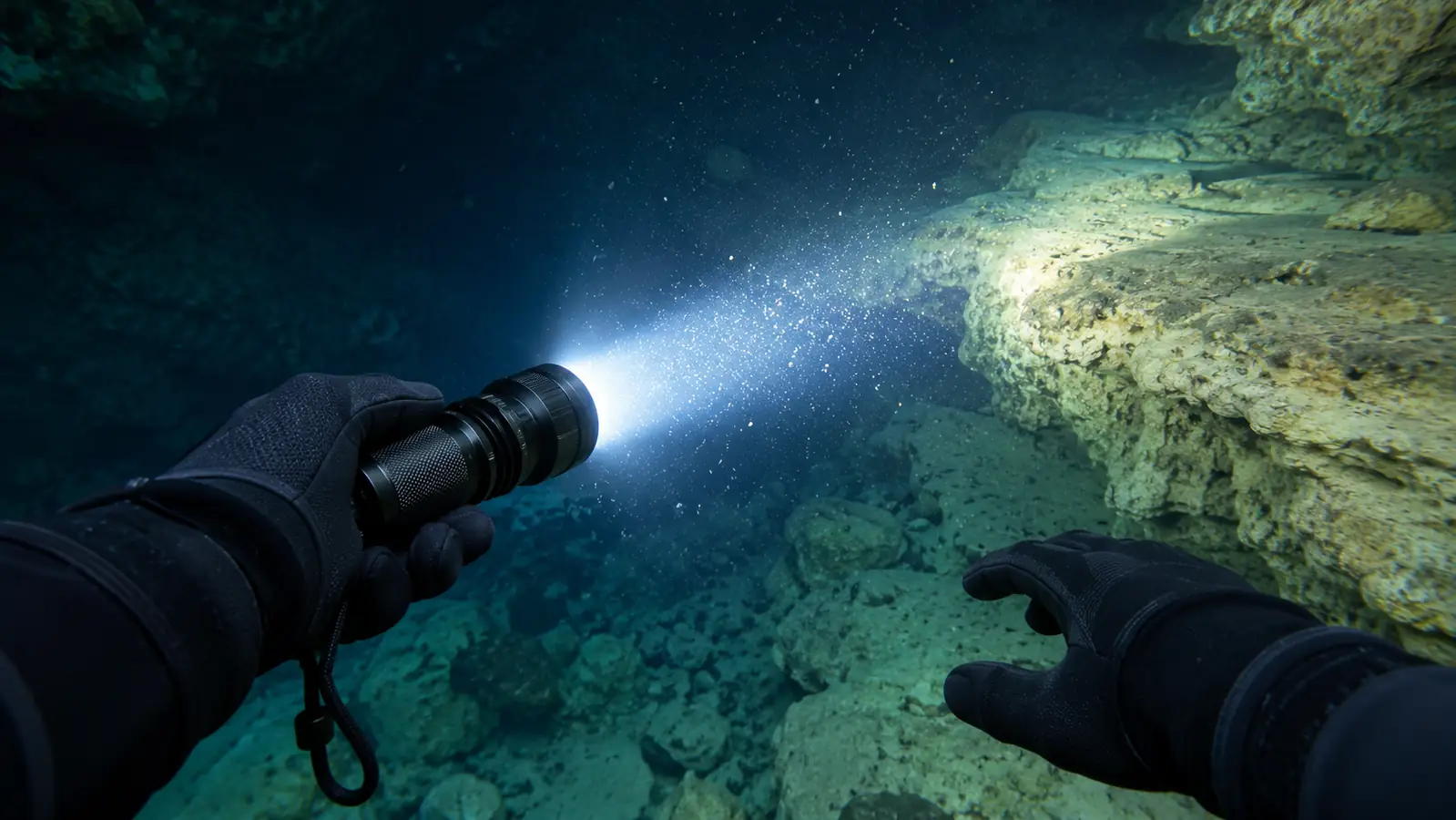
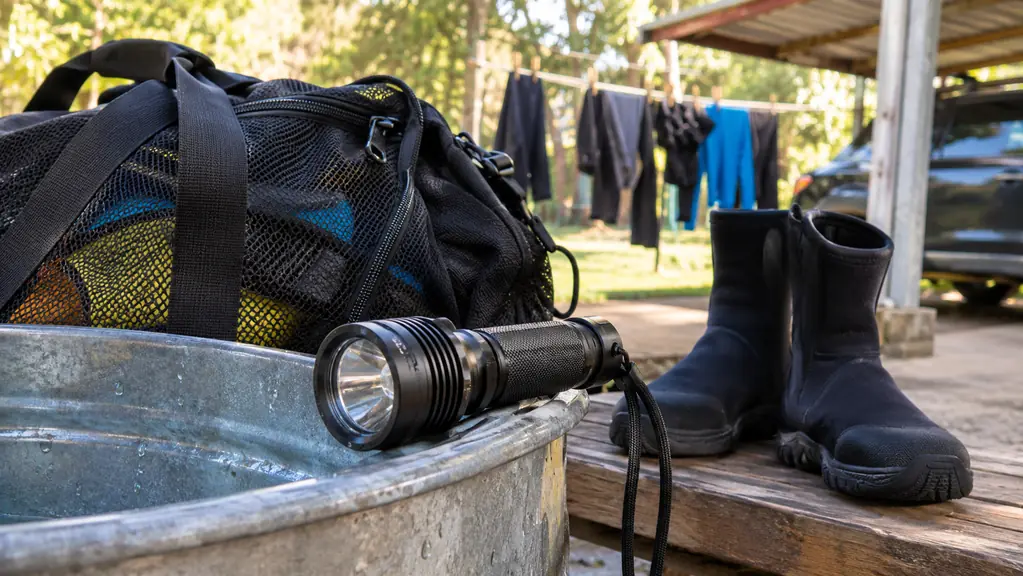
I bought the Genwiss in the spring of last year when my old mesh bag split and I rebuilt my kit in one go. It replaced a dim plastic light I had been borrowing from the dive club. Since then it has been on about 90 dives, which for me means guided night charters, shore dives at the local beaches, and daytime dives where I want to look under a ledge without putting my hand into a hole I cannot see. It rides in the mesh duffle with my boots and gloves, and it gets rinsed in the outdoor tub under the carport after every saltwater day. That routine has not changed, and neither has the light.
On a night dive I do not need a light that turns the reef into a stadium. I need one that shows me the line, my gauges, my buddy's hand signals, and the sand in front of my fins. The Genwiss does that on high. On medium it is enough to look under a ledge in daylight without blasting every fish in the area. On low it is enough to sort gear on the boat before the dive. I have used it as my primary on guided night dives and as a backup on day dives, and it has not left me in the dark. My buddy Cal carries a more expensive light, and his beam reaches farther, but I have never felt underlit on a 45 minute recreational dive.
The first time I took it under a ledge I was worried about the switch moving in my glove and changing modes by accident. That has not happened. The switch has stayed where I put it, and the mode I selected is the mode I got at the bottom. I have dropped it once on a limestone entry, maybe three feet onto rock, and it has a scuff on the body but no crack and no flooding. I would not make a habit of dropping it, but I am not going to pretend it is made of glass either. It is a work light, and it has taken work light treatment.
The 1000 Lumen Question
1000 lumens is a useful number for a recreational night dive. It is enough to light up the sand in front of you, read your gauges, and see your buddy's hand. It is not enough to punch through a silt cloud or light up the back of a wreck. If you are expecting a light that turns a dark hold into daylight, you are going to be disappointed, and no number on the box is going to fix that. The Genwiss is a light for the kind of diving most of us actually do: 20 to 60 feet, warm water, a guide with a line, and a boat waiting when you surface.
The title's larger number is the thing I would ignore. I do not know why the listing carries two different figures, and I am not going to guess. I know the spec panel says 1000 lumens and the feature bullet says 1000 lumens, and I know the light performs like a 1000 lumen light. That is what matters to me. A light is not a number on a box. It is a tool you trust when the sun goes down and the water gets black. At 1000 lumens, this one earns that trust for my kind of diving.
The spec panel says 1000 lumens. That is the number I plan a night dive around, not the number in the title.
Modes, Charging, and the Stuff Nobody Mentions
The switch cycles through high, medium, low, strobe and SOS in the order listed. High is for the dark part of the night dive. Medium is for looking under ledges in daylight. Low is for the boat and for checking gear without blinding anyone. Strobe and SOS are there for emergencies, and I hope I never need either one. I have tested them on land to make sure they work, and they do. I would not buy this light for the strobe. I bought it for the first three modes and for the aluminum body, and those are the parts I use.
Charging is simple. The package includes one lithium-ion battery and a USB charger. I charge it at home from a USB port, and I top it off before every night dive. The spec sheet does not give a runtime, so I do not plan around a runtime I cannot verify. I would rather spend five minutes topping off a battery than spend a night dive wondering when the light is going to dim. That is not a flaw in the light. It is a flaw in the listing, and it is easy to work around if you are the kind of person who checks their gear before they leave the house.
The light has no published depth rating and no published runtime. Those are the two things I would fix if I were writing the listing. The 1000 lumen figure is clear. The five modes are clear. The aluminum body and the included battery and charger are clear. The two numbers a diver actually plans around are missing. I have filled in that gap with my own experience, about 90 dives and no flooding at 60 feet, but my experience is not a manufacturer's rating. You should know that going in.
Where It Falls Short
The first shortfall is the gap between the title and the spec panel. A shopper who reads only the title thinks they are getting one thing. A shopper who reads the spec panel sees another. I do not like that, and I do not think it helps the light. The Genwiss is a good recreational light at 1000 lumens. It does not need a bigger number in the title to sell me. The mismatch makes me trust the listing less, not more, and I would rather the company pick one number and stand behind it.
The second is weight and size. At 7.8 inches long and 331.12 grams, it is a handful. It is not a tiny backup light you forget in a pocket. It takes up room in a mesh duffle, and on a daylight reef dive I sometimes leave it on the boat because I do not want the extra bulk. The third is the switch. With a 3mm glove it is easy to find, but it takes a firm press, and a diver with weak hands or a thick dry glove might find it fussy. I have not had a mode change on its own, but I have had to stop and press it deliberately.
The fourth is the missing depth rating. I have used this light to 60 feet without a problem, but I cannot tell you it is rated to 60 feet, because the listing does not say. That matters if you are a new diver who wants a number to hang your confidence on. It also matters if you are diving with a charter that asks for rated gear. My advice is simple: treat it as a shallow recreational light, keep it inside the kind of diving you can walk away from, and do not take it somewhere you would not go without a backup.
What I Liked
- The spec panel says 1000 lumens, and the light performs like a 1000 lumen light.
- Five modes cover high, medium, low, strobe and SOS.
- The aluminum alloy body with anti-abrasive coating has held up to scuffs and deck handling.
- The package includes one lithium-ion battery and a USB charger.
- It has stayed dry through about 90 dives, including repeated use to 60 feet.
Where It Falls Short
- The title carries a bigger number than the spec panel supports.
- No depth rating is published in the spec sheet.
- No runtime is published in the spec sheet.
- At 331.12 grams and 7.8 inches long, it is bulky for a backup light.
- The switch takes a firm press with thick gloves.
Who This Is For
This light suits the recreational diver who does 20 to 60 foot dives, mostly in warm water, and wants a simple primary for night dives or a solid backup for daytime ledges. It suits the diver who rinses gear in a tub, charges a battery at home, and does not want to think about a light on the boat. It also suits the diver who hunts the sand for lost metal and wants a light to check a hole or a shadow without carrying a technical primary. If you are that diver, the Genwiss is a practical tool at a fair price, and the 1000 lumen spec is honest.
Who Should Skip It
Skip it if you penetrate wrecks or caves, if you need a published depth rating for technical diving, or if you need a runtime figure before you leave the dock. Skip it if you want a tiny backup that disappears in a pocket, because this is not that light. Skip it if you need the brightest primary on the boat, because Cal's light is brighter and you will notice. The Genwiss is honest about what it is once you read the spec panel. It is a recreational dive light, not a technical one, and the diver who buys it for the right job will be happy with it.
If your diving looks like mine, this light makes sense
Read the spec panel, ignore the bigger number in the title, and judge it as a 1000 lumen recreational light with five modes, an aluminum body, a battery and a USB charger. That is the light I have used for about 90 dives.
Amazon Check Today's Price on Amazon →