
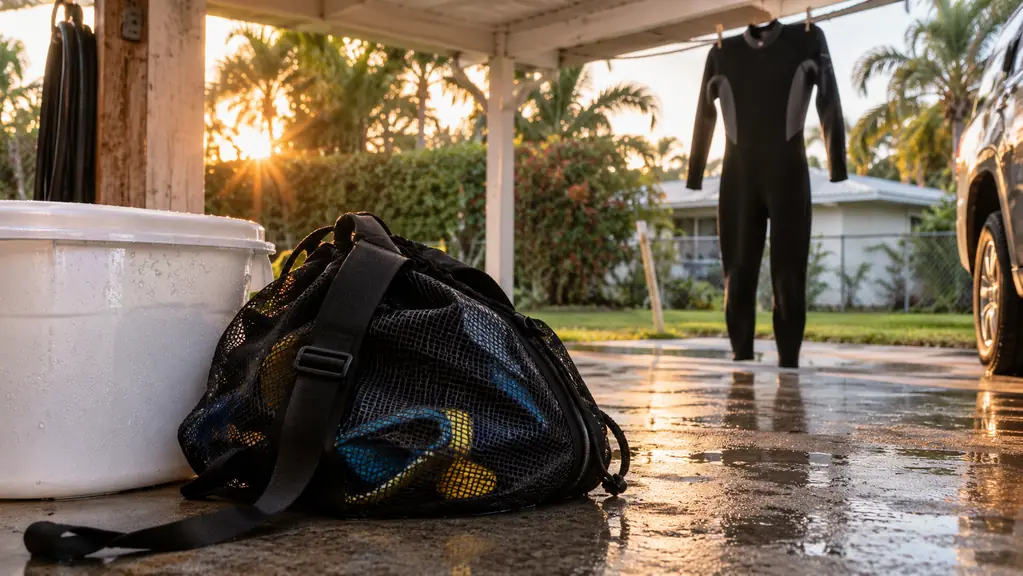
Nobody warns you that a mesh gear bag is a compromise before it is anything else. It is not water resistant. It will not keep a regulator safe from a deck hand's boot. It will not stand up on its own in the corner of a garage. What it does instead is let a wet wetsuit breathe on a carport clothesline so you are not zipping damp neoprene into a closet on a Sunday night and finding it sour by Thursday.
I bought the Bulex 37 inch mesh duffle about 18 months ago, in the same order that replaced most of my kit after my old bag split a seam on the drive home from a shore dive. It has ridden in the back of my 4Runner and on a good many charter boats since, somewhere around 90 dives by now. What follows is the review I would want to read before ordering one, including the parts that are not flattering.
The Quick Verdict
A big, plain, ventilated hauler that carries 60 pounds of wet gear and drains on the way home. It is not water resistant and it protects nothing delicate, so buy it as transport, not as a gear case.
Amazon Check Today's Price →37 inches of bag, for divers who own long fins
136 liters, a working zipper and two side pockets. This is the bag that lives in my 4Runner between dives. Check today's price and current availability on Amazon.
Amazon Check Today's Price on Amazon →How I've Used It
My diving is ordinary recreational work. Twenty to 60 feet, mostly off Tavernier and along the outer reef, with a guided night dive now and then and a fair number of sand hunts at public swim beaches where metal detecting is allowed. The bag has never been on an airplane and never will be. It rides in the cargo area of the 4Runner, gets hauled up a charter ladder by the shoulder strap, and comes home to the clothesline under the carport.
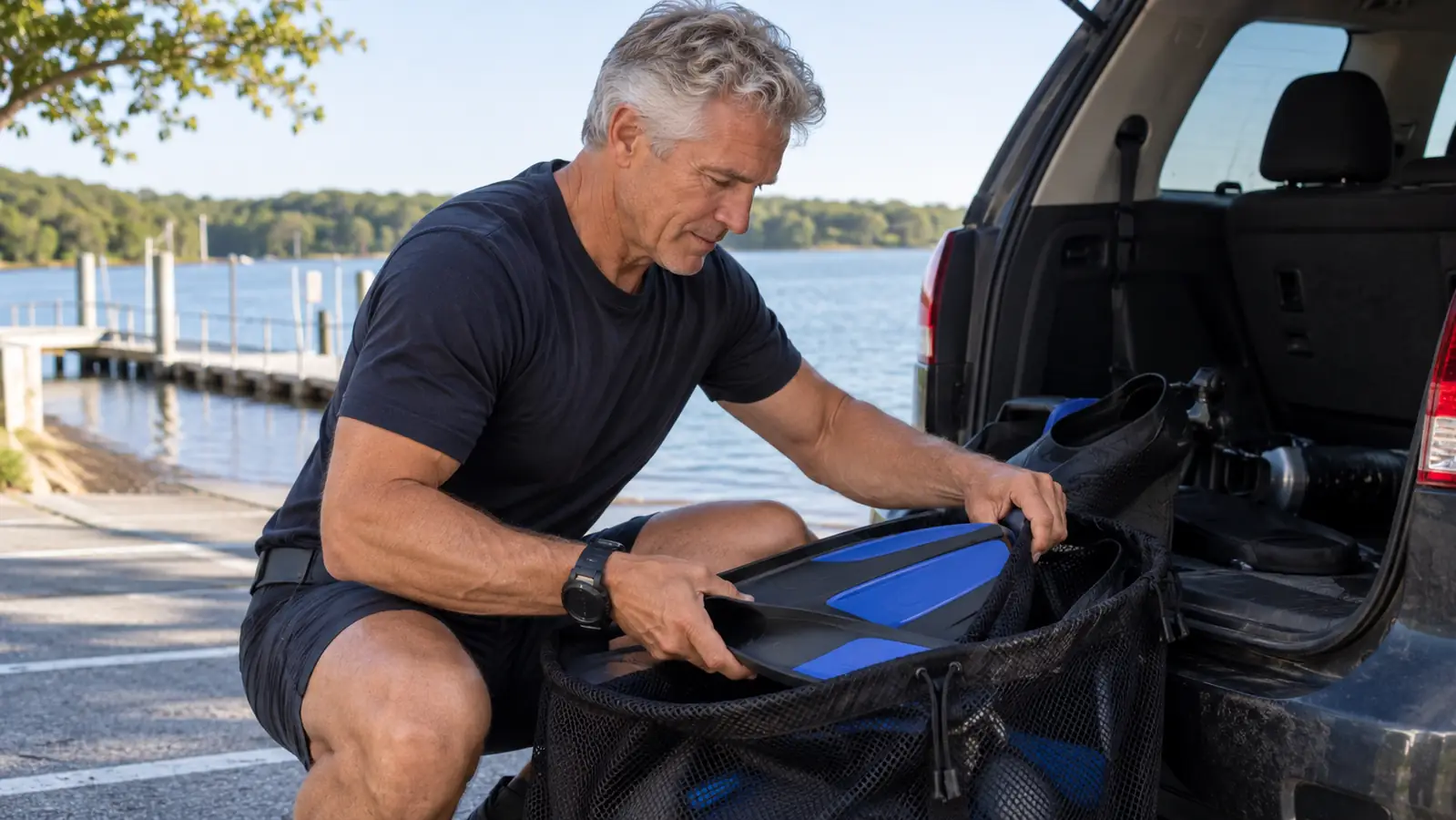
A typical load is open heel fins, 3mm boots, mask, gloves, a wetsuit, the dive light, and the pinpointer wrapped in a towel. That fills roughly two thirds of it. The bag measures 37 inches long, 15 wide and 15 tall, and the length is the number that decides whether it works for you, because long fins are what break the back of a smaller bag. If you dive travel fins, you are buying length you will not use.
At 61 I do not carry it far. Car to boat, car to rinse tub. Full, it is a two handed carry off the top handles rather than a shoulder haul. The listing claims it will carry 60 pounds and I believe it, but 60 pounds of wet neoprene swinging against my hip on a slick dock is not a load I want. That is my limit, not the bag's.
For the first month I loaded it the way I loaded the old one, which is to say badly. I laid the wetsuit in first, dropped the boots on top of it, and pushed the fins down the sides, and by the time I reached the boat the whole thing had settled into a lopsided sack with one heavy corner. What fixed it was a two minute change. Fins go in along the full 37 inch length at the bottom, the wetsuit folds once and lies flat on top of them, then the boots, the light and the pinpointer go at the end that rides against my back. Loaded that way the Bulex carries with something close to a spine, sits flat on a bench instead of flopping over, and comes off the shoulder without a fight. Small thing. Large difference.
What 136 Liters Actually Swallows
Capacity numbers on soft bags are close to meaningless until you load one. 136 liters is enough for a full single tank kit plus a mask, a light and a small spare parts pouch, which is more room than most recreational divers need for a day of local diving. It is not enough to turn it into a two person bag, though people will try, and the second diver's gear always ends up on top of yours anyway.
The temptation is to keep filling it because it keeps accepting. Fins in first, then the wetsuit laid flat, then the heavy items at the end that rides against your back. Load it that way and the bag keeps a rough shape and carries better. Dump everything in loose and you get a sack with one heavy corner that swings under the strap and drags along the deck when you set it down.
The shell is soft polypropylene mesh, so there is no frame and no base panel. Empty, it collapses into a heap you can fold in half. That is a convenience in a car and a small annoyance on a boat, because it will not stand open while you feed gear into it. I hold the mouth open with one hand and load with the other, same as every mesh bag I have owned.
To give a real number instead of a claim, I weighed a typical load on the bathroom scale one Saturday before a two tank morning. Open heel fins, the zippered 3mm boots, mask, gloves, a 3mm wetsuit, the dive light, the pinpointer in its towel, a small spare parts pouch and a liter of water came to a hair under 41 pounds. That is roughly two thirds of the 60 pound rating and about two thirds of the volume, and it left enough room at the top to fold the mouth over and close the zipper without fighting it. The Bulex had room to spare. The rating is headroom, not a target I go looking for.
The Mesh Does One Job and Refuses the Others
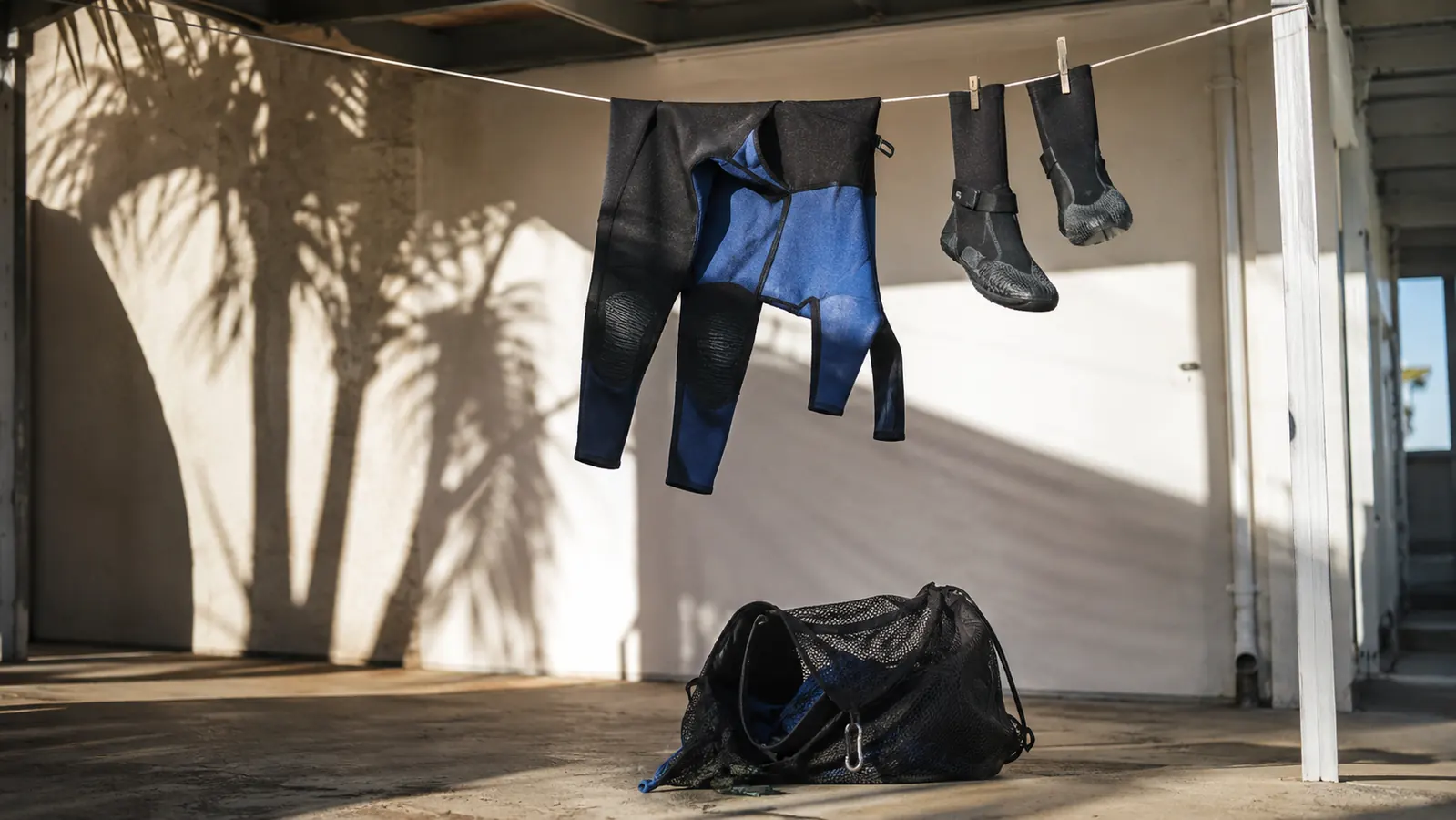
The listing says not water resistant, and that is honest labeling rather than a defect. The mesh is open. Water leaves. That is the entire reason to own the thing. A wetsuit put in wet at the dock comes out at home damp but not stewing, and the bag itself dries on the line in an hour of Florida sun.
The same openness means it does not protect. Sand comes through the mesh and settles into the bottom until you turn the bag inside out and hose it. A loose fin strap will find a cell in the mesh and pull. Anything small and valuable, a spare O ring kit or a wrist compass, needs to live in one of the two zippered side pockets rather than loose in the main compartment, where it works its way into a corner and presses against whatever is next to it.
And it will not keep rain out on an open deck or spray out on the ride in. If you are the diver who leaves gear on a bench overnight, this is the wrong bag for you. If your gear comes home every time, as mine does, the trade is worth making. Wet gear that never gets to dry is how neoprene starts to smell like a bait cooler.
The sand is the part the listing does not mention. Our beaches are coarse shelly sand, and a morning of hunting at waist depth puts a couple of cups of it into the bag along with everything else. Most of it sifts back out through the mesh on the walk to the 4Runner, which is exactly what you want. What stays is a thin layer in the seam channel along the bottom, and it sets like mortar if you leave it. My routine now is to turn the bag inside out over the rinse tub, hose that channel, and hang it on the line. Two minutes, once a week in season. Skip it for a month and you will hear grit in the zipper every time you open the thing.
Where It Holds Up Better Than I Expected
About 90 dives in, the zipper is the part I expected to fail and it has not. It is the only closure on the bag, and it takes the full load every time you open it with the bag hanging heavy. The nylon strap and the top handles have held without the stitching pulling at the anchors. I have owned mesh bags where the shoulder strap let go inside the first season.
The 60 pound claim is not inflated. I have loaded it with a wet 3mm suit, boots, fins and a light and hauled it up a ladder rung by rung. The mesh stretched but did not tear, and the seams at the base held. Polypropylene is not the toughest fabric on the market, but it does not hold water and it does not rot, and for a bag that lives wet that counts for more than abrasion resistance.
The two zippered side pockets get more use than I expected. Spare straps and o-rings in one, mask and gloves in the other on the drive home so they are not buried in the main load. They are pockets, not compartments, and they will not swallow a BCD, but they keep the small things where you can reach them in the dark. The 4.6 star average across more than 2,700 ratings is in line with what I have found with my own hands.
The first thing I check on any bag is the stitching where the shoulder strap meets the body, because that is where the old one let go after two seasons and put my gear on a parking lot. On the Bulex those anchors are bar tacked through doubled mesh, and after around 90 dives, most of them with the bag loaded near 40 pounds, there is no fraying at either end and no pulled thread. The zipper pull has lost some of its finish and the tape has gone gray from salt, but it runs the full length without catching. I have not waxed it once. If it starts to stick this winter I will rub a candle stub along the teeth, which is what I should have done on the bag this one replaced.
What I Considered Instead
When the old bag split, there were three realistic replacements: another mesh duffle, a hard sided dive box, or a padded nylon duffle with drain grommets. The padded bag and the hard box both protect gear, and both hold water if you put a wet suit inside them. I have watched a padded bag come home with an inch of standing water in the bottom and a wetsuit that smelled wrong by midweek.
A hard box survives air travel and a deck hand standing on it. It also weighs something empty and takes the same footprint full as it does empty. In a 4Runner that already carries tanks and a weight bag, that empty volume is a real cost on every trip.
The Bulex mesh duffle was the simplest way to get length, capacity and drainage in one piece. It is also the one that protects nothing, and I accepted that trade going in. I am not going to pretend there is a version of this bag that does all four jobs. There is not, and any review that tells you otherwise is selling something.
What I Liked
- 37 inches of length takes long fins without folding them back on themselves
- 136 liters holds a full single tank kit with room left over
- Open mesh drains and dries, so wet neoprene never sits in water
- Zipper, stitching and nylon strap have held through about 90 dives
- Carries 60 pounds of wet gear without tearing at the base seams
- Two zippered side pockets keep mask, gloves and small parts findable
Where It Falls Short
- Not water resistant, so spray and rain pass straight through
- Sand works into the bottom corners and has to be hosed out
- No wheels and no frame, so a full bag is a two handed carry
- Soft sides collapse, which makes loading it a one handed job
- Mesh cells will catch a loose fin strap if you leave one dangling
Ninety dives, sixty pounds of wet gear, and the same zipper it shipped with. That is the whole argument for mesh, and the Bulex makes it without asking much of you.
The Small Annoyances
No wheels, and the listing says so plainly. On the long walk from a parking lot to a shore entry, the load is on you. I have made that walk at a state park with the bag on my shoulder and the pinpointer under my arm, and I was glad of the shade at the far end of it.
The bag has no rigid base, so the mesh at the bottom corners takes the wear from being set down on limestone and concrete. Mine is scuffed there. Not torn, but scuffed, and I expect that is where it will eventually go, long before the zipper does.
One more thing worth saying out loud: nothing about the bag signals that it is not water resistant until you read the label. Buy it expecting a dry bag and you will be disappointed on the first wet boat ride. It is a transport bag. Treat it as one and it behaves exactly as advertised.
Storage is the other small cost. Empty, it does not stand, so it lives folded on a shelf under the carport rather than hanging open to air. That is fine for a bag that gets hosed and hung after every trip, and less fine if your habit is to leave gear in the bag between dives. A bag that cannot stand open stays damp in its own folds, and damp in the folds is how a wetsuit cuff starts to go.
Who This Is For
This suits the recreational diver who hauls gear in a car, dives from shore or from a charter, and rinses everything at home the same day. It suits anyone with long fins, since the 37 inch length is the entire point of the design. And it suits the diver who wants one bag that lives in the back of the vehicle and does not need to look like luggage.
It also suits the person hunting metal in the shallows, which is a lot of what I do now. The pinpointer goes in wrapped in a towel, the small finds go in a zippered side pocket, and the wet sand that comes back with everything drains out onto the carport instead of into the footwell of the 4Runner. My buddy Cal has watched me load this thing a hundred times and still keeps his own gear in a plastic tote, which is why his truck bed always has an inch of standing water in it after a beach day.
Who Should Skip It
Skip it if you fly to dive. I would not check this bag. Soft mesh with a single zipper is an invitation for a baggage handler to hook it, and there is nothing inside to protect a regulator from the bag next to it. A hard case or a padded roll aboard is the right answer for air travel, and this is not that.
Skip it if your gear sits on a boat overnight, or if you want one bag that does both the wet and the dry job. It will not keep clothes dry, it will not keep dust off a stored wetsuit, and it will not cushion anything with a glass lens or a diaphragm from a knock. It is a wet gear hauler. Asked to be anything else, it fails, and the listing never claims otherwise.
And skip it if you want to stay organized. One main compartment and two small pockets is the whole system. The diver who wants a slot for every item should buy a padded bag with dividers, and then remember that the dividers hold water as well as they hold shape.
One bag, 136 liters, drying in the sun before you unpack it
The mesh is the feature, not the flaw. Mine has carried a full kit for about 90 dives and the zipper still works. Check today's price and availability on Amazon.
Amazon See Today's Price on Amazon →