
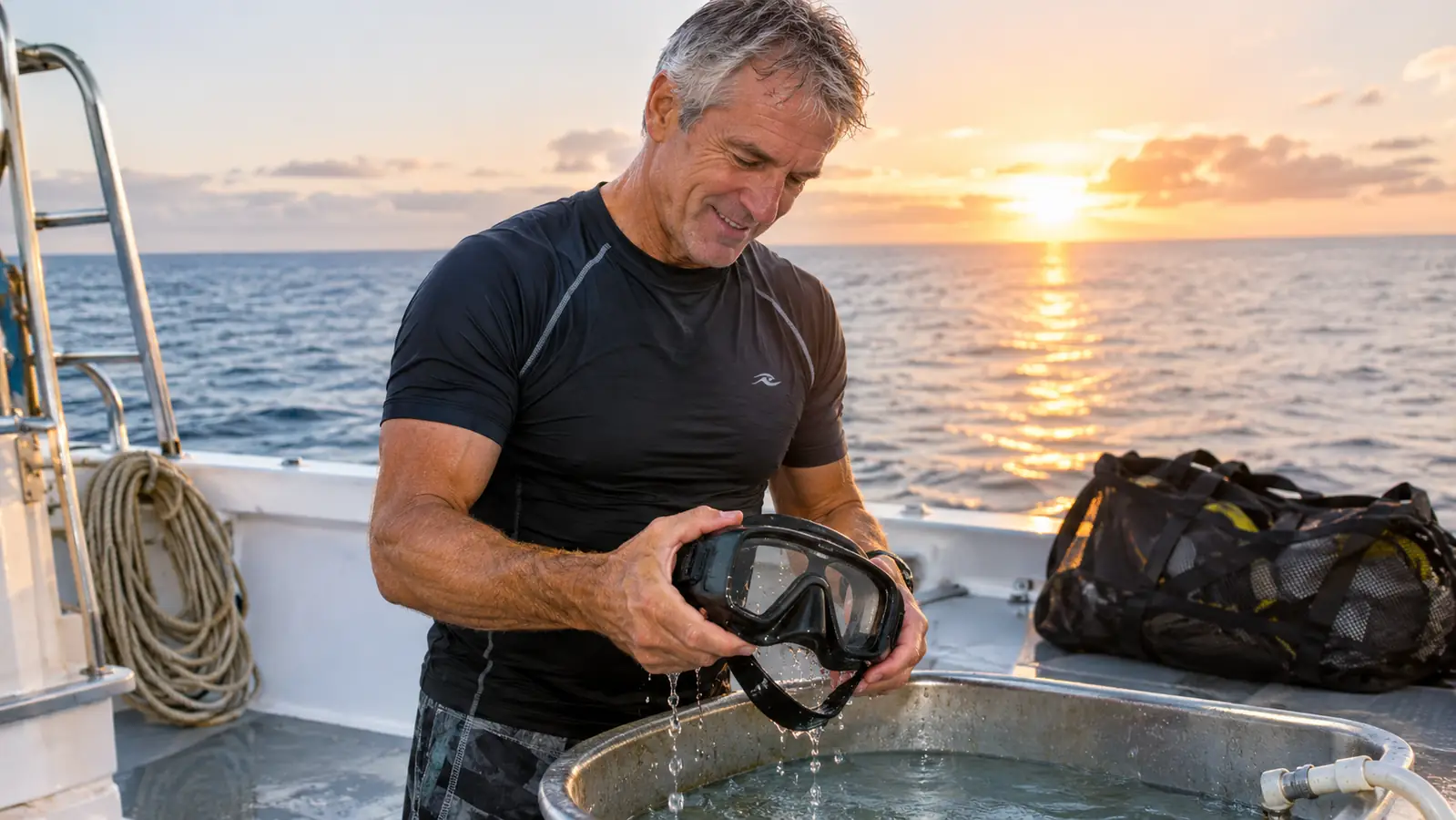
Short answer first, because you might be reading this on a phone in a shop with the two of them in front of you. If your bag is already full and you want a mask that folds flat and carries a stated two-year limited warranty, the Cressi F1 is the better travel pick. If you spend your water time working a sand bottom in daylight and you want to see off both cheeks without turning your head, the EXP Vision Pano 3 is the one I reach for. I own the Pano 3. I have never had my hands on the F1, so everything I say about that one comes off its listing, and I will flag it each time it matters.
The Pano 3 came into my kit about ten months ago and not because I wanted a second mask. I was on a morning charter out of Tavernier, the boat sitting on a mooring, and my buddy Cal was gearing up on the bench when his mask strap snapped in his hands. Nobody aboard had a spare strap. The mate found him one, Cal sat out the first dive and made the second, and that was the whole of it. I ordered the EXP Vision mask that same week. It lives in my mesh duffle inside a small hard case I bought separately, and it has about fifteen dives on it, every one of them a shallow sand hunt in ten to twenty feet of daylight water.
| EXP Vision Pano 3 | Cressi F1 | |
|---|---|---|
| Windows | Three windows: one front lens and two side windows, tempered glass | Single tempered lens, frameless |
| Skirt and frame | Food grade liquid silicone skirt in a plastic frame | Frameless, the skirt folds flat on itself |
| Packs down | Holds its shape, travels better in a case, and no case comes in the box | Folds flat into a fin pocket or a bag corner |
| Buckles | Adjustable strap with a buckle closure | Quick-adjust buckles |
| Side view | Two side windows widen the picture without turning your head | Single lens, no side windows listed |
| Warranty | Satisfaction policy handled through the seller's after-sales team | Two-year limited warranty |
| Case included | Mask only in the box | Not listed |
| Best for | Working a sand bottom in daylight, and spare mask duty | A travel bag that has to stay small |
How I Am Judging These Two
One of these masks I have used in salt water. The other I have read. That is an uneven comparison and I am not going to dress it up. I have never seen a Cressi F1 in person, in a shop or on a boat, and neither has Cal. So the F1 column is built from what the listing states: a single tempered lens, a frameless body, it folds flat, quick-adjust buckles, a two-year limited warranty, an Italian design made in Taiwan. Where the listing gives me nothing, the cell says Not listed. I would rather hand you a gap than a guess about how a mask sits on a face I have never put it on.
The Pano 3 I have both the listing and the water for. The listing is unusually complete for a budget mask, which helps: three windows, tempered glass, food grade liquid silicone in the skirt, a plastic frame, an adjustable strap with a buckle closure, and one mask in the box with nothing else. The fifteen dives fill in the rest. Anything I tell you about how it clears, how it sits, or how the coating held up came out of salt water and a rinse tub at the carport, not off a spec sheet. The faults in this article are mine, not the seller's, and they are further down.
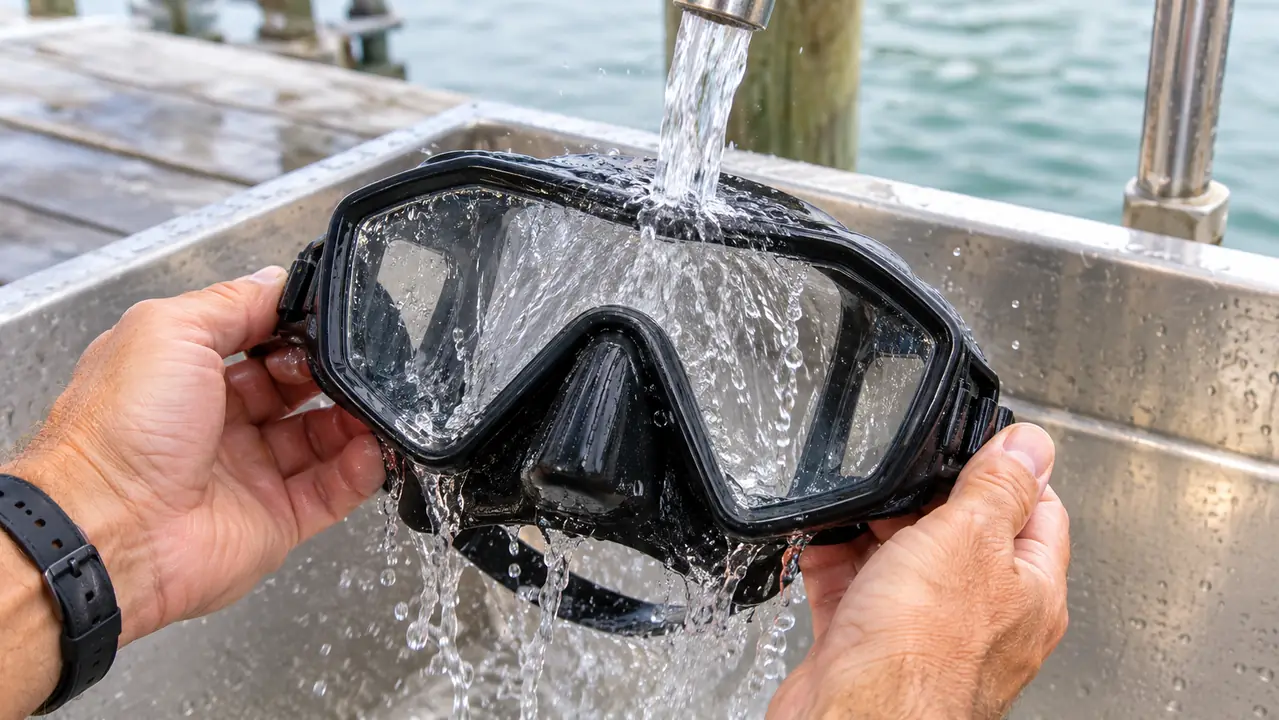
The Pano 3 in the Water: Three Windows on a Sand Bottom
The three windows are the whole idea. One front lens, two side windows, all tempered glass, set in a plastic frame with a silicone skirt that seals against the face. In shallow water over sand, that layout earns its keep. I kneel on the bottom to dig, mask on my face the whole time, and the side windows let me read the ground off both cheeks without lifting my head or turning it. On a public swim beach where the interesting things are scattered instead of stacked, that saves a lot of small head movements across an hour of slow swimming.
The strap went on at the carport before the first dive. I set it across the crown of my head, above the ears, snug and not tight, and I have not moved it since. Tight straps cause leaks, and most of the seeping I hear about from other divers comes from a strap cranked down like a jar lid. Fifteen dives in, the skirt still seals on my face and the strap has not slipped a notch. Every one of those dives was a daylight sand hunt in ten to twenty feet. It has never been on a charter dive. When it comes out of the water I lay it lens up on a towel, then it goes back in the hard case, because the listing warns against dropping it and against jumping in wearing it.
Now the honest part. There is more air inside this mask than inside my main mask, a Cressi Matrix, so it takes more clearing. If you are used to low volume and you come to this one, you will notice it on the first dive, and you will mostly stop noticing it a few dives later. The factory anti-fog coating did not last. It was gone within the first handful of dives, and now I prep the lens like any other mask, a drop of mild dish soap and a fresh water rinse, plus a plain toothpaste scrub before first use, never a flame. It also feels a little heavier on the face than the Matrix. Not heavy. A little.
The side windows are the reason it stays in the bag. I can read the bottom off both cheeks without turning my head, and on a sand hunt that is the difference between seeing a ring and swimming over it.
What the Cressi F1 Offers, Going by Its Listing
The F1 is a different animal. Single tempered lens, frameless. That is not a marketing line, it is a construction fact with a practical consequence: with no frame wrapping the glass, the mask folds flat. It goes into a fin pocket or the corner of a bag that is already overpacked. If you fly to your diving, or if you dive off a charter where the bag is small and the deck is crowded, folding flat is worth more than an extra window. I can say that without ever wearing one, because it follows from the shape of the thing rather than from anything I felt on my own face.
The quick-adjust buckles are the other listed advantage, and the two-year limited warranty is the third. A stated term is a real thing to have, because it is a number of years written down by a company you can hold to it. What I cannot tell you is how the F1 sits on a face, how it handles glare, or what it weighs, because none of that is in the listing and I have never had one in my hands. I can tell you what it is built for and what it asks of your bag, and the answer to the second is almost nothing. That is enough to make it worth a look if packing space is your limiting factor.
What I Liked
- Three windows, including two side windows that widen the view without a head turn
- Tempered glass in all three windows
- Food grade liquid silicone skirt that has sealed for fifteen dives
- Strap set once at the carport and never adjusted again
- Fully stated listing: window count, lens type, strap type, closure type, materials
Where It Falls Short
- More internal air than a low-volume mask, so it takes more clearing
- Factory anti-fog coating wore off within the first handful of dives
- Feels a little heavier on the face than my main mask
- Ships with no case, and mine needed one
- Seller warns against jumping in wearing it and against dropping it
Where the EXP Vision Pano 3 Wins
Side view, plain and simple. A single-lens mask gives you a good forward picture and very little else, and on a sand hunt forward is not where the interesting things are. The two side windows widen the picture enough that I scan a strip of bottom instead of a line of it. I hunt public swim beaches and the sand around docks and boat ramps where the rules allow, and I check the local rules before I get in the water. A wide view of the ground is the tool for that work, and it is a job the F1's listing does not claim to do.
Second, the strap and the seal have held without fuss. Set once at the carport, snug across the crown, and fifteen dives later it is still where I put it and still sealing. Third, the listing is complete enough to compare on. Window count, lens type, strap type, closure type, materials, all stated. That matters when you are buying from a screen and cannot put the thing on your face. A seller who tells you the skirt is food grade liquid silicone and the lens is tempered glass is telling you something checkable, and checkable is worth more than a slogan.
Where the Cressi F1 Wins
Travel. The F1 folds flat and the Pano 3 does not. Mine holds its shape and needs a case to travel safely, and that case did not come in the box, I bought it separately. That is a genuine advantage for the F1 and I am not going to talk around it. If you are packing a mask into a carry-on or a small gear bag, flat beats shaped every time. A frameless mask is built for exactly that, and no amount of extra window makes up for a mask that will not fit where you need to put it.
Buckles and warranty. Quick-adjust buckles are easier to reset by feel than a plain buckle closure, and anyone who has fumbled a strap on a moving deck knows why that matters. The two-year limited warranty is a stated term with a length attached, where the Pano 3's coverage is a satisfaction policy handled through the seller's after-sales team. That is a promise of service, and service is worth something, but it is not the same as a number of years. Some divers will never need either. Some will. If you are the sort who wants the term written down, the F1 is the better answer.
The F1 folds flatter. The Pano 3 sees sideways. Pick the one you will curse less at the worst moment.
I keep the Pano 3 because I work sand in daylight and I want the side windows. If that is your diving too, the listing is a short read: three windows, tempered glass, silicone skirt, adjustable strap.
Amazon Check today's price on Amazon →Who Should Buy Which
Buy the Pano 3 if your diving looks like mine: shallow, daylight, sand or open bottom, often ten to twenty feet, and you want to see sideways without working at it. Buy it as a spare, which is exactly what mine is, and understand what a spare is for. Mine exists for my own strap or my own lens going bad on a boat morning. It is not a loaner. Nobody else uses my gear, and I never hand a mask to a buddy or a guest. If you want a second mask so you are never the one sitting out a dive, this is a sensible way to spend on that.
Buy the F1 if your kit lives in a travel bag and space is the thing that breaks first, or if you want a frameless single-lens mask from a brand that puts a two-year limited warranty in writing. It is designed for the diver who wants one lens, one seal and nothing folded around the glass. If you already own a low-volume main mask and you are shopping for a backup, these two do different jobs. That is a reason to own one of each rather than a reason to declare a winner and move on.
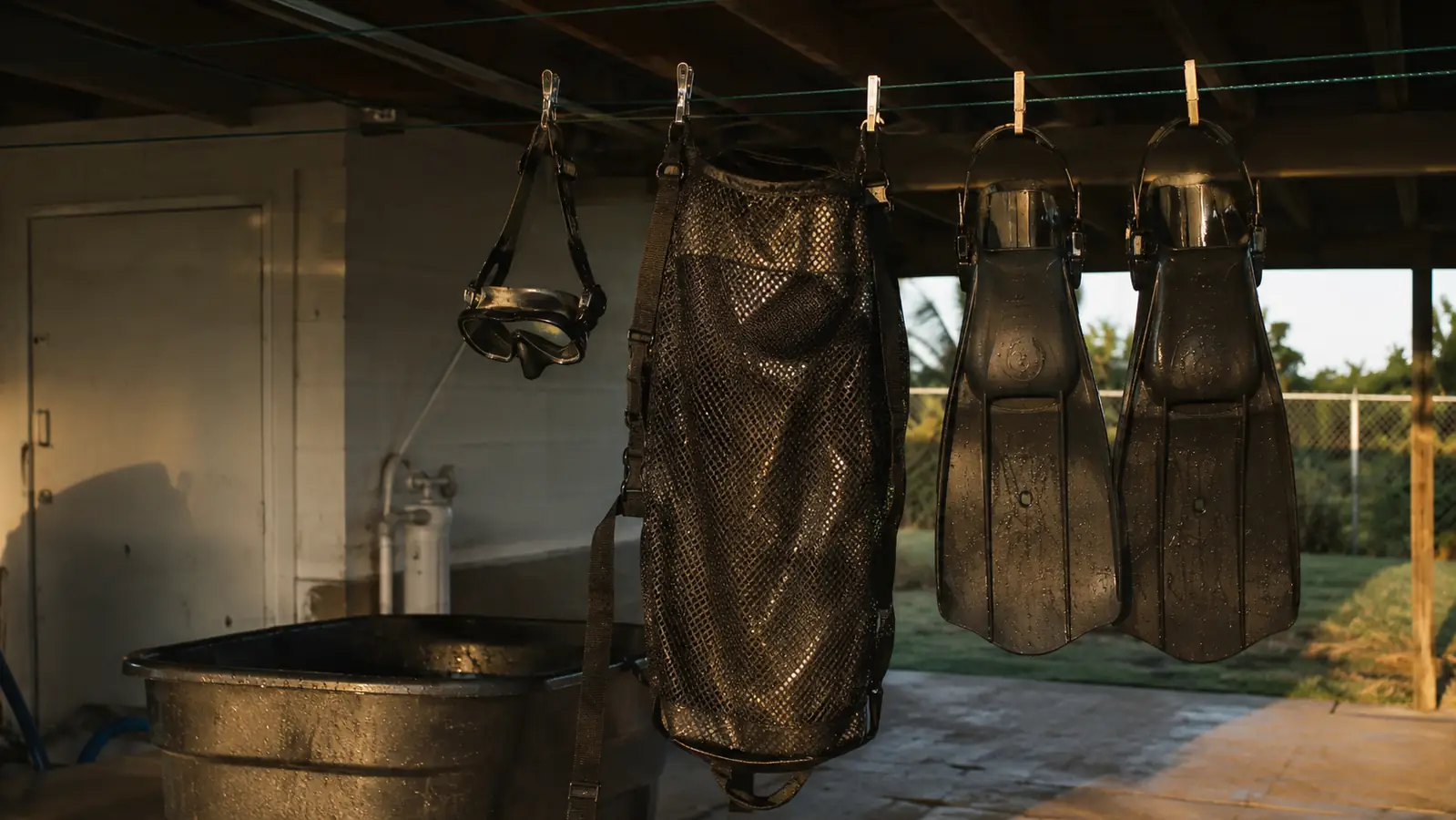
Whichever you pick, treat it the same way after the dive. Fresh water rinse at the carport tub once you are home, not a bucket of salt water sitting in the sun. Toothpaste scrub on a new lens before the first dive, never a flame. A drop of mild dish soap and a rinse before each dive instead of spit. Strap across the crown, above the ears, snug and not tight. Lay the mask down lens up, never face down on a deck. None of that is exciting and all of it is what decides whether the skirt still seals two seasons from now.
Shallow, daylight, sand bottom: that is the whole job description. If it matches yours, start here.
EXP Vision Pano 3, three windows, tempered glass, silicone skirt, about fifteen dives of my own on it. The faults are real and they are listed above, so go in with your eyes open.
Amazon See the Pano 3 listing on Amazon →